
The Conqueror's Curse
"The crown he claimed with fire and sword never stayed secure for long, and the cost of his conquest was a dynasty that struggled to find peace."


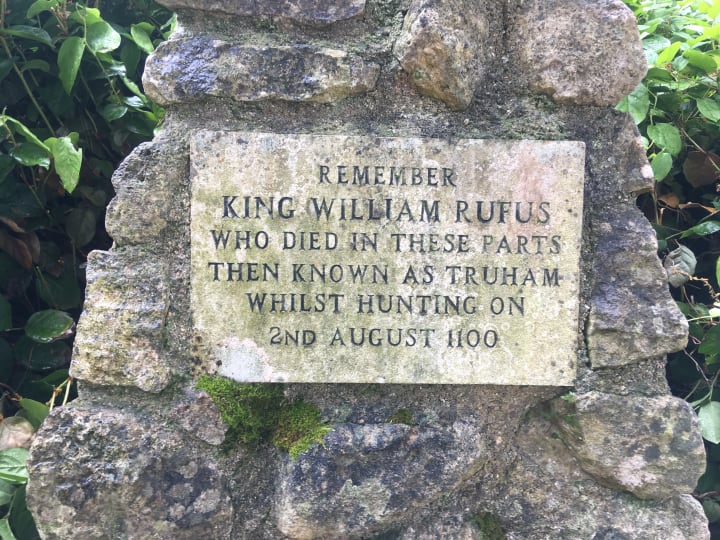
In the heart of the New Forest, outside the village of Minstead, you will discover an ironclad 'stone' called the Rufus Stone.
This stone (although not actually a stone) supposedly marks the spot where William Rufus (King William II) is said to have died. The true cause of the unpopular king's death has been unsolved for over 900 years.
A Quick History Lesson
Upon the death of William the Conqueror, Duke of Normandy, in 1087, his third son, William Rufus (nicknamed Rufus because of his red hair), became king.
His older brother Robert inherited estates in Normandy (wasn't chosen as heir after rebelling against his father), while his younger brother Henry (later known as Henry I) claimed nothing but the medieval equivalent of a trust fund..
The 'Accident'
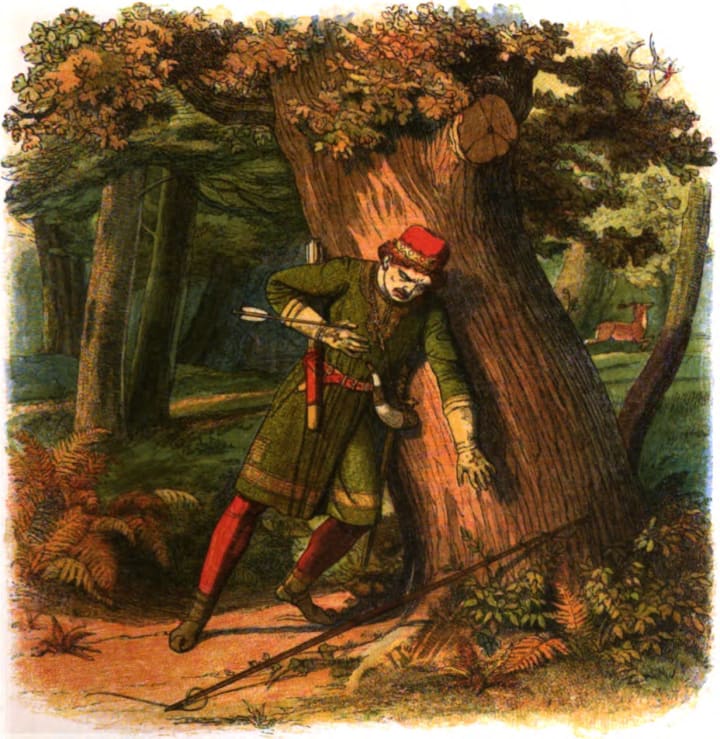
Rufus met his fate on 2nd August 1100 AD. On a boar hunt, the king and his men spotted a stag. Frenchman Sir Walter Tryell, the acclaimed archer, drew his bow. He missed the stag and hit the king, puncturing his lung.
Once the men realised their king had been killed, they fled the scene. Legend has it that Tryell stopped at a blacksmith and ordered the smith to turn his horses' hooves backwards so he could not be pursued.
He needn't worry, as it appears no one cared.
Oh, and yes, this story inspired the death of a fictional character and absolute icon - Robert Baratheon.

An account by William of Malmesbury writes in the ‘Chronicle of the Kings of the English’ (1128):
On receiving the wound, the king uttered not a word; but breaking off the shaft of the arrow where it projected from his body… This accelerated his death.
Walter immediately ran up, but as he found him senseless, he leapt upon his horse and escaped with the utmost speed.
Indeed, there were none to pursue him: some helped his flight; others felt sorry for him.
The king’s body was placed on a cart and conveyed to the cathedral at Winchester… blood dripped from the body all the way.
Here he was buried within the tower. The next year, the tower fell. William Rufus died in 1100, aged forty years.
He was a man much pitied by the clergy… he had a soul which they could not save… He was loved by his soldiers but hated by the people because he caused them to be plundered.
Doesn't exactly read like Rufus was well-liked, does it? This account is written 28 years after the 'accident', and reads more like a piece of fiction rather than a reliable historical account.
Unlike the Anglo-Saxon Chronicle, which claims he was:
"shot by an arrow by one of his own men"
Is it possible that Rufus's death was a plot well executed? Or was it an unfortunate accident? Or perhaps something otherworldly?
The Conqueror's Curse:
In 1079, William the Conqueror officially marked the forest as a royal hunting ground. To do this, many people, villages and entire communities were displaced.
Druids and witches considered (and some still consider) the forest as sacred. Consequently, it is believed that those who suffered at the hands of the conqueror laid a curse on the direct male bloodline. It is said to this day that the trees in the New Forest hold the blood of the sons of William.
Not only did William Rufus meet his end in the forest, but so did his elder brother, the second son of the conqueror, Richard of Normandy.
Richard, like his brother, died during a hunting trip somewhere around 1075–1079. According to some accounts, he died after being thrown from his horse and impaled on a tree branch.
Even Norman historians and monks seemed to acknowledge this curse, such as Orderic Vitalis, who wrote:
“The forest, in which William Rufus met his end, had long been accursed by God.”
Anglo-Saxon writers saw this curse as retribution for the conqueror's tyranny.
It was an Unfortunate Accident
Hunting accidents weren't uncommon. With arrows flying around, horses potentially spooked, anything could happen at any moment. Health and safety weren't around. So perhaps it isn't unlikely that Rufus' death was an accident.
Other indicators point out that there was no formal investigation by either the royal court or the church; some interpret this decision as an implicit acceptance that it was indeed an accident. Some may argue this proves Rufus death was an assassination.

Additionally, Tryell was a loyal knight who had no motive of killing the king. It is possible the arrow he shot deflected and hit the wrong target, or he wasn't the one to sling the kill shot at all.
Either way, it appears, everyone at the time concluded that Rufus's death was an accident.
Yet, according to historian Frank Barlow, the aftermath of King William II's death suggests otherwise.
A Man with a Clever Plan
Yet to become Henry I, the youngest brother of the four sons of the conqueror, had nothing to his name. No lands, titles, nothing but royal blood and a load of money.
Once he received the news of his elder brother's death, Henry rode fast to Winchester (the capital at the time) and declared himself king three days after the accident.
Henry was in the area when the accident occurred, leaving people to believe it was Henry's plot to kill his brother and secure the throne for himself.

Robert Curthose, the eldest son, was returning from his first crusade to find his baby brother wearing his crown.
Robert was furious, and this led to a civil war between the brothers. In 1101, Robert attempted an invasion, which ended in paperwork rather than battle. However, the 'terms of peace' established between the two were very short-lived.
In 1106, Henry stormed Normandy, beating his older brother at battle and imprisoning him for 28 long years. Robert died a royal prisoner in 1134. Henry dies a year later. He left no living male heir after his son drowned on a voyage in 1120.
Causing what historians refer to this era as the Anarchy. A civil war between King Stephen, Henry's nephew, and his daughter, Empress Matilda.
A brutal civil war that inspired the Targaryen conflict between Rhaenyra and her half-brother Aegon, known as the Dance of Dragons.
Through Matilda's line (Rhaenyra), the Plantagenet dynasty was born, with her son Henry II taking the throne.

Final Thoughts:
It is because of this chaos after Rufus's death that people believe that:
- The curse was real and/or complete - the conqueror's line survives through Matilda.
- Henry's swift actions after the 'accident' and lack of ceremonies (burial of Rufus) suggest it's likely he killed his brother - well...maybe two of them?
- The line of succession led to a civil war - whether this is because of the curse, political betrayal or hubris, we will never know. All we have is the outcome of this conflict.
I think it is highly likely that Henry had plotted his brother's death. Remembering that these events in history inspired Game of Thrones, I think I can confidently assume this was an assassination. It's just too perfect for it, not the be.
However, I do not own a Tardis or a Delorean, so I cannot go back and find out. What do you think? Did Tryell kill the king under orders? Or was it just an unfortunate accident?
Or maybe the curse did exactly what it was supposed to...
_________________________________________________
Thank you for taking the time out of your day to read my work. It is very much appreciated.
If you like what I do, don't forget to hit the like button and subscribe. If there is a mystery you would like me to investigate, then please let me know in the comments below.
About the Creator
Keep reading
More stories from Rosie J. Sargent and writers in FYI and other communities.
The Warminster "Thing"
The small garrison town of Warminster, once known for clothiers and wool, is home to a mystery of unexplained events. From strange sounds and mysterious lights to unidentifiable objects (or UFO's) in the sky. Located just 15 miles away from Stonehenge and west of Salisbury Plain, Warminster earned the title as the UFO capital of the UK.
By Rosie J. Sargent10 months ago in FYI
A Failed Artist, A Disillusioned Poet, An Underpaid Game Show Host
I took my son and niece to Gori, a small town in Georgia where Joseph Stalin was born. They talked me into visiting the Stalin's Museum, the largest in the post-Soviet space. I had resisted going there because I just can't stand the monster and know enough about him, or so I thought.
By Lana V Lynx6 days ago in FYI
How to Time Travel: 5 Methods According to Science
For a long time, the idea of traveling through time was tucked away in the "fiction" section of the library, right next to wizards and space monsters. But in recent years, the conversation has shifted. With mysterious "time traveler" photos popping up on the internet and physicists like Stephen Hawking weighing in, we have to ask: Is time travel actually possible?
By Areeba Umairabout 4 hours ago in FYI
Where's the Glory?
In breaking news, rehabilitated Republican Senator Johnnie Johnson (Pronouns: HE, HIM, HIS) called a press conference from the Men’s room of the New Orleans Louis Armstrong International Airport, Concourse B, across from the Ignatius Reilly’s Lucky Dog stand. The Senator had just returned from a sexual reorientation rehabilitation program in Memphis, TN after being publically disgraced at a Buckee’s Truckstop restroom soliciting sex from an undercover cop three months ago. He is a founding member of the Reformed Christians for Christ, a conservative, pro-family and ex-gay advocacy group. In the spirit of being reborn, Senator Johnson invited reporters to marvel at his plans for a major remodeling of airport bathrooms.
By Cathy Schieffelin4 days ago in Humor


Comments
There are no comments for this story
Be the first to respond and start the conversation.