
The Billion Dollar Secret: Inside the World’s Richest (and Deadliest) Temple
Gold, curses, and the $20 billion treasure of Sri Padmanabhaswamy.


In a world that has been around for thousands of years, it’s a bit naive to think our ancestors didn't leave anything behind. We like to think we know everything about our history, but what about the ancient knowledge lost to time? Is it our job to dig up every secret, or were some things buried for a reason?
In the heart of Kerala, India, sits a structure that forces us to ask those exact questions: the Sri Padmanabhaswamy Temple. It is officially the richest temple in the world, and one look at its gold-covered exterior tells you why. But it’s what lies underneath the gold that has the entire world holding its breath.
The Treasure That Shook the World
The history of this temple stretches back as far as 500 B.C., serving as a place of worship for the deity Vishnu. While it has always been prestigious, it wasn't until 2011 that the world realized just how wealthy it actually was.
Following a Supreme Court order to inventory the temple's assets, five of its six known subterranean vaults were opened. What the explorers found inside was straight out of a movie:
- Gold coins dating back to 200 B.C.
- Solid gold statues of deities.
- Ancient crowns and necklaces dripping with precious stones.
The estimated value? Billions of dollars. It was one of the largest treasure finds in human history, instantly turning this ancient site into a global sensation.

The Forbidden Door: Vault B
Despite the billions already found, the most exciting (and terrifying) part of the temple remains hidden. Out of the six vaults, one remains stubbornly shut: Vault B.
This isn't your average door. It features no latches, no bolts, and no keyholes. Instead, it is adorned with two massive carved cobras, a universal sign for "keep out." According to legend, the door is sealed by a "Naga Bandham" (snake bind) and can only be opened by a high-ranking monk chanting the "Garuda Mantra."
The catch? There is currently no one in the world believed to be powerful enough to perform the chant correctly.
Curses and Cobras: Why We Haven't Opened It
The mystery isn't just about gold; it’s about fear. Historical records show that people have tried to breach the vaults before. In 1908, explorers reportedly fled in terror when they found the chambers infested with cobras.
Today, the battle over Vault B is being fought in the courts. While the government is curious about the riches inside, the Travancore Royal Family and many devotees are fighting to keep it closed. They performed a ritual called Devaprasnam to consult the deity, and the answer was clear: The deity is not pleased. Astrologers warn that forcing the door open could trigger catastrophic events of "apocalyptic proportions."
Practicality vs. Faith
This leaves India in a fascinating dilemma. On one hand, you have a modern nation with economic needs where the treasure could be used for the public good. On the other hand, you have a deep-seated religious tradition that says this wealth belongs to Vishnu, and Vishnu alone.
In Indian law, deities can actually own property, but they are treated as minors. This means the Travancore family acts as the "adult" guardian of the treasure.
Will the Indian government eventually force the door open, or will the warning of the cobras keep the secret safe for another thousand years? For now, the "Inner Sanctum" remains a silent, golden mystery.
About the Creator
Areeba Umair
Writing stories that blend fiction and history, exploring the past with a touch of imagination.
Keep reading
More stories from Areeba Umair and writers in FYI and other communities.
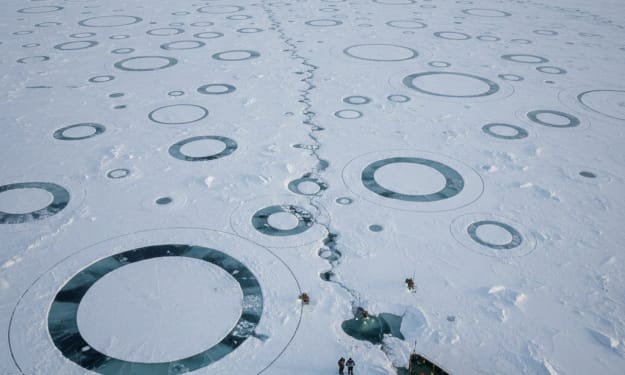
NASA’s Arctic Mystery: What Are the Beaufort Sea Ice Circles?
In the world of the unexplained, we’ve seen it all: crop circles in England, fairy circles in the desert, and even bizarre craters on Mars. But a new mystery has emerged from one of the most remote places on Earth: the Arctic.
By Areeba Umairabout 10 hours ago in FYI
A Failed Artist, A Disillusioned Poet, An Underpaid Game Show Host
I took my son and niece to Gori, a small town in Georgia where Joseph Stalin was born. They talked me into visiting the Stalin's Museum, the largest in the post-Soviet space. I had resisted going there because I just can't stand the monster and know enough about him, or so I thought.
By Lana V Lynx6 days ago in FYI
The Silence After Trying
The silence didn’t arrive suddenly. It came slowly, like dust settling after a room has been emptied. At first, there were noises—emails opening, notifications buzzing, the familiar hum of effort. Messages sent. Applications submitted. Conversations started with careful optimism. There was movement, and movement felt like progress.
By Talha khan5 days ago in FYI



Comments
There are no comments for this story
Be the first to respond and start the conversation.