
The Allegory World of Plato's Cave
Exploring the Allegory of the Cave and Its Relevance Today

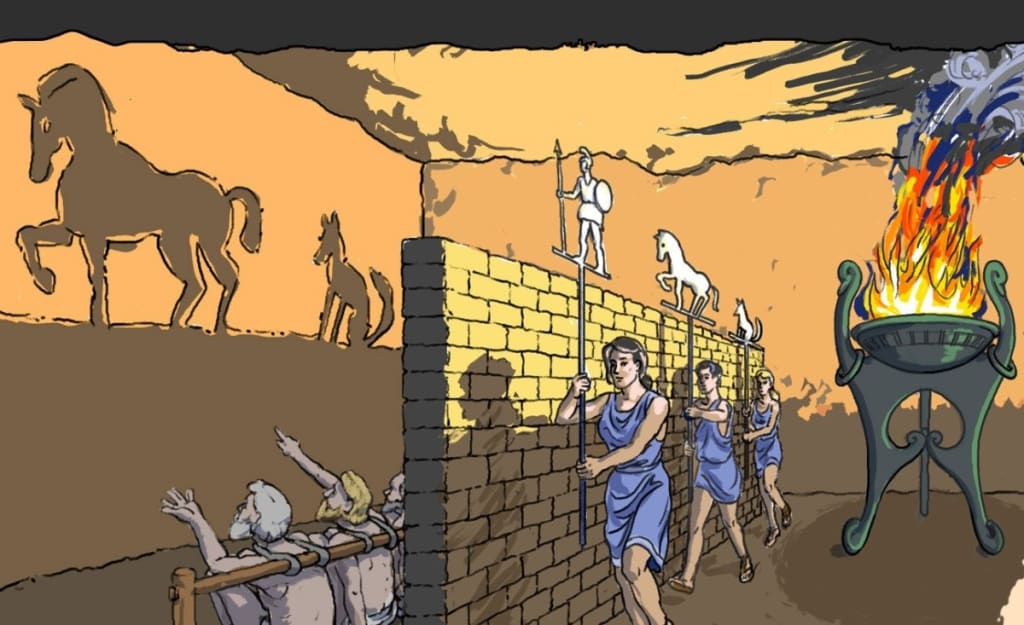
Plato's Cave is one of the most enigmatic and thought-provoking allegories in the history of philosophy. It was first introduced in Plato's "Republic," and it has since been the subject of much interpretation and analysis. The allegory is a powerful metaphor for human ignorance and the difficulty of reaching true knowledge. In this essay, we will explore the meaning of Plato's Cave and its relevance today.
The Allegory of the Cave
The Allegory of the Cave is a narrative in which Plato describes a group of people who have been chained in a cave their entire lives, facing a wall. They are unable to turn their heads and can only see the shadows of objects cast by a fire behind them. They mistake these shadows for reality and believe that they are all there is to the world.
One of the prisoners manages to break free from his chains and sees the true nature of the world. He realizes that the shadows he had been seeing were only a distorted reflection of reality. However, when he returns to the cave to tell the other prisoners what he has seen, they do not believe him and think he is insane.
The Allegory of the Cave is a metaphor for the human condition. The prisoners represent people who are trapped in their own ignorance, unable to see beyond their own limited perspective. The fire represents the limited knowledge that we are born with, and the shadows represent the distorted reality that we believe to be true. The prisoner who escapes represents the philosopher who seeks true knowledge, while the other prisoners represent the majority of people who are content with their limited perspective.
Relevance Today
The Allegory of the Cave is still relevant today. We live in a world where there is an abundance of information, but much of it is biased, incomplete, or distorted. Many people are content with their limited perspective and are unwilling to see beyond their own beliefs and opinions.
The internet has made it easier than ever to access information, but it has also made it easier to become trapped in an echo chamber. We tend to seek out information that confirms our beliefs and ignore information that contradicts them. This leads to a distorted view of reality and an inability to see beyond our own limited perspective.
The Allegory of the Cave reminds us that we should be skeptical of our own beliefs and open to new ideas. We should question what we think we know and be willing to consider alternative perspectives. We should be like the prisoner who breaks free from his chains and seeks true knowledge, rather than the prisoners who are content with their limited perspective.
The Allegory of the Cave also has implications for education. Plato believed that education was the key to breaking free from ignorance and achieving true knowledge. He believed that education should not be limited to the acquisition of facts but should also involve the development of critical thinking skills and the ability to question one's own beliefs.
Conclusion
Plato's Cave is a powerful allegory that reminds us of the importance of questioning our own beliefs and seeking true knowledge. It highlights the dangers of being trapped in our own ignorance and the difficulty of breaking free from it. The allegory is still relevant today, reminding us of the importance of education, critical thinking, and open-mindedness. By embracing these values, we can move beyond the shadows of our own limited perspective and see the true nature of the world.
About the Creator
Keep reading
More stories from Tsar Banks and writers in FYI and other communities.
The Mystery of Sacrifice: Exploring the Origins and Practices of Ancient Rituals
Sacrifice has been a part of human history since the beginning of civilization. From ancient Aztec rituals to modern-day animal sacrifices, the act of offering something valuable to a deity or higher power has been a way for people to seek favor or appease divine wrath. But the concept of sacrifice has long been shrouded in mystery and controversy, with questions surrounding its origins, purpose, and ethical implications. In this essay, we will explore the mystery of sacrifice, delving into its history, different forms, and cultural significance.
By Tsar Banks3 years ago in FYI
A Planetary Alignment will coincide with Mercury Retrograde
Double phenomena in the heavens Some people say in jest that the planets have aligned in their favor when life works the way they desire. Were you aware that there are seasons when things do line up in the heavens? There will be a planetary alignment AKA a planet parade, on February 28, 2026.
By Cheryl E Preston18 days ago in FYI
How FAA Safety Management Systems (SMS) Affect Parts Procurement
The aviation industry operates under strict safety and regulatory standards to ensure the reliability of aircraft operations. One of the most important frameworks guiding safety in the United States aviation sector is the Federal Aviation Administration’s Safety Management System (SMS). This system is designed to help aviation organizations identify risks, implement safety controls, and continuously improve operational practices. While SMS is often associated with flight operations and maintenance procedures, it also plays a critical role in aircraft parts procurement.
By Beckett Dowhan6 days ago in FYI



Comments
There are no comments for this story
Be the first to respond and start the conversation.