
She is Fierce
Three Fearless Ukrainian Women We Should be Celebrating


Women's History Month is upon us and as the world stage looks to the events unfolding in Ukraine, it has never been more important for the west to step outside of itself. We have to look to Eastern Europe to provide support, but also as an example of stalwart bravery in the face of an old threat. The men and women of Ukraine have been facing Russia and the threat it poses for decades (at least). This is not a new threat for the people of Ukraine, or for that matter the people of Lithuania, Latvia, and Estonia - four of which share a major land border with Russia, all of which have citizens who not only remember life in the USSR but who lived the largest part of their lives under Russian rule.
So, amongst all the lists of inspiring women you'll see this month, take a moment to remember these 3 women and all the women of Ukraine, Latvia, Lithuania, Estonia, Georgia (and every other post-Soviet nation) who may be living with memories they might rather forget right now.
Alla Horska (1929 - 1970)
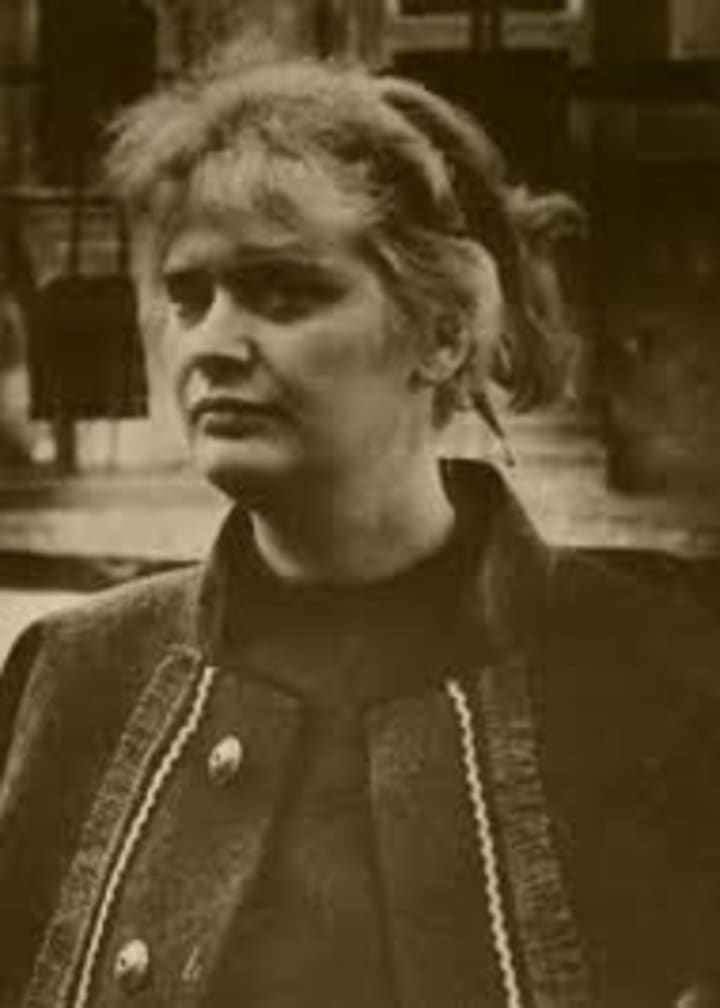
Born in September 1929, Alla Horska was a Ukrainian monumentalist painter, a vanguard of the underground art movement, dissident, and well-known human rights activist of the Sixtiers Movement. Professionally speaking, she was known for creating stunning mosaics, murals, and stained glass artwork (some of which you can see on Wikiart), she was also a pioneer of Ukrainian cinema. Horska's political actions are what she is most often recognized for today, however.
Don't think there was a hard line between art and politics, however; Horska's art was subversive, nationalistic, and political in nature. So much so that pro-Soviets and the KGB often destroyed her pieces and banned them from public display. At one point she was blacklisted in Kyiv and left unable to work as a result of her refusal to bow to pro-Soviet demands. Despite this Horska supported individuals who were targeted by the Soviets as well as their families', testifying for them in court and providing material support to those they left behind when they were detained in labour camps.
In 1962 Horska, Vasyl Symonenko, and Les Tanyuk revealed the location of unmarked mass grave sites holding the bodies of "enemies of the Soviet state" who were murdered by the NKVD. Between 1965 and 1968, she took part in protests against human rights abuses against Ukrainians, and in 1967 she, along with many other artists, writers, and political dissidents, signed Protest Letter 139 to call for a cease of illegal proceedings such as the 1967 trial of Viacheslav Chornovil - all of these actions rendered her a target of the KGB.
In 1970, Alla Horska was murdered. At the time, the finger was pointed at her father-in-law, who was found decapitated by the tracks at Fastiv train station. 40 years later, Alla Horska and Viktor Zaretsky's son, Oleksij Zarestsky undertook an investigation which resulted in the release of Soviet documents from the KGB archive. These documents show, unsurprisingly, that Alla was not murdered by her father-in-law but that they were both victims of KGB agents.
Today Horska's birthplace of Yalta, Crimea, falls under Russian control but is considered by Ukraine and the majority of the international community to be occupied Ukrainian land.
Olena Teliha (1906 - 1942)

Born in July 1906 near Moscow in a small village that her parents frequently holidayed in, Olena Teliha was a poet and activist of Ukrainian and Belarusian nationality. An educated woman, Teliha attended a Ukrainian teachers' college in Prague where she studied history and philosophy and lived in many places including Poland and Czechoslovakia. Like many of the young Ukrainians she associated with, Teliha became a member of the Organization of Ukrainian Nationalists in 1939. In 1941, she and her husband moved to Nazi-occupied Kyiv.
This is where she expanded her presence as an activist, both in cultural and literary circles. During her time in Kyiv, Teliha headed the Ukrainian writer's guild, edited a weekly culture and arts newspaper "Litavry", and acted in open defiance of Nazi authority time and time again. She watched colleagues from Litavry's parent paper "Ukrayyins'ke Slovo" get arrested but refused to flee. She would not, Teliha stated, go into exile ever again.
In February 1941, she and her husband were arrested by the Gestapo in Babi Yar, Kyiv, for their actions against Nazi authority. In the prison cell where she was kept, Teliha carved her final words,
"Here was interred and from here goes to her death Olena Teliha."
Today, there stands a monument (erected in February 2017) dedicated to Teliha. Unveiled at Babi Yar and consecrated by Patriarch Filaret of the Ukrainian Orthodox Church, the monument stands as a testament to her life and bravery.
Olha Kobylianska (1863-1942)

Born in 1863 in what is now Suceava County, Romania, Olha Kobylianska was an influential Ukrainian modernist writer, novelist, and feminist. In fact, there are some who would say that without Kobylianska there could have been no real feminist movement in Ukraine (though many others who would disagree, I'm sure). Largely self-educated, Kobylianska had four years of formal education undertaken in German. As well as speaking German, she spoke Polish and, of course, Ukrainian, though many of her early works were written in German.
In the 1890's she wrote some of her best-known works including Tsarivna, Arystokratka, Impromptu Phantasie, and Valse Melancolique which constituted a pioneering treatment of same-sex love in those days. In fact, many of her works were progressive in nature because of her penchant for strong, educated, and sexually fulfilled female characters. There is also some suggestion that she herself may have been gay or bisexual, though there is no evidence to prove or disprove this.
Branded a "Red Writer" by encroaching Nazi forces, Kobylianska was unable to flee due to her age and declining health. The Romanian fascist administration located in Chernivtsi formally scheduled a court-martial trial for her. It is likely that her death in March 1942 was all that saved her from a trial and subsequent conviction, followed by execution.
About the Creator
S. A. Crawford
Writer, reader, life-long student - being brave and finally taking the plunge by publishing some articles and fiction pieces.
Keep reading
More stories from S. A. Crawford and writers in FYI and other communities.
Why Chocolate is the Typical Valentine's Day Gift
Chocolate is one of the most commonly given gifts when it comes to Valentine's day. In fact, Valentine's day falls behind only easter and Christmas when it comes to chocolate and candy sales in the UK (and the USA for that matter). Of course, the idea of giving simple or ornate chocolates as a gift is older than all of these holidays, having roots in pre-Christian South America.
By S. A. Crawford4 years ago in FYI
A Planetary Alignment will coincide with Mercury Retrograde
Double phenomena in the heavens Some people say in jest that the planets have aligned in their favor when life works the way they desire. Were you aware that there are seasons when things do line up in the heavens? There will be a planetary alignment AKA a planet parade, on February 28, 2026.
By Cheryl E Preston8 days ago in FYI




Comments
There are no comments for this story
Be the first to respond and start the conversation.