

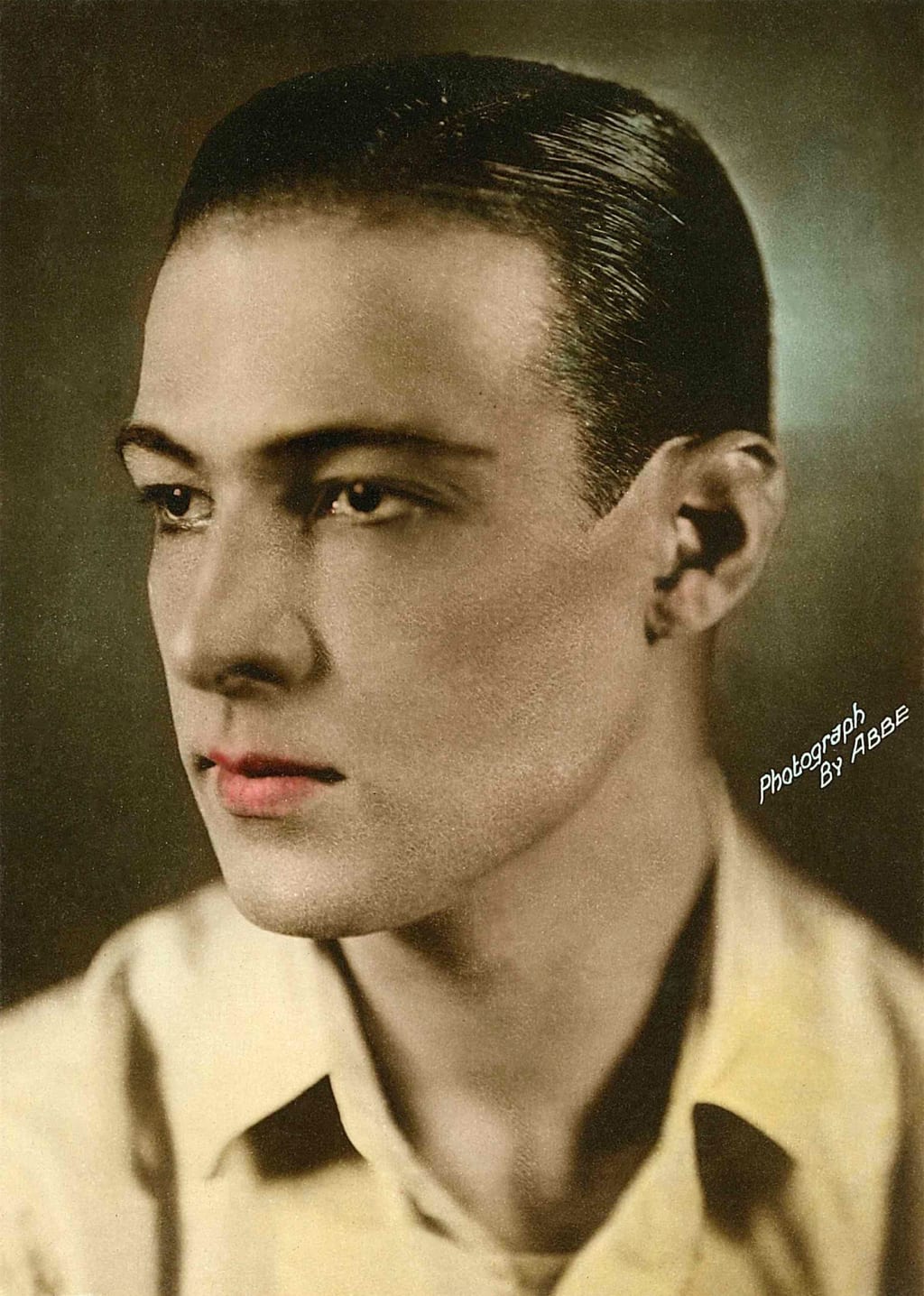
He was born Rodolfo Alfonso Raffaello Pierre Filibert Guglielmi de Valentina d'Antonguolla. When the film industry was in its infancy, he became one of the few actors who rose to stardom, becoming incredibly famous and popular. Even though his career was a short one, he captured women’s hearts all over the world. He is remembered as one of the greatest silent film actors of all time.
He was Rudolph Valentino.
Rudolph was born in Castellaneta, Italy, on 6th May, 1895. His father was Giovanni, a veterinarian and an extremely strict father. As a result, Rudolph ‘feared’ his father but worshipped his beautiful mother, French born Gabriella. Rudolph had an older brother, Alberto, a younger sister, Maria, and an older sister who had died in infancy, Beatrice. As Rudolph was exceptionally good looking, even as a child, he was indulged by his mother who ‘coddled’ him, but his father disapproved of Rudolph, (was it through jealousy? We'll never know). Rudolph did poorly in school and was enrolled in an agricultural school in Genoa, where he earned a certificate.
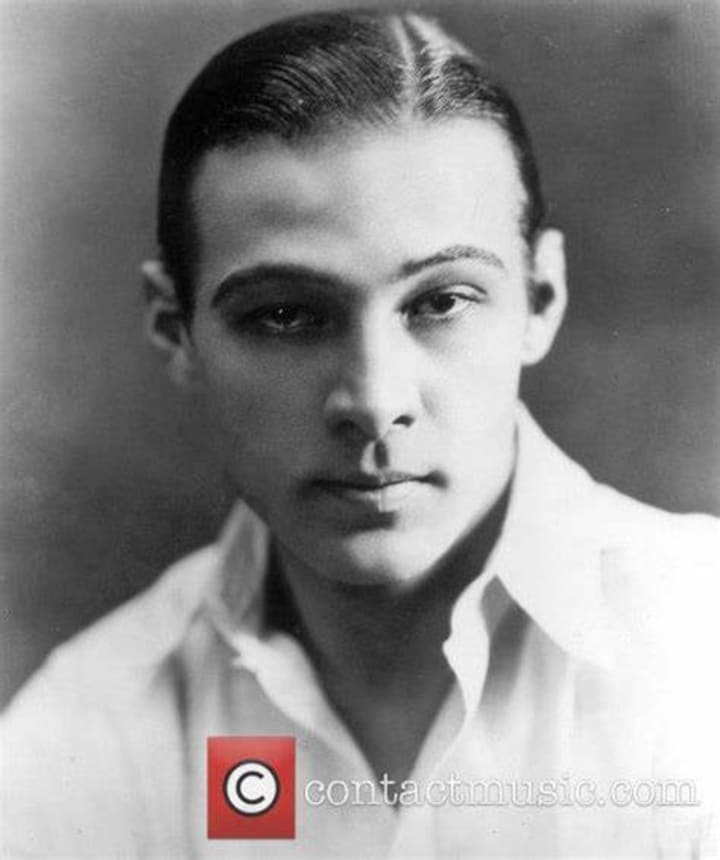
His nickname was “Mercury” after the wing-footed trickster God. He said: “I became to myself an imaginary figure of great excellence, daring and glamour”. Rudolph dared to dream even at such a young age.
In 1906, his father died of malaria and Rudolph's ‘goth-tinged rebelliousness’ started to concern his Catholic family, who sent the young dreamer to boarding school. At 17 years of age, Rudolph ‘escaped’ to Paris and the Monte Carlo, where he became a guest, learning the tango (which was a scandalous dance at the time) and losing his money.
In 1912, he returned to Italy but unable to secure employment, Rudolph moved on to the USA in 1913. On 23rd December, 1913, Rudolph was processed at Ellis Islands at the age of 18. Rudolph never applied for a US citizenship, preferring to keep his Italian citizenship.
Doing odd jobs, such as working in restaurants and gardening, Rudolph eventually made money by dancing with upper-class women, sometimes giving them ‘private’ lessons.
Rudolph moved to Los Angeles in 1918 and started to focus on acting. It was now that he chose the ‘stage name’ Rudolph Valentino. In 1919, Rudolph married actress Jean Acker but the marriage was doomed to fail and the unhappy couple divorced in 1922. It was reported that Jean was a lesbian.
Luckily for Rudolph, his professional life was more successful. After playing several small parts in films, this budding actor was cast as Julio in The Four Horsemen of the Apocalypse (1912). It became one of the first films to make $1 million at the box office, the 6th highest grossing silent film ever. The film was a war drama which became known for the tango scene featuring Rudolph and Beatrice Dominguez, and this made him a star.

Rudolph appeared in several romantic dramas, notably The Sheik (1912), Blood and Sand (1922), and The Eagle (1925). These films were packed with extravagant costumes, heavy makeup and Rudolph’s exotic and sexually ambiguous good looks.
Unfortunately, Rudolph became ‘involved’ with Natasha Rambova who was a set designer and costumer. The ‘union’ was tumultuous, with Natasha becoming too controlling. She was eventually banned from Rudolph’s film sets and the couple split in 1925.
Rudolph starred in his last film in 1926, The Son of the Sheik. It was his most popular film and the one which cemented his status as a legendary heartthrob. The film was released just after his death.
Rudolph Valentino died at 31 years of age. His death came as a shock to everyone. The actor collapsed at the Hotel Ambassador (in New York City), and was taken to the New York Polyclinic Hospital. He was suffering from appendicitis and gastric ulcers. The surgery appeared to be a success but because of his frail disposition, Rudolph had a pleuritis relapse. The actor believed that he would recover but fell into a coma and died on 23rd August, 1926.
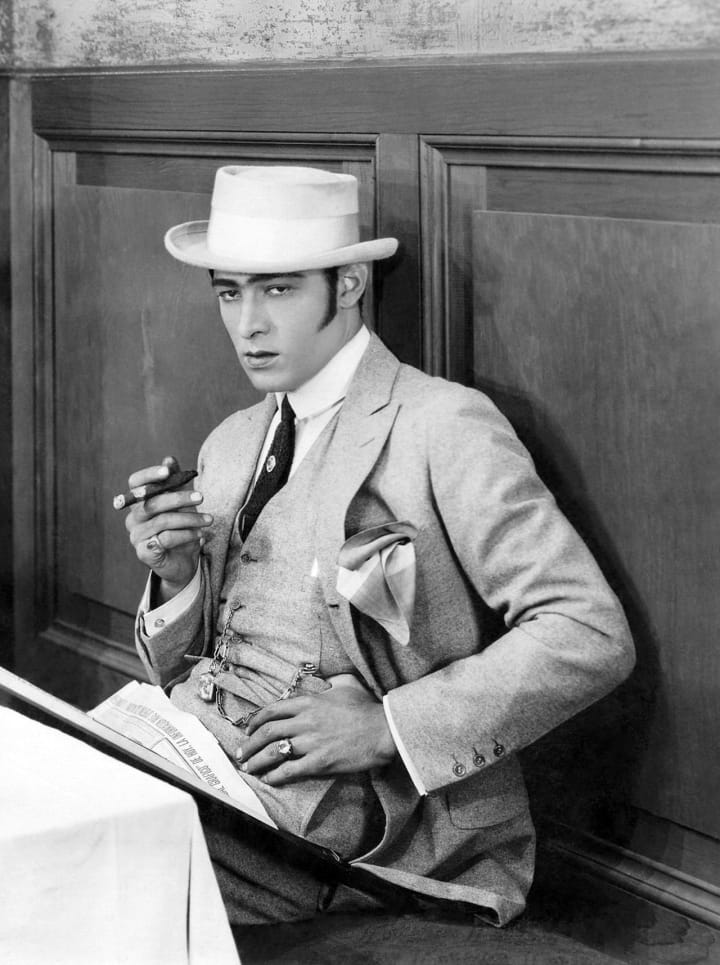
The announcement of the death of Rudolph Valentino caused a ‘tremendous scene’. A riot broke out requiring 100 mounted police officers to gain control of the situation. It is ‘believed’ that women committed suicide out of sheer devastation. The funeral was a public spectacle and the body of Rudolph Valentino came to rest at Hollywood Memorial Park Cemetery, (now called Hollywood Forever Cemetery), in Hollywood, California.
Nearly a century after his death, Rudolph Valentino is still remembered as one of the most iconic and influential stars of the silent films. His ‘acting’ continues to inspire and captivate people of all generations and nationalities.

“Women are not in love with me but with the picture of me on the screen. I am merely the canvas upon which the women paint their dreams” — Rudolph Valentino.
About the Creator
Ruth Elizabeth Stiff
I love all things Earthy and Self-Help
History is one of my favourite subjects and I love to write short fiction
Research is so interesting for me too
Keep reading
More stories from Ruth Elizabeth Stiff and writers in FYI and other communities.
"The Purge" Film Series
As a rule, I don’t watch violent films. Forget Saw or its ‘offspring’, even the ‘modern’ Batman is cringing for me to watch. BUT, one evening I thought: “Toughen up and watch The Purge”. I had been told about this film series and was curious about it. Is it really like ‘that’? I didn’t bother with the book, written by Sofi Oksanen — my imagination will beat any film or book!!!
By Ruth Elizabeth Stiffabout a year ago in FYI
A Failed Artist, A Disillusioned Poet, An Underpaid Game Show Host
I took my son and niece to Gori, a small town in Georgia where Joseph Stalin was born. They talked me into visiting the Stalin's Museum, the largest in the post-Soviet space. I had resisted going there because I just can't stand the monster and know enough about him, or so I thought.
By Lana V Lynx7 days ago in FYI
Singapore Logistics Market: Trade Connectivity, Automation, and Regional Hub Strength
According to IMARC Group’s latest research publication, the Singapore logistics market size reached USD 26.4 Billion in 2024. Looking ahead, the market is expected to reach USD 42.2 Billion by 2033, growing at a compound annual growth rate (CAGR) of 4.37% during 2025–2033.
By Sam walterabout 13 hours ago in FYI
The steps to losing a child
Step One: Lose a child. Not what anyone wants to happen and nothing you can do to change it, but you can go through steps to becoming happy again. You can go through steps to loving again. You can go through steps to become a new you because after losing a child you will never be the same person you once were.
By Tabitha Hinkley4 days ago in Fiction



Comments (1)
best writing