
REALISM IN KENYA
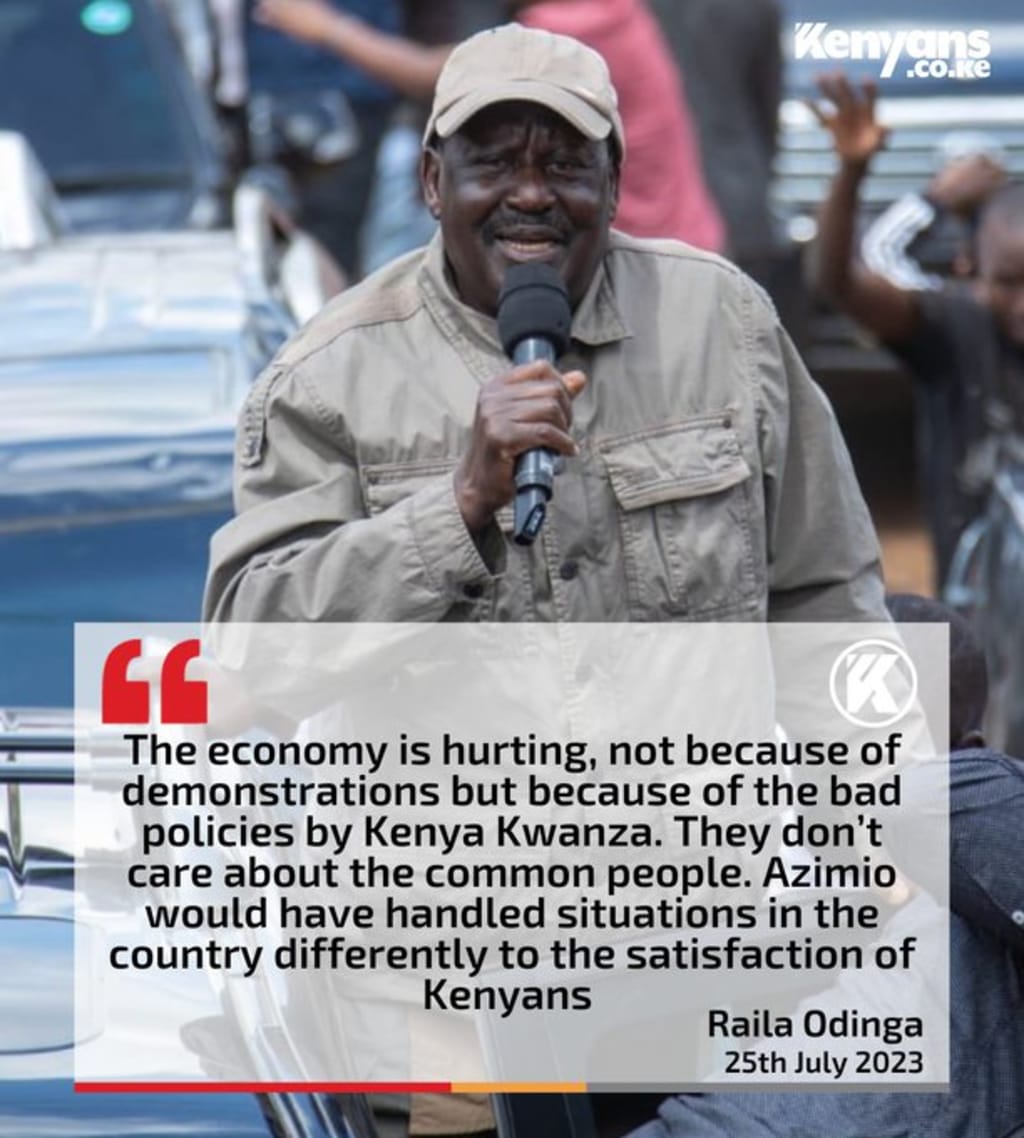
Raila Odinga's take on economic realism in kenya
Theories are constantly emerging and competing with one another. For that reason it can be disorientating to learn about theoretical approaches. Thomas Kuhn’s The Structure of Scientific Revolutions (1962) set the stage for understanding how and why certain theories are legitimized and widely accepted. He also identified the process that takes place when theories are no longer relevant and new theories emerge. For example, human beings were once convinced the earth was flat and accepted this as fact. With the advancement of science and technology, humans discarded this previously accepted belief. Once such a discovery takes place, a ‘paradigm shift’ results and the former way of thinking is replaced with a new one. Although changes in IR theory are not as dramatic as the example above, there have been significant evolutions in the discipline. This is important to keep in mind when we consider how theories of IR play a role in explaining the world politics and how, based upon different time periods and our personal contexts, one approach may speak to us more than another. This paper comprehensively shows that realism is the best IR theory to useful in making sense of world politics because it best applies to our daily individual lives and, therefore, dominates how we shape international relations.
Realism gained momentum during the Second World War when it appeared to offer a convincing account for how and why the worst conflict in known history originated after a period of supposed peace and optimism. Although it originated in named form in the twentieth century, many realists have traced its origins in earlier writings. Indeed, realists have looked as far back as to the ancient world where they detected similar patterns of human behavior as those evident in our modern world. As its name suggests, advocates of realism purport it reflects the ‘reality’ of the world and more effectively accounts for change in international politics. Thomas Hobbes is often mentioned in discussions of realism due to his description of the brutality of life during the English Civil War of 1642–1651. Hobbes described human beings as living in an order less ‘state of nature’ that he perceived as a war of all against all. To remedy this, he proposed that a ‘social contract’ was required between a ruler and the people of a state to maintain relative order. Today, we take such ideas for granted as it is usually clear who rules our states. Each leader, or ‘sovereign’ sets the rules and establishes a system of punishments for those who break them. We accept this in our respective states so that our lives can function with a sense of security and order. It may not be ideal, but it is better than a state of nature. As no such contract exists internationally and there is no sovereign in charge of the world, disorder and fear rules international relations. That is why war seems more common than peace to realists, indeed they see war as inevitable. When they examine history they see a world that may change in shape, but is always characterized by a system of what they call ‘international anarchy’ as the world has no sovereign to give it order.
One central area that sets realism apart is how they view human nature. Realists do not typically believe that human beings are inherently good, or have the potential for good. Instead, they claim individuals act in their own self-interests. For realists, people are selfish and behave according to their own needs without necessarily taking into account the needs of others. Realists believe conflict is unavoidable and perpetual and so war is common and inherent to humankind. Hans Morgenthau, a prominent realist, is known for his famous statement ‘all politics is a struggle for power’ (Morgenthau 1948). This demonstrates the typical realist view that politics is primarily about domination as opposed to cooperation between states. Here, it is useful to briefly recall the idea of theories being lenses. When viewing that world through the realist lens, the world appears to be one of domination. The realist lens magnifies instances of war and conflict and then uses those to paint a certain picture of the world.
Liberals, when looking at the same world, adjust their lenses to blur out areas of domination and instead bring areas of cooperation into focus. Then, they can paint a slightly different picture of the same world It is important to understand that there is no single liberal or realist theory. Scholars in the two groups rarely fully agree with each other, even those who share the same approach. Each scholar has a particular interpretation of the world, which includes ideas of peace, war and the role of the state in relation to individuals. And, both realism and liberalism have been updated to more modern versions (neoliberalism and neorealism) that represent a shift in emphasis from their traditional roots. Nevertheless, these perspectives can still be grouped into theory ‘families’ (or traditions). In your studies, you will need to unpack the various differences but, for now, understanding the core assumptions of each approach is the best way to get your bearings.
For example, if we think of the simple contrast of optimism and pessimism we can see a familial relationship in all branches of realism and liberalism. Liberals share an optimistic view of IR, believing that world order can be improved, with peace and progress gradually replacing war. They may not agree on the details, but this optimistic view generally unites them. Conversely, realists tend to dismiss optimism as a form of misplaced idealism and instead they arrive at a more pessimistic view. This is due to their focus on the centrality of the state and its need for security and survival in an anarchical system where it can only truly rely on itself. As a result, realists reach an array of accounts that describe IR as a system where war and conflict is common and periods of peace are merely times when states are preparing for future conflict.
Another point to keep in mind is that each of the overarching approaches in IR possesses a different perspective on the nature of the state. Both liberalism and realism consider the state to be the dominant actor in IR, although liberalism does add a role for non-state actors such as international organizations. Nevertheless, within both theories states themselves are typically regarded as possessing ultimate power. This includes the capacity to enforce decisions, such as declaring war on another nation, or conversely treaties that may bind states to certain agreements. In terms of liberalism, its proponents argue that organisations are valuable in assisting states in formulating decisions and helping to formalise cooperation that leads to peaceful outcomes. Realists on the other hand believe states partake in international organisations only when it is in their self-interest to do so. Many scholars have begun to reject these traditional theories over the past several decades because of their obsession with the state and the status quo.
About the Creator
Keep reading
More stories from writers in FYI and other communities.
A Failed Artist, A Disillusioned Poet, An Underpaid Game Show Host
I took my son and niece to Gori, a small town in Georgia where Joseph Stalin was born. They talked me into visiting the Stalin's Museum, the largest in the post-Soviet space. I had resisted going there because I just can't stand the monster and know enough about him, or so I thought.
By Lana V Lynx20 days ago in FYI
When Trees Explode: The Secret Behind Winter’s Loudest Cracks
Trees are remarkable living structures, standing tall through storms, droughts, heatwaves, and freezing winters. Yet under certain conditions, even the hardiest trees can undergo dramatic changes .. sometimes described as “exploding.” These sudden bark splits startle observers and raise questions: do trees truly explode, and if so, what causes it?
By Aarsh Malik3 days ago in FYI
The Path to Salvation
The late autumn evening air filled the monk's lungs, but it wasn't the season that chilled his bones. The heavy-handed presence of evil he had sensed upon entering the woods surrounding this mountain village had not bothered to conceal itself from him.
By Made in DNA4 days ago in Fiction


Comments (1)
Amazing story about the reality realization.