

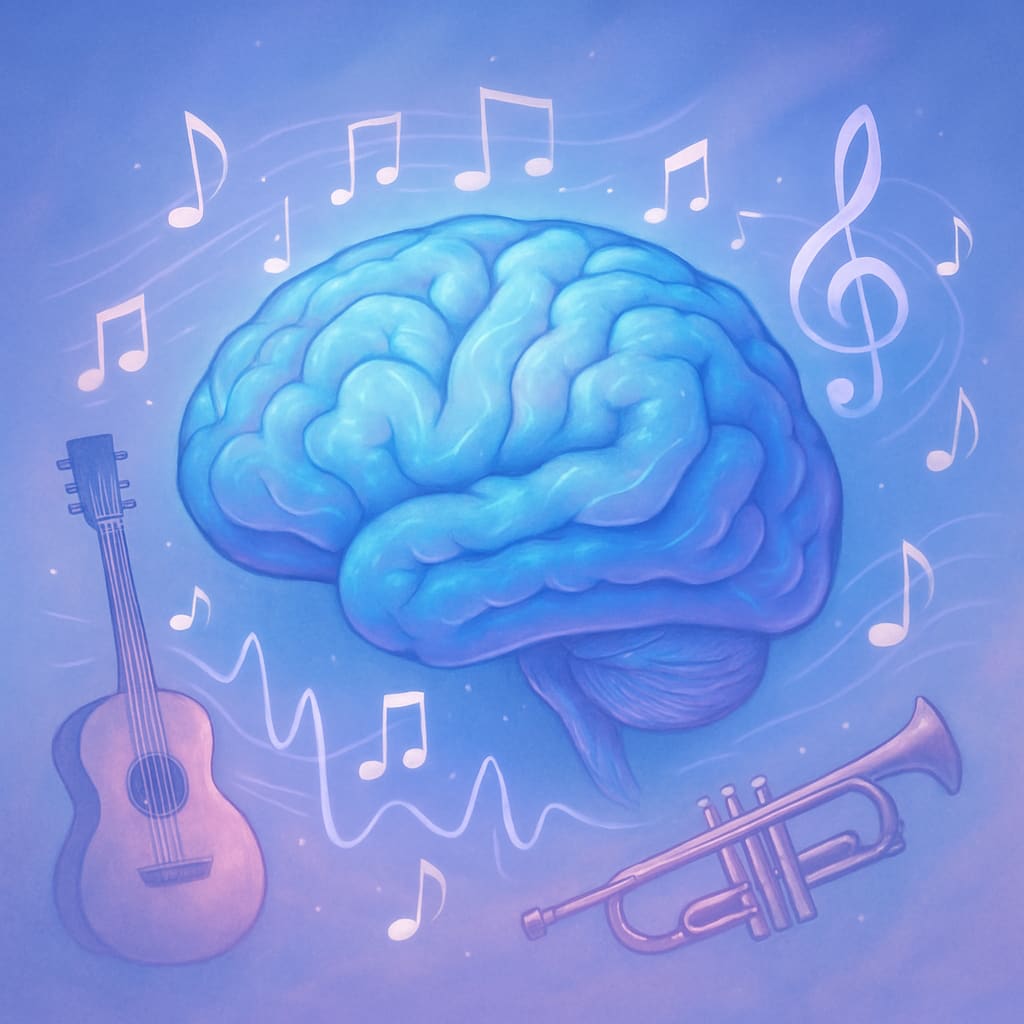
Have you ever played your favorite song and suddenly felt your mood change? Maybe your stress melted away, or your energy came back after a long day. That’s not just in your head—it’s actually science! Music has a powerful effect on your brain, body, and emotions.
Your Brain on Music Is Like a Firework Show
When you listen to music, your brain lights up—literally! Music is one of the only things that activate almost every area of your brain at the same time.
• Your auditory cortex hears the music.
• Your motor cortex reacts, making you want to tap your feet.
• Your limbic system (your emotional center) makes you feel things—happiness, sadness, peace, or even motivation.
Cool Fact: People who play instruments (like guitar or piano) often have a stronger connection between the left and right sides of their brain. That’s because music makes the brain work in harmony!
Music Makes You Happier (Literally)
When you hear a song you love, your brain releases dopamine—the “feel good” chemical. It’s the same thing that makes you feel great after a hug, a delicious meal, or when you achieve a goal.
• Slow music (like soft piano or lo-fi beats) can help reduce stress by lowering cortisol, the stress hormone.
• Fast music (like pop or dance tracks) can boost your mood, give you energy, and even help with workouts.
Science Says: A study from Nature Neuroscience found that listening to music can increase dopamine by 9%. That’s why a good playlist feels like a mental hug!
Want Better Sleep? Music Can Help
If you have trouble falling asleep, music can be the answer.
• Songs with a slow tempo (60–80 beats per minute) help your body and brain calm down.
• It slows your heart rate, your breathing, and prepares your brain for rest.
Try These for Sleep:
• Classical music like Clair de Lune by Debussy
• Ambient soundtracks (soft electronic music)
• Nature sounds (like ocean waves or rain)
Pro Tip: Turn off music after 30 minutes using a sleep timer. Your brain will link it to bedtime, helping you sleep faster over time.
Music Helps You Focus and Study
Music can also help you concentrate, memorize, and learn better—if you choose the right kind.
• Music with no lyrics (like classical, lo-fi, or instrumental) is best for focusing.
• It blocks distractions and keeps your mind calm.
Study Hack: Listen to Baroque music (like Bach or Vivaldi). It often has a steady beat of 60 BPM, which helps your brain stay focused and alert.
What Music Should You Listen to for Different Moods?
Here’s a fun playlist guide to match your mood:
How You Feel Best Music Type
Need to study ------- Lo-fi, instrumental, classical
Feeling stressed ------ Soft piano, ambient, nature sounds
Want energy ----- Dance, pop, upbeat electronic
Feeling sad ----- Uplifting pop, indie rock
Going to sleep ----- Slow classical or chill ambient
Working out ----- Fast-paced EDM, hip-hop, rock
Remember: The right song can totally change your mood.
Music Therapy: Healing Without Medicine
Music is now being used in hospitals and therapy centers to help people heal.
• It helps reduce anxiety and pain.
• People with Alzheimer’s or Parkinson’s disease respond better when they hear music they love.
• Stroke patients sometimes use singing therapy to speak again, because music uses different brain areas than normal talking.
Music = Natural medicine for your mind!
Final Thoughts: Let the Music Heal You
Music isn’t just fun—it’s powerful. It can make you smarter, happier, and even healthier. It helps you sleep better, study better, and feel less stressed.
So next time you feel tired, sad, or overwhelmed, just put on a song you love. Whether it’s a peaceful piano piece or a dance beat that gets you moving—let the music take over.
Let your brain dance. Let your heart heal. And always keep a song ready for every moment.
About the Creator
Kunalika jaswal
Medical student from India sharing science made simple, smart life hacks, book reviews, and playlists worth listening to. I love turning everyday moments into something insightful, helpful, or just a little more fun.
Keep reading
More stories from Kunalika jaswal and writers in FYI and other communities.
A Failed Artist, A Disillusioned Poet, An Underpaid Game Show Host
I took my son and niece to Gori, a small town in Georgia where Joseph Stalin was born. They talked me into visiting the Stalin's Museum, the largest in the post-Soviet space. I had resisted going there because I just can't stand the monster and know enough about him, or so I thought.
By Lana V Lynxabout a month ago in FYI
How Structural Materials Prevent Hidden Aircraft Failures
Aircraft are designed to withstand forces that would overwhelm most engineered structures. Yet many of the most dangerous threats to aviation safety are not sudden or obvious. Instead, they develop slowly hidden within materials until they reach a critical point. Preventing these hidden failures is one of the most important roles structural materials play in modern aircraft design.
By Beckett Dowhanabout 20 hours ago in FYI
The Devil's Triangle
The sails ruffled in the breeze as we cruised along. The Sea Breeze was a mid-size catamaran that sailed out of Royal Naval Dockyard in Bermuda. We had booked this trip weeks in advance and were now looking at our Captain, Spike and two boat hands. Paddy and Wilson seemed like nice guys, joking around with the passengers and telling us some stories about Bermuda that only locals would know. Their island accents sounded almost British but they were pleasant to listen to.
By Barbara Gode Wiles3 days ago in Fiction



Comments
There are no comments for this story
Be the first to respond and start the conversation.