
'Joy to the World' History and Meaning
Isaac Watts didn't write 'Joy to the World' to be a Christmas song about Jesus' birth.

We all know the song “Joy to the World.” We sing it every Christmas season. However, very few people know the history and meaning of this song. Here's what the song means, who wrote it, and where it came from.
Isaac Watts, Writer of “Joy to the World”

Isaac Watts wrote “Joy to the World” as a part of a collection of hymns called “The Psalms of David, Imitated in the Language of the New Testament.”
Watts, an English Christian minister, lived from 1674 to 1748. “Joy to the World” first appeared in his famous collection, The Psalms of David, Imitated in the Language of the New Testament. Watts wrote “Joy to the World” to encourage the entire world to make a joyful noise about Jesus.
Even though most people are familiar with only “Joy to the World,” Watts also penned around 750 additional hymns, earning himself the title “Godfather of English Hymnody.” He was a creative and popular hymn writer during his time.
History and Meaning of “Joy to the World”
This might shock some of you, but “Joy to the World” is not a Christmas song about Jesus' first coming. Instead, it is about His second coming. This popular hymn is not based on the Christmas stories in the Gospels of Matthew and Luke. Rather, it was written based on a single verse from one of King David's most meaningful psalms. It is not about the coming Christ, but rather the Christ who has already come.
Psalm 98:4 reads:
“Make a joyful noise unto the LORD, all the earth: make a loud noise, and rejoice, and sing praise.”
As you can see, the theme of the above verse is “joy.” The words “joyful” and “rejoice” appear twice. King David and Watts had the same idea—that all the earth should make a joyful noise unto the Lord. That means all voices can sing praises—the song is not reserved only for those who have received awards for their melodious voices. It is for “all the earth.”
Popularity of “Joy to the World”
Most people consider “Joy to the World” to be a popular Christmas song. It is sung in churches and at holiday gatherings around the world.
Countless popular artists have recorded the song in their own style. The song is in the public domain, so when musicians sing, record, and release it, they do not have to purchase the rights to the song. Hundreds of artists know the song can be sung, remixed, and recorded because it is considered common content due to its age.
Lyrics of “Joy to the World”
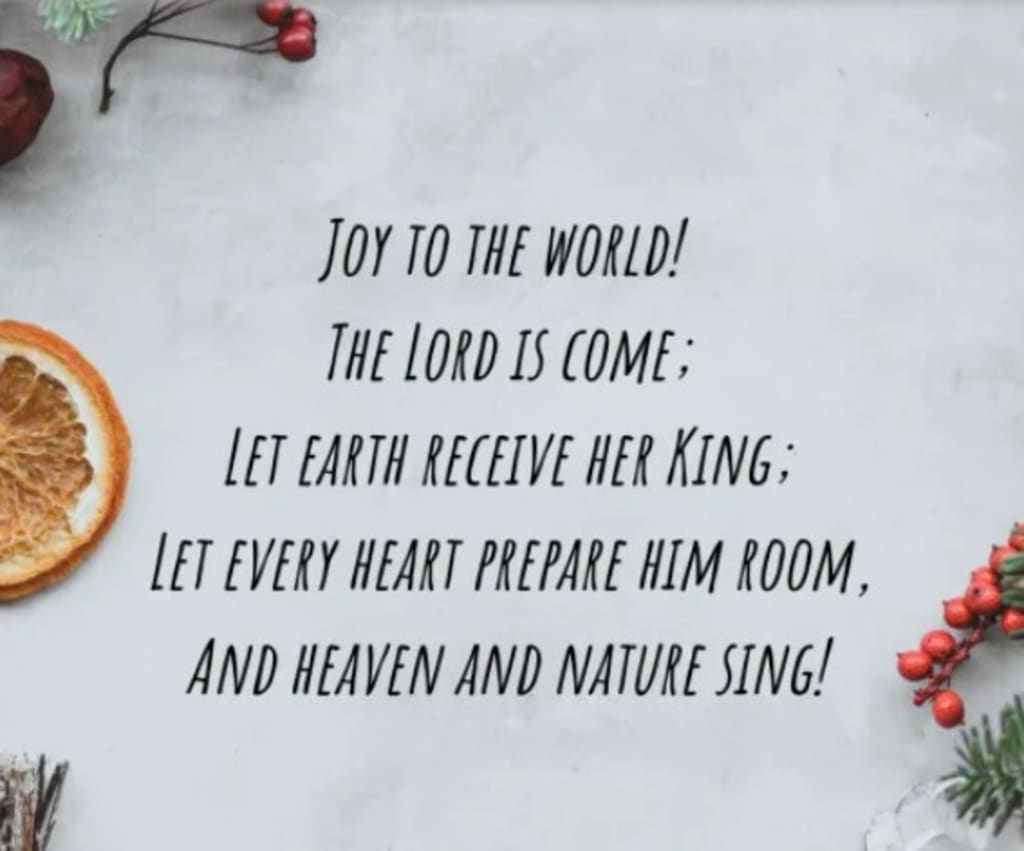
Here is the first stanza of the popular song. Notice, “The Lord is come! and not “The Lord has come!”

Nine out of ten people sing the first line incorrectly because “the Lord has come” seems more natural, but “the Lord is come” is correct. The phrase “the Lord is come” uses an archaic form of English that was very common in 1719 when Isaac Watts wrote the song. Even Mariah Carey sang it wrong in her 1994 rendition.
The lyrics indicate that Christ is come and is already here among us. Jesus Christ didn't just come—He is here now. That's why we should not sing, “The Lord has come.” We should emphasize that He is now here. The next time you sing “Joy to the World,” be mindful to say “the Lord is come.”
Did you learn something new about “Joy to the World”?
95% Yes
5% No
About the Creator
Margaret Minnicks
Margaret Minnicks has a bachelor's degree in English. She is an ordained minister with two master's degrees in theology and Christian education. She has been an online writer for over 15 years. Thanks for reading and sending TIPS her way.
Keep reading
More stories from Margaret Minnicks and writers in FYI and other communities.
Meaning of the Star on Top of Christmas Trees
There are many customs and traditions surrounding Christmas. One tradition is to have a decorated Christmas tree in houses. It might be a live fir, spruce, pine, or cypress. Some people use artificial trees that they keep from year to year.
By Margaret Minnicks20 days ago in FYI
A Failed Artist, A Disillusioned Poet, An Underpaid Game Show Host
I took my son and niece to Gori, a small town in Georgia where Joseph Stalin was born. They talked me into visiting the Stalin's Museum, the largest in the post-Soviet space. I had resisted going there because I just can't stand the monster and know enough about him, or so I thought.
By Lana V Lynx6 days ago in FYI
Where's the Glory?
In breaking news, rehabilitated Republican Senator Johnnie Johnson (Pronouns: HE, HIM, HIS) called a press conference from the Men’s room of the New Orleans Louis Armstrong International Airport, Concourse B, across from the Ignatius Reilly’s Lucky Dog stand. The Senator had just returned from a sexual reorientation rehabilitation program in Memphis, TN after being publically disgraced at a Buckee’s Truckstop restroom soliciting sex from an undercover cop three months ago. He is a founding member of the Reformed Christians for Christ, a conservative, pro-family and ex-gay advocacy group. In the spirit of being reborn, Senator Johnson invited reporters to marvel at his plans for a major remodeling of airport bathrooms.
By Cathy Schieffelin4 days ago in Humor



Comments
There are no comments for this story
Be the first to respond and start the conversation.