


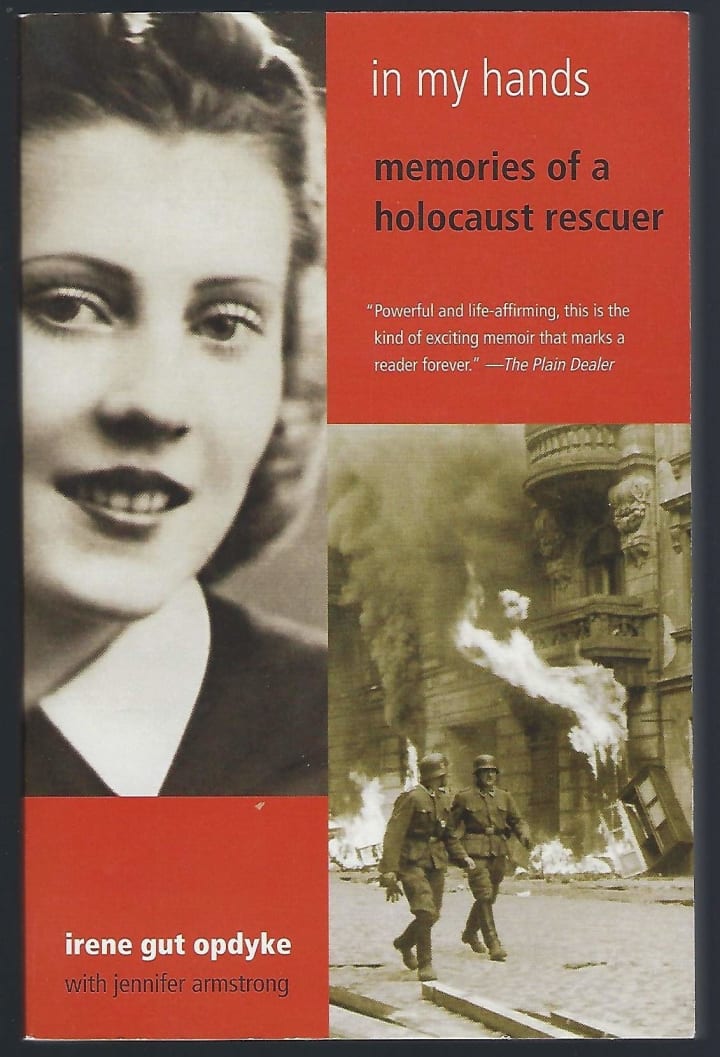
Her story is one of great courage and heroism, especially during World War Two. She saved the lives of more than 12 Jewish people by hiding them in the house of a Nazi Major officer. She was honoured as one of the German Righteous Among the Nations.
She was Irene Gut Opdyke.
Irene Gut was born in 1922 in Kozienice, Poland, into a Catholic family. She grew up in a caring and loving environment with seven siblings. Her mother and father instilled into their daughter the qualities of compassion and empathy for others, which gave her strength in the days to come.
The family moved to Radom, where Irene enrolled at a nursing school at 15 years of age, before the Nazi-Soviet invasion in 1939. When Poland was invaded, she tried to hide but was caught by soldiers, beaten and gang-raped, and then forced to work in a munitions factory. Irene was about 19 years of age.
During her time in the factory, a Major Eduard Rugemer noticed that Irene could speak German, which was ‘useful’, so he arranged for her to work in the kitchens of a hotel used by Nazi officers. Whilst working in the kitchens, Irene saw a soldier do something that ‘could’ make anyone lose their faith in God. He took a baby from its mother’s arms and threw it, head first, onto the ground, killing. The mother, screaming for her baby, was shot straight away after. However, this made our heroine realize that people do have a choice to do good or evil, and she was determined to help the Jewish people as much as she could and at every opportunity.

Irene started to secretly take food from the kitchen to the Tarnopol Ghetto, where the Jewish people were rounded up to ‘live’ before being taken to the concentration camps. She was able to smuggle Jews into the surrounding forest where she also delivered food to them. This took a great deal of courage on Irene’s part because anyone caught helping the Jews was shot.
At around the same time, Irene started to work as housekeeper for Major Eduard Rugemer. He had noticed her intelligence and that she was good with figures and was good at organising, so he ‘asked’ her if she would be his housekeeper for the villa he had just requisitioned. Irene, of course, agreed but I’m not sure how much choice she would have had. Maybe our heroine could see a way of helping more Jewish people by being the housekeeper of this villa.
Once in and settled, Irene hid 12 Jews in this villa, finding them a good hiding place and making sure they had food, water and electricity for light. Being the housekeeper of an important Major, she had the ‘authority’ without too many people asking too many questions. When the Major was out, away from the villa, the Jews would come out and help Irene with the cleaning and food preparation. It was their way of thanking her.
Unfortunately, one day the Major came back early and saw these Jews. He had now found out that Irene had been hiding them under his nose all this time. The Major agreed to keep the secret as long as Irene became his mistress (or sex slave possibly). Irene agreed to this, wanting to save ‘her friends’ lives. So for a while, she lived as his mistress whilst the Jews hid in the villa. We can only imagine how Irene must have felt, having to have sex with this much older man and being treated quite badly by the natives, who had no idea of what was going on. Irene still did it in order to save the Jewish people that were hiding there.
In time, these 12 Jewish people managed to escape into the forest, joining others, even as the Russians advanced. Major Rugemer fled with the other Nazi officers when he realized that they had lost the war. What happened to our heroine, Irene?
She was put into a Displaced Persons Camp, and it was here that she met a United Nations person who would eventually become her husband, William Opdyke. It was after 1956, when Irene had emigrated to America that Irene and William married, and the couple had a daughter they named Jennie.

Irene kept very quiet about her ‘story’ until she heard someone trying to deny that the Holocaust had ever happened. She felt that she must tell the truth of what life was really like during those terrible years in Poland, and told her story out loud, giving lectures and writing her own memoirs. She even agreed to a film being made.
Irene Gut Opdyke died in 2003 at 85 years of age.
Our heroine's life inspires us today to never doubt that choosing to do the right thing ‘is the right thing to do’. Her legacy lives on through the “Irene Gut Opdyke Foundation” which promotes education, tolerance and respect.
I’ll let Irene have the last few words: “Remember, hate destroys. Love builds.”
About the Creator
Ruth Elizabeth Stiff
I love all things Earthy and Self-Help
History is one of my favourite subjects and I love to write short fiction
Research is so interesting for me too
Keep reading
More stories from Ruth Elizabeth Stiff and writers in FYI and other communities.
Inventing Anna
Flicking through Netflix one evening, a title and picture caught my eye, “Inventing Anna”. I read the tiny review below the picture and thought to myself: “Why not? Looks like an easy watch, a film I don’t have to think too much about”, and started watching. It’s actually a ‘limited series’ with 9 episodes, and each episode is over an hour long. I didn’t watch it all in one evening but over the week.
By Ruth Elizabeth Stiff8 months ago in FYI
A Failed Artist, A Disillusioned Poet, An Underpaid Game Show Host
I took my son and niece to Gori, a small town in Georgia where Joseph Stalin was born. They talked me into visiting the Stalin's Museum, the largest in the post-Soviet space. I had resisted going there because I just can't stand the monster and know enough about him, or so I thought.
By Lana V Lynx5 days ago in FYI
Venezuela, Greenland, and the Rules-Based Order’s Autopsy
In the immediate aftermath of the U.S. raid that captured Venezuelan president Nicolás Maduro, the global reaction split almost exactly the way you’d expect. Governments with ideological or geopolitical ties to Caracas rushed to condemn the move. Brazil’s Lula called it an “extremely dangerous precedent.” Colombia’s Petro and Chile’s outgoing president Gabriel Boric echoed the concern. Russia, without a trace of irony, warned of a “return to lawlessness.”
By Lawrence Leaseabout 16 hours ago in FYI
'20/20'
"Do It Again" the track that would ultimately open the Beach Boys final album on Capitol Records which was released on February 10th 1969 had originally been released as a single in August of 1968. The track was the first of many post-Pet Sounds era throwbacks to the early Beach Boys sound which would become continually more cliched and eventually lead the Beach Boys to the level of self-parody they would eventually succumb to in the 1980s while their closest contemporaries The Beatles nearing the end of their run in 1969 would go on to be viewed as the most influential band of all time. However, the song itself is not bad on its surface, and it opens with a futuristic sounding (for 1969) drumbeat captured by then-Beach Boys engineer Stephen Desper using tape delays on the drums performed by Dennis Wilson and John Guerin. The song has been re-recorded numerous times over the years on various Beach Boys-related projects most notably the 2011 re-recording at Capitol studios featuring the five surviving Beach Boys at the time backed instrumentally by various members of both the Brian Wilson Band and Mike Loves touring "Beach Boys" to promote the then upcoming Beach Boys 50th Anniversary reunion tour in 2012. The hammering and power drill sound at the end of the song was an excerpt from a track called "Workshop" that was to be a part of the uncompleted "SMiLE" album.
By Sean Callaghan5 days ago in Beat



Comments
There are no comments for this story
Be the first to respond and start the conversation.