
Imaginative medieval dark medicine: hairdressers as doctors, bleeding to cure all ills
Hairdressers do the work of surgeons as patients beg to be bled.

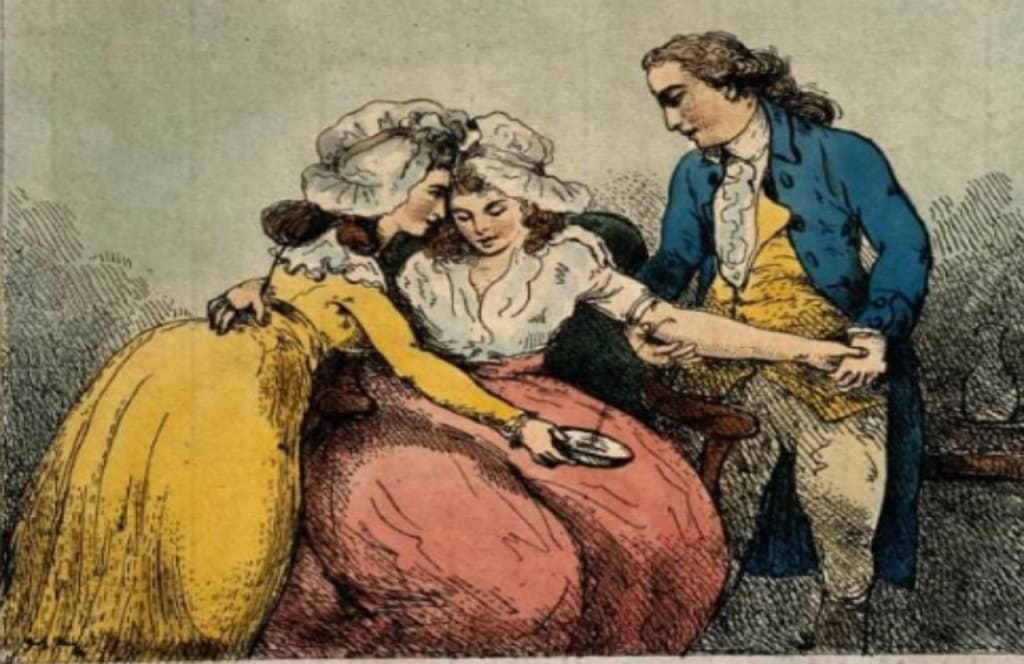
At a time when innovation is especially scarce, imagination is a surefire flattery. Little do I know what a horror it would be if it had anything to do with medicine, which is what people in the Middle Ages had to deal with on a daily basis: craniotomy for headaches, bleeding at the slightest word, rough enema, amputation... Cured is God's blessing, not cured, only your own SINS.
I just want to say "Amen" three times and feel very grateful to live in the 21st century with advanced medical science...
The running deviation of medieval medicine
Imagined medieval times were beautiful and romantic? Have the ability to have a disease try, minutes let you experience what is worse than death: doctors are like death, the doctor depends on luck!
In the early Middle Ages, with the rise of Christianity, European medicine was immediately dragged back to the days of witch doctors, who believed that diseases could be exorcised with amulets, holy water and, let alone hymns and prayers. If a patient wanted to see a doctor, he could only go to a hospital run by a monastery at that time, but as for how to treat you, it was very Buddhist.
First, you will be warmly received by the beautiful and gentle nuns, who will use all the facilities of the church to make sure you eat, drink and sleep well. Then, in order to keep you happy, they will take you to visit the church from time to time, let you do the prayer service, observe the holy relics and other activities, and give you some holy oil for good treatment, but they will not give you medical treatment!
If you ask why you're sick, they'll just tell you, "Being sick means you're guilty, and you can only get better through sincere repentance and God's forgiveness."
What if the big hospital doesn't treat you? Don't lose heart. You can also go to a private clinic. However, the painting style is very strange, estimated that the patient has not been cured, was scared to death or toss dead. Why do you say that?
In contrast to the clean image of modern hospitals, private clinics of the time had a dark style. Instead of "angels in white," the doctors wore long black robes, wide black hats, and long beaks on their mouths when the bubonic plague broke out, making them look like death.
The equipment is said to scare away demons that possess the patient, and the necessary walking stick has both "practical" and "symbolic" functions: it can be used to lift up the patient's clothing to avoid contact with it during medical treatment; When a dead horse was a living horse doctor, he could whip the patient to get rid of the disease.
In those days, everything was associated with ghosts. But that's not the worst part. Have you ever heard of horoscopes?
This is no joke. Medieval doctors believed that the health of the human body was related to the astrological chart, and that astrological signs affected different parts of the body, such as Aries affecting the head, Gemini affecting the arms...
Doctors will treat their patients according to the horoscope. If you have the misfortune to break your brain in March, sorry, Aries moon is not a good time to treat it. Wait until the sun goes past Aries.
For many years the practice was chaotic, with countless patients suffering, burning money and eventually losing their lives. Finally, someone jumped out, he is respected by the West as the "father of medicine" Hippocrates. In order to resist various medical fallacies prevalent at that time, he actively explored the characteristics of human body and the causes of disease and put forward the famous "humoral theory".
He believed that the complex human body was made up of four humors: blood, mucus, yellow gall and black gall. These four humors were in different proportions in the human body and formed different temperaments: bile, which was impatient and swift in action; A sanguine substance with active and sensitive temperament; A phlegmatic, slow-moving phlegm; A depressive substance of weak temperament and sluggish movement and the reason why people get sick is because of the imbalance of these four body fluids. Too much of a fluid, as long as it is removed, can restore health.
But Hippocrates never expected, in order to correct the chaos "humoralism" became the theoretical basis of later absurd bloodletting therapy, all diseases can be bloodletting prevailed throughout the Middle Ages...
Sick joke, barber gave you a knife
Shouldn't blood-letting, which requires technical expertise and a sterile environment, be performed by doctors themselves? In fact, you'd never guess what the doctors of that time were thinking.
Before the Middle Ages, the Ostrogoth kingdom, which ruled Italy, had a strict law: doctors performing surgical procedures must be 100 percent successful, and if they failed or resulted in death, doctors must be handed over to the patient's family.
On the other hand, the distinction between physicians and surgeons was great: physicians were respected and served as personal physicians to popes and princes; Surgeons, on the other hand, have so little respect, even for teaching positions in universities, that it is generally considered "undignified to have blood on your hands". Thus, the final "burden" of bleeding falls on the shoulders of the barber.
The hairdresser of this period was a double-handed man with deep knowledge and reputation! With scissors in one hand, they trim people's hair, and with a scalpel in the other hand, they help customers remove hemorrhoids and skin tumors. Of course, the thing that does the most is bleed.
People in the Middle Ages believed that bloodletting not only cured diseases, but that regular bloodletting also strengthened the body. As a result, many people undergo regular blood-letting treatments in the spring and autumn to adapt to the changing climate, and hairdressers have become popular jobs.
Although some barbers gained the title of famous doctor through long-term accumulation of experience, but because of the poor cultural quality of most of the practitioners, and the existence of pathophysiology in the Middle Ages, it is inevitable that they will not make a point of fooling patients when they encounter some difficult diseases.
For example, in French literature from the 12th century, there is a young couple who both die of lovesickness after being unable to see their lovers for a long time. Before his death, a man was given a six-hour bleeding procedure by a hairdresser to relieve his lovesickness. The artist Hieronymus Bosch's "The Foolish Cure" also depicts a grotesque "surgical operation."
The common belief at that time was that the reason for low intelligence was the presence of stones in the head, so some priests would work with barbers and wear a "wisdom funnel" to cut open the scalp of patients, and then deceive the patients with prepared stones, telling them that the stones had been removed in order to cheat them out of money. What a horrible thing to think about, to open another man's head in a deceitful way for profit!
Of course, if you reject the bloodletting, the doctor recommends arsenic vomiting and an enema with pig bile. The basic idea is to get the mess out of the way, and it's beautiful.
Bloodletting is still very much alive, and it's been around for 2,000 years or more. It was not until the 19th century, when Europeans discovered the principles of pathogens and diseases, that the "first black science of the ancient world" officially retired from the stage of history...
About the Creator
Keep reading
More stories from writers in FYI and other communities.
A Failed Artist, A Disillusioned Poet, An Underpaid Game Show Host
I took my son and niece to Gori, a small town in Georgia where Joseph Stalin was born. They talked me into visiting the Stalin's Museum, the largest in the post-Soviet space. I had resisted going there because I just can't stand the monster and know enough about him, or so I thought.
By Lana V Lynx23 days ago in FYI
Is There a Hidden Ocean Inside the Earth, and Are We Running Out of Time?
If you think you understand what’s beneath your feet, science might want a word with you, because recent research suggests our planet may be hiding something massive. And no, this isn’t sci-fi. It’s grounded in real discoveries, strange footage, and unsettling predictions about where humanity is headed.
By Areeba Umair4 days ago in FYI
🅼🅸🅳🅽🅸🅶🅷🆃 🆂🅽🅰🅲🅺🆂
"It's 10 in Tuscon! We all know what that means... It's Time for Midnight Snacks with your man, Gerald Gee! Ready to spend the night together? Me too! I'm full of snacks and can't wait to regurgitate them all back into your hungry ears. Crack a brew! Pop some corn! Anything to get ready for one hell of a show where the talk maybe cheap but the words cut deep...
By Lamar Wiggins6 days ago in Fiction




Comments
There are no comments for this story
Be the first to respond and start the conversation.