
Have you ever wondered how solar energy got so cheap?
Made posibble: Government policies and cheap manufacturing costs
I’d put my money on the sun and solar energy. What a source of power!”
Thomas Edison, 1931
In the memoir of James D.Newton's, Uncommon Friends published in 1987, he mentioned that Thomas Edison had talked about solar energy to his friend, Henry Ford in 1931.
For the better part of a century, Edison’s forecast went largely unrealized. But after years of optimistic talk and halting progress, solar is finally on the brink of going big-time. Slowly but steadily, solar has been in the throes of a quiet revolution, with efficiencies rising, costs falling, and new technological breakthroughs
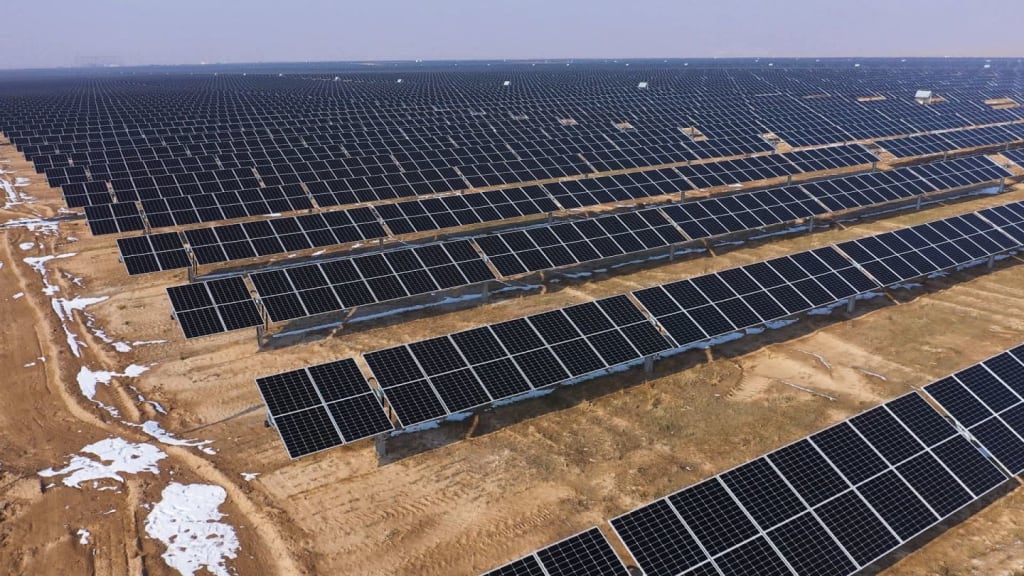
The cost of solar energy has come down tremendously in the last 70 years, making it cheaper than coal, natural gas, or nuclear power in many places. This was made possible by research and development for alternative energy in the 1970s, with the US federal government allotting more than $8 billion to solar research and development under Project Independence. However, the project was canceled by President Reagan before the idea of increasing production to reduce cost could be fully tested. Japan and Germany then stepped in, with Germany implementing feed-in tariffs, a program that deployed solar at scale. The policy incentivized power companies to produce renewable energy, which Germany would buy from them for double the market price, and continue to pay that rate for the next 20 years. As a result, solar projects in Germany became a no-brainer for developers, even though Germany is not the sunniest place in the world. Solar farms like the one shown in the video were built, and the more panels produced, the cheaper it got to generate electricity with solar. China then made solar cheaper than even the original idea of increasing production to reduce cost by subsidizing the production of solar modules, and by producing them at an unprecedented scale. Policies in other countries, such as the United States, also helped create markets for solar modules, making it one of the defining breakthroughs of the 21st century.
In 1953, the US made a significant purchase from Bell Labs - the first commercial silicon solar cell. However, these early solar cells were not highly efficient, and if installed on rooftops, they would cost around $300,000 per month to generate electricity. Fast forward 70 years, and the cost of solar energy has drastically decreased. Solar energy has become the most affordable it has ever been, nearly 90% cheaper than in 2009. In many regions, it is now cheaper to generate electricity from solar power than from coal, natural gas, or nuclear energy. This remarkable progress is an undeniable success story, and it holds valuable lessons for creating and deploying other technologies essential to preserving our planet.
The rapid decline in solar energy costs has become a breakthrough that will define the 21st century. So, how did solar energy transition from being prohibitively expensive to cheaper than fossil fuels? In the 1970s, during the oil crisis, there was a significant focus on alternative energy research and development. The US government initiated Project Independence, allocating over $8 billion for solar research, which made a substantial difference and significantly improved the efficiency of solar cells. Paul Maycock, who had experience at Texas Instruments working on calculators, recognized the economies of scale and believed that solar costs would decrease with increased production. However, President Reagan halted Project Independence before the US could fully explore Maycock's idea.
Fortunately, Japan and Germany stepped in to put Maycock's hypothesis to the test. Japan, facing the impact of the oil crisis, started funding solar research concurrently with the US. They developed small yet powerful solar cells that could run watches, calculators, and toys. While these applications seemed trivial on a global energy scale, they played a crucial role in attracting large companies to solar technology and uncovering methods to construct solar panels at significantly lower costs. In the mid-90s, Japan's solar industry received a major boost when the government introduced a substantial subsidy for rooftop solar.
However, it was Germany's implementation of the feed-in tariff that truly revolutionized the solar market. Starting in 2000, the German government offered power companies a deal: they would purchase renewable energy at double the market price, guaranteeing this rate for the next 20 years. This policy spurred the deployment of solar energy at scale. Solar developers in Germany found it irresistible to invest in solar projects, even in a country not known for its abundant sunshine. The incentives led to a fourfold increase in solar installations within a year, and the trend continued as the cost of generating electricity from solar panels decreased with each production increase.
China played a pivotal role in making solar energy even more affordable. Deng Xiaoping's plan in the 1980s sent Chinese students abroad to learn and bring back valuable knowledge. One group went to the University of New South Wales in Australia, where they worked on highly efficient solar cells. One student returned to China and established Suntech, the country's first commercial solar manufacturer, in 2002. With Germany's supportive legislation, Suntech achieved immense success by selling solar panels to Germany. This success, in turn, attracted competitors and motivated Chinese manufacturers to produce solar panels on an unprecedented scale, driving down prices.
The declining prices caught the attention of policymakers worldwide, resulting in the creation of new markets through legislation. The United States passed the Energy Policy Act of 2005, which included an investment tax credit that proved vital for solar deployment. This tax credit allowed companies to recoup 30% of their solar project costs as a tax credit. This sparked the rise of solar leasing, where companies installed solar panels to reduce their tax liabilities. Similar policies were implemented in Spain, Italy, and notably, China, where a subsidy program modeled after Germany's guaranteed prices led to China becoming the largest solar panels manufacturer.
#solarenergy #thomasedisononsolarenergy #renewableenergy #declineofpriceforsolarpanels
About the Creator
Keep reading
More stories from Pn Masitah Hassan and writers in FYI and other communities.
Everything we buy is worse now. Here is Why.
Have you noticed that everything seems to be of lower quality these days? It's not just the state of the world, but the products we buy are just not as good as they used to be. This thought crossed my mind when my colleague, Darcy complained about having to replace her shoes. So, like any normal person, I decided to buy the exact same shoes from the exact same place. But after a few weeks, it fell apart. This got me thinking about the overall decline in product durability.
By Pn Masitah Hassan3 years ago in FYI
A Failed Artist, A Disillusioned Poet, An Underpaid Game Show Host
I took my son and niece to Gori, a small town in Georgia where Joseph Stalin was born. They talked me into visiting the Stalin's Museum, the largest in the post-Soviet space. I had resisted going there because I just can't stand the monster and know enough about him, or so I thought.
By Lana V Lynx20 days ago in FYI


Comments
There are no comments for this story
Be the first to respond and start the conversation.