
Get Knotted! Mathematically, of Course
OK, but there is a finite limit to the number of ways I can do that

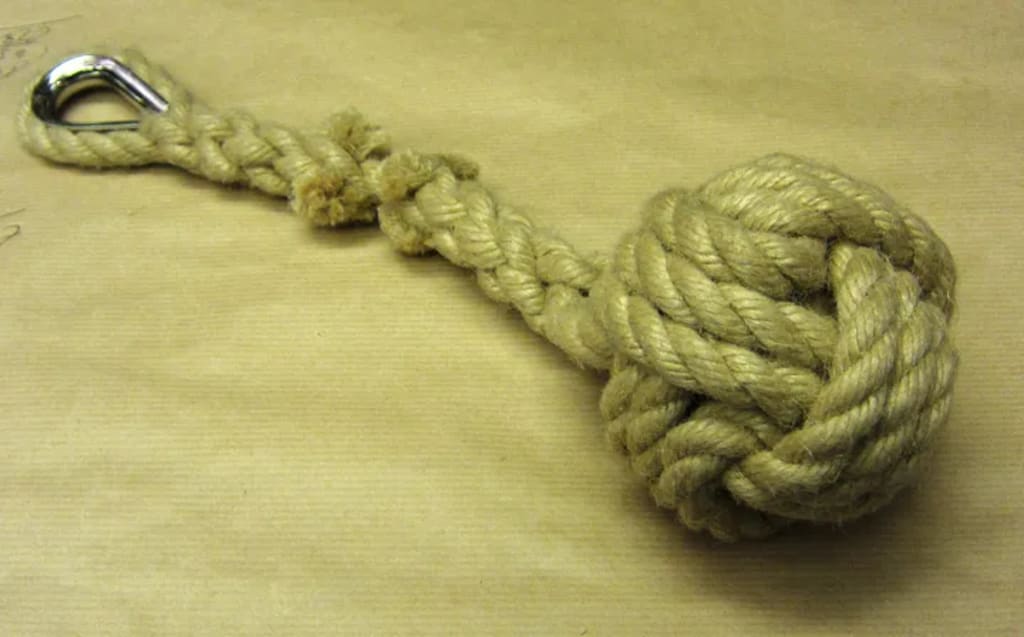
Depending on what country you live in, ‘Get knotted’ may be a way of telling someone that they are wrong, or worse to go away…so the Monkey’s Fist might come in handy. Sailors often put a bolt or other piece of metal inside to add weight, when used in a heaving line by deckhands and dockhands, thousands of times a day, worldwide. As we did…

I’m a sailor, I live on a boat and so knots are an everyday matter for me. I used to be able to tie the flying bowline but I’ve lost the knack now. However I can still tie a bowline in the dark behind my back when drunk — well, it does depend how many I’ve had — but you know what I mean.
Bowline, reef knot, clove hitch, round turn and two half hitches, rolling hitch — I use those and a few others every single day.
I know more too, including knots for fishing and a couple for fancy ropework, such as the Monkey’s Fist I mentioned. And my Ship Captain’s Medical Guide shows me how to tie a surgeon’s knot, although I haven’t needed to use one yet…
Math has always interested me up to postgrad level, and I recently came across the name of a mathematician who made knots a large part of his life’s work.
John Conway
John Conway was a mathematician known for his work on surreal numbers and the Conway group. He also created the Game of Life, a cellular automaton that can produce complex patterns and behaviors.
Conway’s most notable contribution to mathematics, however, may be his invention of the theory of knots. This theory allows mathematicians to classify all possible knots, which has led to new understandings of the geometry of three-dimensional space.
Conway was born in England in 1937. He attended the University of Cambridge, where he earned a degree in mathematics. After graduation, Conway began working on his doctoral dissertation, which was about number theory. He did not finish his dissertation, however, as he became interested in combinatorial game theory and decided to work on that instead.
Conway’s work on knots began in the early 1960s. At the time, there was no systematic way to classify knots. He devised a way to do this by creating a mathematical model of knots. This allowed him to prove that there are only a finite number of possible knot types.
How many types of knot are there?
On the surface, it might seem like there are an infinite number of knots. After all, there are countless ways to tie a knot (and that’s a contradiction). But Conway’s theory allows mathematicians to classify all knots into a finite number of types.
In fact, according to his theory, there are precisely 9,582 different types of knot.
Yes, I know a few of them, just about 9,575 left to learn.
So where are my books on knots?

Yes, I know. Types of knot is different from individual knots.
What does this mean for geometry?
The classification of knots has led to new understandings of the geometry of three-dimensional space. In particular, it has shown that certain geometric shapes (such as spheres and tori) cannot be knotted. This in turn has led to new questions about the nature of space and its geometry.
Conway’s work on knots has led to new insights into the geometry of three-dimensional space. It has also been used to study the behavior of DNA and other biological molecules.
Conway died in 2009, but his work on knots will continue to be studied by mathematicians for years to come.
And most sailors, climbers, speleologists (that’s cavers for the uninitiated), boy scouts, girl guides and bondage fetishists will still go on using knots without knowing about John Conway and the limit of 9,582.

Before I go…
I should perhaps mention the Gordian Knot, so complex that it was thought to be impossible to undo. Of course, if it can’t be undone then it’s not a knot.
Since then, ‘Gordian Knot’ has been used as a term describing an intractable problem.
Alexander the Great solved the problem. He cut through the knot with his sword, but somehow the story might have been a little better if the knot had been cut with Occam’s Razor. Never mind, we’ll talk about Occam's Razor on another day.
RIP
RIP John Conway and thanks for your insights into knots...
***

Canonical link: this story was first published in Medium on 24 March 2022
About the Creator
James Marinero
I live on a boat and write as I sail slowly around the world. Follow me for a story diet of Tech, AI, Geopolitics and more as the world is rapidly changing. I also write techno thrillers, with six to my name. More of my stories on Medium
Reader insights
Outstanding
Excellent work. Looking forward to reading more!
Top insight
Eye opening
Niche topic & fresh perspectives
Keep reading
More stories from James Marinero and writers in FYI and other communities.
A Planetary Alignment will coincide with Mercury Retrograde
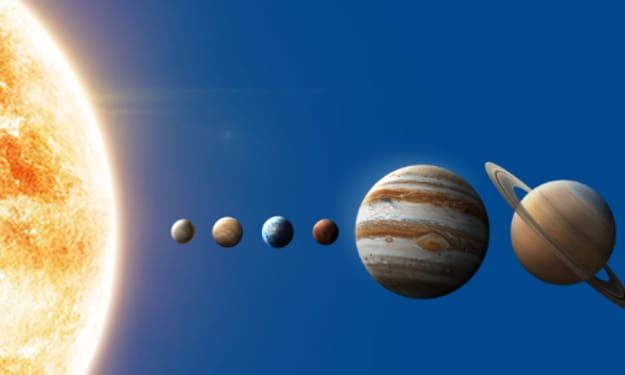
Double phenomena in the heavens Some people say in jest that the planets have aligned in their favor when life works the way they desire. Were you aware that there are seasons when things do line up in the heavens? There will be a planetary alignment AKA a planet parade, on February 28, 2026.
By Cheryl E Preston13 days ago in FYI
KAI KF-21 Boramae South Korea’s Advanced Fighter Jet Revealed
The unveiling of the KAI KF-21 Boramae marks a defining milestone in South Korea’s aerospace and defense evolution. Developed by Korea Aerospace Industries (KAI) the KF-21 represents the nation’s ambitious effort to strengthen its domestic defense capabilities while positioning itself as a competitive force in the global fighter aircraft market. As regional security dynamics continue to evolve the introduction of this advanced multirole fighter jet reflects technological maturity strategic independence, and long-term defense planning.
By Beckett Dowhan7 days ago in FYI
Guard Your Battery
Why are some people so attractive just by standing there? It’s not because they are "likable," but because they don’t need everyone to like them. I realized later that truly charismatic people allow themselves to be criticized, but they never criticize themselves. They never try to please the world; instead, the world stops to watch them.
By Emily Chan - Life and love sharing6 days ago in Poets



Comments
There are no comments for this story
Be the first to respond and start the conversation.