

The Georgian Era had one of the most beautiful “fashions” of any Era, but it was also a very ‘impractical’ fashion. For the rich, upper-classes, the materials were lavish and the colours were ‘rich’, but women could only (just about) sit down in these exquisite dresses. This Century was known for its “Opulence”, with elaborate wigs, rich embroidery and (very) full skirts. The rich showed off their wealth through their clothes, and this applied to men as much as it did to women. The working-classes wore similar clothes, but they were not so rich in colour or material, and they owned fewer clothes, wearing more ‘practical’ clothes for working in.
Luckily for us today, there are many examples of the 18th Century or Georgian fashions, the Victoria and Albert Museum holding one of the best collections in the world. Think of the drama “Bridgerton” or the film “The Duchess” and you will see some of the really exquisite examples of this fashion period.
The Georgian Era covers the period from 1714 to 1830, and it is extended to include William IV, who died in 1837. The Georgian “style” was influenced by Classicism, with light colours, embroidery and nearly translucent fabrics. Yards of ruffles and ropes of jewels were the epitome of beautification.

The “Mantua” dress was worn for formal occasions. It was an open-fronted silk or fine wool gown with a train and matching petticoat. The train itself was worn looped up over the hips to reveal the petticoat. The bodice had loose elbow-length sleeves finished with wide turned-back cuffs. A long petticoat and several under-petticoats were worn beneath the outer petticoat.
To get the required shape, a corset was worn under the bodice, made of linen and stiffened with whale bones inserted between parallel lines of stitching. They fastened by lacing down the back, which could be laced tightly to give an upright posture and to emphasise the waist. A ‘busk’ or strip of bone, wood or metal was sometimes put into the front of the stays.
The “Sack back” dress was worn over a hoop petticoat. This dress was made from five or six panels of silk pleated into two box pleats at the centre back of the neckband. It flowed down and was added into the fullness of the skirt. It was worn over a matching petticoat as well as a hoop petticoat. The “style anglaise” had a pleated back. The pleats were stitched flat from the back of the neck to the centre back waist.
The “hoop petticoat” was (usually) made of linen with split cane hoops stitched in at intervals and held the skirt of the petticoat and the robe out at the sides. They could measure over 1.5m across at their widest. These were worn on formal occasions, and may have been used to display the richly embroidered cloth of the skirt that showed how rich the lady was.

Both men and women of the upper-classes wore the most tremendous wigs, which were worn very high on the head and could have been of (almost) any ‘scene’, from farmyards to ships on the sea. These elaborate ‘hairstyles’ could be worn for days or even weeks at a time, remaining untouched and sometimes becoming home to vermin. Sometimes a small hat was worn on the top of these hairstyles, and sometimes feathers were worn.
For men, a ‘typical’ outfit was a full-skirted, knee-length coat, knee breeches, a vest or long waistcoat (which could be sleeved), a linen shirt with frills and linen underdrawers. The showing of the lower legs was an important part of the ‘silhouette’. These same men also wore silk stockings and leather shoes with heels.
English fashion closely followed French fashion, with France dominating the fashions of the day. However, these very rich fashions changed drastically after the French Revolution. For example, the exotic wigs were replaced with very short hair, which showed the neck. This style was called “Coiffure à la Victime” and copied the hairstyles of the gentry who went to the guillotine, and who had their hair cut short in order for the blade to sever the head easier. Simple and more modest clothes now became the fashion, with darker colours and more “plainer” materials.
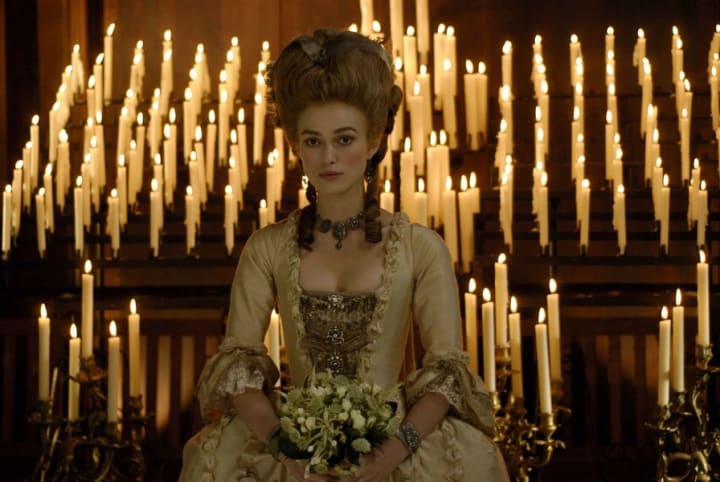
This is one of the most notorious fashions in English history, one which quickly changed according to the changed situation within France. Of course, I have only just touched on this, because the wealth of information fills hundreds of books on fashion. Again, if you would like to actually see these beautiful clothes in person, go to the Victoria and Albert Museum, or watch “The Duchess” or “Bridgerton”, or find one of the many books in the library. The pictures are exquisite. However, this fashion really does not look very ‘comfortable’ and certainly would never work in today’s world, but still very beautiful.
About the Creator
Ruth Elizabeth Stiff
I love all things Earthy and Self-Help
History is one of my favourite subjects and I love to write short fiction
Research is so interesting for me too
Keep reading
More stories from Ruth Elizabeth Stiff and writers in FYI and other communities.
The Original Gentleman Jack
The series “Gentleman Jack” is actually based on a true story. The drama is based in 1832 in West Yorkshire, England, (the cradle of the evolving Industrial Revolution). It is here that landowner Anne Lister is determined to save her ancestral home, Shibden Hall. Bucking against society’s expectations, “Gentleman Jack” refused to marry, dressed in black from head to toe and ‘charmed’ polite society. She was called “Gentleman” because she wore a top hat (as well as being in business), and”Jack” because — it was the Victorian nickname for lesbian.
By Ruth Elizabeth Stiff4 years ago in FYI
A Failed Artist, A Disillusioned Poet, An Underpaid Game Show Host
I took my son and niece to Gori, a small town in Georgia where Joseph Stalin was born. They talked me into visiting the Stalin's Museum, the largest in the post-Soviet space. I had resisted going there because I just can't stand the monster and know enough about him, or so I thought.
By Lana V Lynx9 days ago in FYI


Comments
There are no comments for this story
Be the first to respond and start the conversation.