
Eight of My Mum’s Favourite Idioms
(and where they came from)

I have always loved idioms. When I was working, I used them all the time to explain principles of policies to the employees I was training.
As long as I can remember, my mother would always have an idiom that she would use. I can see her now as she goes about her business.
“I’ve had this old knife for donkey’s years; I don’t remember where it came from,” she would say when I asked about it.
“You had better go and hit the sack; you have got school tomorrow.”
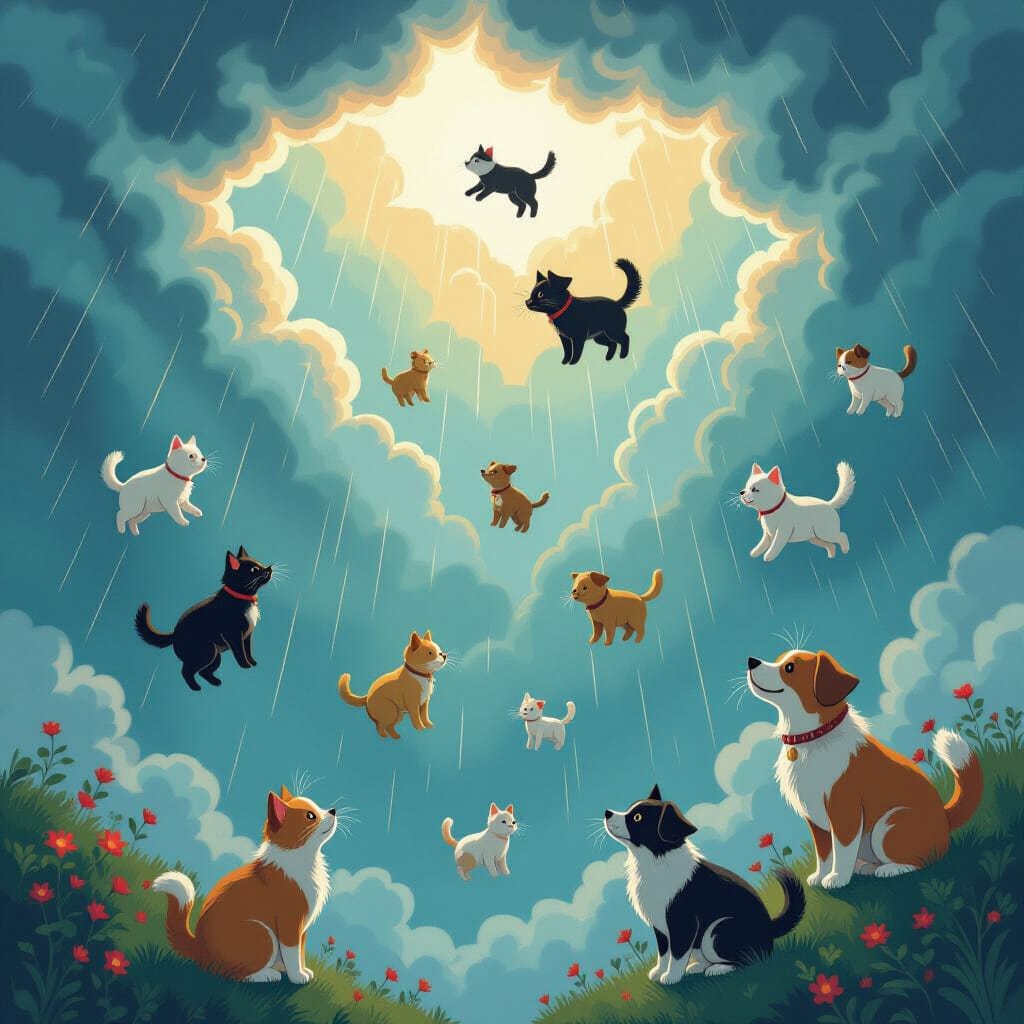
“Put on your raincoat; it’s raining cats and dogs out there."
Here are eight of my mum’s favourite idioms and explanations of how they may have come about. Why eight?
Why not? It's a nice-looking number. 😉😉
#1 "Bob's your uncle."
In 1887, British Prime Minister Robert Gascoyne-Cecil appointed his nephew, Arthur Balfour, as Chief Secretary for Ireland. This looked like nepotism. It suggested that Balfour's success came easily due to "Uncle Bob."
These days, it is used to indicate that something has been completed or resolved, often in a few simple steps. To show that something is finished quickly and easily.
"Just add the flour and eggs to the bowl. Mix it all together, and Bob's your uncle! You've got a batch of cookies!"
It is used in place of "and there you have it" or "it's done," and is typically said at the end of a set of instructions.
#2 "Donkey's years”
This started as a pun about a donkey's long ears. The original phrase was "donkey's ears" for a long time. The phrase became a favorite Cockney saying and fell into the typical rhyming slang. "Ears" is a rhyme for "years," supported by the idea that donkeys have a long lifespan.
It is used to signify a long period of time. For example, “If you're going to count all those leaves you have raked up, you will be here for donkey's years.”
#3 "over the moon"
The idiom "over the moon" likely comes from the nursery rhyme "Hey Diddle Diddle." This rhyme dates back to the 16th century. In this rhyme, a cow jumps over the moon. The phrase "over the moon" comes from the older idea of "jumping for joy." This saying has been around since at least the 1700s.
The phrase "leap over the moon" came from the 1718 London comedy, The Coquet: Or, The English Chevalier. Charles Molloy, an Irish playwright and journalist (1690-1767), opens his play with Ranger. Ranger, who serves Bellamy, the English Chevalier, and discovers his master in prison."
Tis he, ’tis he! I know him now: I shall jump over the Moon for Joy! Master, my dear master, have I found you!"
#4 "hit the sack"
Likely started in the early 1900s. Back then, mattresses were simple cloth sacks stuffed with straw or hay. The phrase literally meant to go to sleep on this sort of bed. Then, it turned into a casual way to say going to bed or sleeping.
In those days, there were no “Dreamtime” or “Dunlopillow” mattresses. "Hitting the sack" meant fluffing the straw to make the bed comfy before lying down.
The phrase has become a common, informal way to say "go to bed," and it is still used today to mean "go to sleep."
#5 "as happy as Larry”
This has a controversial origin. Some believe it started in late 19th-century Australia or New Zealand. The exact source is still debated. The most popular theory connects it to the undefeated Australian boxer, Larry Foley. He made a lot of money from his last fight, which secured his finances.
Accounts in a newspaper headline called the excited crowd "Happy as Larry" after his win.
Some theories link it to the slang "larrikin," which means a rowdy young man. Others think "larrie" might come from Irish or Scottish, meaning "joking."
This theory connects the phrase to a larrikin. He is happy due to his carefree lifestyle or being intoxicated.
#6 "under the weather"
“Under the weather” is thought to have originated from an old British maritime phrase. Sailors would go below deck when they felt seasick or unwell. This helped them escape the harsh weather. This literally put them "under the weather". Over time, the phrase evolved to mean anyone feeling unwell, not just sailors.
Many 19th-century cases of feeling under the weather aren't about bad health. It can also mean personal money issues, a political party's flaws, or a city's struggle to thrive.
#7 “piece of cake”
In the mid-nineteenth century, there was a popular dance called the “cakewalk”. It was mainly done by enslaved people. They mocked the fancy dances of white slave owners. The winner of the dance would be given a piece of cake as a prize, hence the term “piece of cake.”
“Piece of cake” is usually preceded by “a” to indicate that something is easy.
For example, "I finished my housework today; it was “a piece of cake” (OK, bad example, no housework is a piece of cake ). Another example, "I trained so hard; the race was a piece of cake."
#8 "raining cats and dogs"
Last but not least, is my favourite explanation. Most likely, this idiom came from references to heavy rains in 17th-century England. Heavy rains sometimes washed dead animals through the streets.
Jonathan Swift's 1710 poem, "A Description of a City Shower," paints a vivid picture. He describes "drowned puppies, stinking sprats, all covered in mud, and dead cats" swirling in the flood.
Other, less likely explanations are a twist on the Greek word for waterfall or a comparison to a cat and dog fight.
So there we have my Mum’s favourite right idioms.
Do you have a favourite idiom? I would love to hear it.
Till next time,
Calvin
About the Creator
Calvin London
I write fiction, non-fiction and poetry about all things weird and wonderful, past and present. Life is full of different things to spark your imagination. All you have to do is embrace it - join me on my journey.
Reader insights
Nice work
Very well written. Keep up the good work!
Top insights
Compelling and original writing
Creative use of language & vocab
Easy to read and follow
Well-structured & engaging content
Eye opening
Niche topic & fresh perspectives
Heartfelt and relatable
The story invoked strong personal emotions
Masterful proofreading
Zero grammar & spelling mistakes
On-point and relevant
Writing reflected the title & theme
Keep reading
More stories from Calvin London and writers in FYI and other communities.
A Failed Artist, A Disillusioned Poet, An Underpaid Game Show Host
I took my son and niece to Gori, a small town in Georgia where Joseph Stalin was born. They talked me into visiting the Stalin's Museum, the largest in the post-Soviet space. I had resisted going there because I just can't stand the monster and know enough about him, or so I thought.
By Lana V Lynx6 days ago in FYI
United States Glass Drinkware Market Size and Forecast 2025–2033
United States Glass Drinkware Market The United States Glass Drinkware Market is expected to reach US$ 7.99 billion by 2033, rising from US$ 3.7 billion in 2024, at a CAGR of 8.93% from 2025 to 2033. Growing consumer awareness of sustainability and reusable materials, the expansion of the hospitality and beverage industries, and the desire for high-end, fashionable glassware in both homes and foodservice settings are the main factors propelling the U.S. glass drinkware industry.
By jaiklin Fanandisha day ago in FYI
If You Love Me, You'll Do It
I met Jason when I was five years old. I could say that I loved him from the moment I saw him. He was so handsome to me and I felt in awe by his presence. When they introduced him as the new kid in school, I wanted to be his friend right away. I remember it like it was yesterday. I remember his smile and how he didn't seem shy. He appeared confident and ready to learn. I waved at him and said "hello," before anyone else could even say a word. He sat next to me, and I asked him if he wanted to be friends. He looked so happy as he said, "Yes!"
By Sidney Smith (Sid Smith)6 days ago in Fiction




Comments (4)
🐕The image you created was so adorable. - getting naughty with the number 8 I see. I can't say I didn't like it, I do ☺️ 🐕'And there you have it,' doesn't sound as cool as, Bobs your uncle. So I am glad they came up with this following the backstory. 🐕Donkeys years may be one I would like to use at some point. I just don't know when. - over the moon. I am very familiar with. But the backstory made it all the more charming. 🐕 Personal money issues, works well with 'under the weather' idiom. That helps broaden the mind a bit. - I could not agree more. No housework is a piece of cake. 🐕love the explanation for the last one. The rhythm got me in Jonathan swifts poem. This was so fun to read also learnt a lot. Awesome work, Calvin 🤗❤️🖤
“Mad as a hatter” is one that immediately came to mind. I don’t use it very often, but it’s a fun one. It never made much sense to me, and for years I just accepted it no questions asked. But when I was an au pair in England, the father of the family I worked for used it quite often, and I finally asked about the origin of the idiom. The explanation made me love it even more! "Spill the beans" is another good one!
Thanks for all these explanations, excellent piece
I say all those too lol and people laugh and smile at me. Love them lol where you been for holiday this year? Oh I went to Our Gate. I used to say to my mam where you been mam? lol there and back she would say. Where? There and back why mam? to see how far it is lol♦️🦋♦️