

The Power of Echolocation: How Anyone Can Learn to Navigate with Sound
Have you ever wondered what it would be like to have superpowers? Imagine being able to navigate any environment, even one you've never been in before, with just the power of sound. That's exactly what echolocation can do for you. Echolocation is the use of sound waves to navigate and perceive the environment around you. You might associate echolocation with animals like bats and dolphins, but did you know that humans can learn to echolocate too?
Meet Molly Burke, a blind YouTuber who has been using passive echolocation since she was seven-years-old. Molly was diagnosed with a rare genetic disease called retinitis pigmentosa when she was four-years-old. Slowly over time, she went blind, losing the majority of her vision when she was 14. Despite this, Molly navigates the world in a special way that blew Joe, her interviewer's mind. Joe immediately became fascinated with Molly's guide dog, Gallop, and how she uses passive echolocation to navigate the world around her.
Passive echolocation is the use of existing sounds in the environment to navigate. Molly learned how to pay attention to the sounds that exist already. She learned how to pick out any one sound and use it to navigate any environment. Molly's O&M (orientation and mobility) teacher trained her by blindfolding her and having her walk down the sidewalk while counting trees. Molly explains that the best way to understand it is by understanding the concept of "sound shadows."
Sound shadows refer to the lack of sound, which still makes noise. Most people don't notice every sound in their environment because their brain is constantly tuning out what's not important. But for Molly, she can use sound shadows to form a mental map of her surroundings. Molly's echolocation abilities are so astute that scientists have found that blind people are almost always better at echolocating than sighted people.
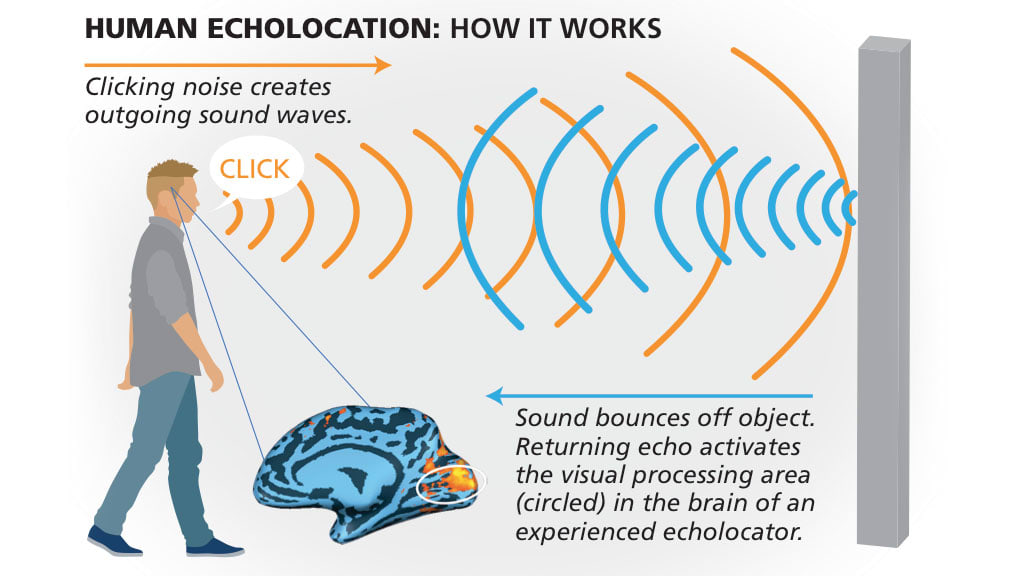
Joe surprised Molly with a guest, Brian Bushway, a master echolocator who works with a nonprofit called Visioneers. Brian uses active echolocation, the same way that animals like bats and dolphins do. Active echolocation is the use of sound waves that you create, and then read the echoes that come back to you. Brian explained that anyone who can hear can learn how to do this.
Active echolocation can be taught at a more enhanced level than passive echolocation. The brain can construct an image based on patterns of sound just like it constructs an image based on patterns of light. The idea that the brain is fixed and can't be changed past a certain age is an old idea. In reality, the brain is a lot more flexible and adaptable than we thought. Scientists call this ability to adapt and rewire "neuroplasticity."
If you're already able to passively detect trees while walking down the sidewalk, that means your hearing is super astute. Learning active echolocation will bring more clarity to your image. Brian teaches active echolocation with a click, which sounds different from a tongue click. With some practice, anyone can learn to echolocate and navigate their environment with sound.
In conclusion, echolocation is a powerful tool that anyone can learn to use. Molly Burke and Brian Bushway have shown us that echolocation isn't just for animals like bats and dolphins. Humans can learn to echolocate too, and it's a skill that can be taught and developed. With the help of echolocation, blind individuals can navigate the world with ease. But even sighted individuals can benefit from learning how to echolocate. Echolocation is a skill that can enhance your senses and help you navigate your environment in a whole new way.
About the Creator
Keep reading
More stories from Tsar Banks and writers in FYI and other communities.
The Origin and Evolution of the Seven-Day Week
The Origin and Evolution of the Seven-Day Week Have you ever wondered why the week is divided into seven days? While most of our calendar units come from natural astronomical cycles, there's no natural or astronomical cycle that measures seven days. Despite that, almost every culture on Earth today divides its calendar this way. So, where does the seven-day week come from, and why is it a fundamental division of time?
By Tsar Banks3 years ago in FYI
A Planetary Alignment will coincide with Mercury Retrograde
Double phenomena in the heavens Some people say in jest that the planets have aligned in their favor when life works the way they desire. Were you aware that there are seasons when things do line up in the heavens? There will be a planetary alignment AKA a planet parade, on February 28, 2026.
By Cheryl E Preston11 days ago in FYI



Comments
There are no comments for this story
Be the first to respond and start the conversation.