
Did 'Divine Aid' Kill All the Hoppers Near Jefferson, SD?
On the Trail of the Grasshopper Crosses.


The first seven years of the 1870s decade were darned good ones . . . if you happened to be a grasshopper in the Dakotas.
Not so much if you were a human living in and around places like Elk Point, Richland, McCook, and Adelscat -- which eventually became Jefferson -- or anywhere else in what is now eastern South Dakota.
Perhaps the settlers should have known that grasshoppers were going to be a pain in their sod-busting rears. But then, how could they? For nature has always played some untimely and cruel jokes on humanity in the form of natural disasters. This seemed especially true if you lived on the Great Plains or the middle and tallgrass prairies of the United States at that time.
The Sioux Uprising had occurred in 1862 which led to the abandonment of towns like Sioux Falls, Elk Point, and settlements up and down the valleys of the Missouri, Big Sioux, and James Rivers. The U.S. Army had kept citizens out of the area until 1865.
And that was the summer the grasshoppers first came wiping out the crops in the region.
In 1874 the grasshoppers returned.
Untold acres of crops, and even towns, were destroyed by the insects in the course of a few years. The U.S. Entomological Commission estimated damage from the 1874-1877 grasshopper plagues cost American farmers west of the Mississippi $200 million in damages – about $116 billion in today’s terms. In 1874 an invading cloud of grasshoppers wiped out crops in the community of Kampeska City, thus ending the existence of that settlement, the predecessor to Watertown in Codington County, SD.
These invading clouds of grasshoppers filled the air with white glistening particles making people think it looked like it was snowing. They struck the ground turning into a brown dirty mass causing people to slip on the crushed grasshoppers when they tried to walk. People took shelter inside their homes. It is said you could hear the insects thudding into the sides and roofs and that it sounded like hail.
Grasshoppers ate the leaves of vegetables, tormented farm animals, even gnawed away soft wood handles of hand tools. They laid their eggs in the fields, hatching the next year to destroy new crops, and fly away to another dinner site.
In May 1876 the people in eastern Dakota Territory were again immersed in a battle with the grasshoppers. The Federal Writers Project of the Works Project Administration, The South Dakota Guide (1938) said, "farmers, frenzied with grief from the devastation of the grasshopper plague, decided to ask for Divine Aid." Father Pierre Boucher, the pastor of Jefferson's St. Peter's Catholic Church then announced at mass that a pilgrimage was to take place.
Protestants and Catholics alike came to the church the next morning -- many of them barefoot.
Led by the priest bearing a cross, a procession formed two miles south of Jefferson and then proceeded north six miles. Next, the party marched from east to west in the form of a cross.

At each of the four points, they placed a simple cross and recited prayers. By the time the group placed a larger cross in the church cemetery at Jefferson the pilgrimage had lasted nearly the entire day.
Not long after the event great heaps of dead grasshoppers were found along the Big Sioux and Missouri Rivers." (Works Project Administration, 1938, p. 332) Though the grasshoppers came again in later years to the region, apparently the area within the crosses was never touched by the insects.
Do you believe in miracles? The farmers around Jefferson, SD did and still do.
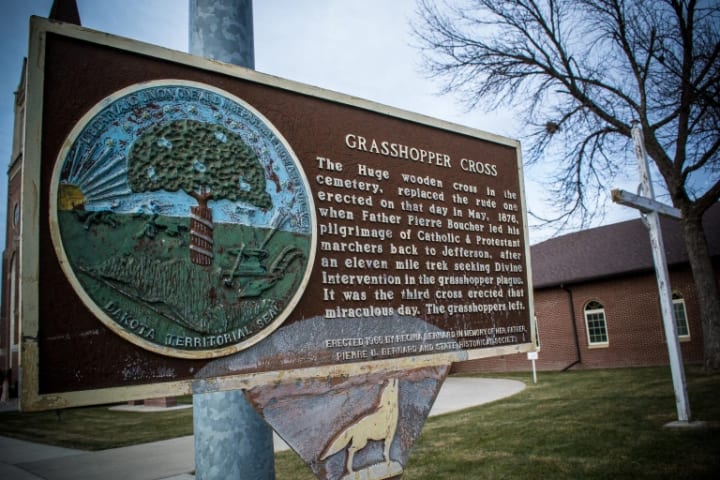
Today the largest of the crosses can be found adjacent to St. Peter's Catholic Church in Jefferson, SD. Two others are located at their original sites: two miles west of Jefferson at the Chicoine farmstead near the corner of 330th St. and 480th Ave. and four miles north of town on County Road 1B near the Southeast Farmers Coop Elevator. State historical markers are located near each cross.
About the Creator
Gary Dickson
I'm a retired mental health counselor, newspaper editor, and photojournalist. I write stories about Great Plains living, recovery, odd observations, and conversations with my cat, Willie. My wife often tells me I'm an amusement to myself.
Keep reading
More stories from Gary Dickson and writers in FYI and other communities.
Ask Not For Whom The Therapist Knocks. (He knocks for thee.)
It was late on an August afternoon in Sioux City, Iowa -- a city that's not as bad as it smells. The late summer temps had been flirting with the century mark that week and the humidity made it feel like a YMCA steam room. Of course, the cicadas enjoyed the weather. They'd crawled out of the ground sometime during the last week. Most of us hoped the smell from the few remaining packing plants and rendering operations would choke the little bastards before school started next week. No such luck, though. The meaty, winged insects were cheerfully whirring away in a rising and falling buzz. A local TV news reporter said last night that it's the males of the species that make the most noise. She said they make their wings vibrate loudly in order to attract females.
By Gary Dickson4 years ago in Journal
A Failed Artist, A Disillusioned Poet, An Underpaid Game Show Host
I took my son and niece to Gori, a small town in Georgia where Joseph Stalin was born. They talked me into visiting the Stalin's Museum, the largest in the post-Soviet space. I had resisted going there because I just can't stand the monster and know enough about him, or so I thought.
By Lana V Lynx20 days ago in FYI
Eco-Friendly Beach Travel: 7 Tips for Responsible Tourism
Beach destinations have a way of drawing us in. The sound of waves, the warmth of sand underfoot, and the open horizon create a sense of ease that many of us seek when planning a getaway. Yet beaches are also among the most fragile environments on the planet. Coastal ecosystems support marine life, protect inland communities, and sustain local livelihoods, but they are increasingly under pressure from careless tourism practices. Eco-friendly beach travel is not about giving up comfort or joy; it is about traveling with awareness and respect so these places remain vibrant for generations to come.
By Anna Paquin3 days ago in FYI




Comments
There are no comments for this story
Be the first to respond and start the conversation.