
Colocation vs. Data Center: What’s the Difference and Why It Matters?
The terms colocation and data center are often used interchangeably — but they represent two distinct approaches to managing IT infrastructure

As businesses face increasing demands for secure, scalable, and reliable infrastructure, the terms colocation and data center are often used interchangeably — but they represent two distinct approaches to managing IT infrastructure. Choosing between colocation and running your own data center can have a significant impact on costs, security, scalability, and overall performance.
MedOne, Israel’s leading colocation provider, offers state-of-the-art infrastructure and interconnection solutions, making it a preferred partner for businesses seeking secure and scalable IT environments. This article explores the key differences between colocation and data centers, the advantages of each, and why colocation with MedOne is often the smarter choice for modern enterprises.
What is a Data Center?
A data center is a physical facility designed to house IT infrastructure, including servers, networking equipment, and storage systems. Data centers are equipped with power, cooling, security, and connectivity solutions to ensure continuous operation and protect against outages or physical threats.
Data centers can be:
- On-Premises Data Centers – Owned and operated directly by an organization within its own facility.
- hird-Party Data Centers – Facilities operated by specialized providers that lease space and infrastructure to businesses.
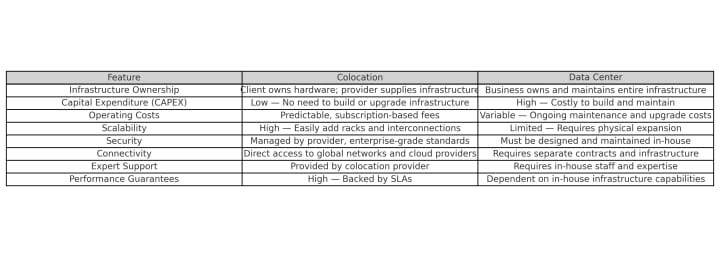
An on-premises data center gives businesses complete control over their infrastructure, but it comes with significant capital expenses (CAPEX) and ongoing operational costs. The organization is responsible for maintaining and upgrading hardware, securing the facility, and ensuring connectivity and redundancy.
Challenges of Operating a Data Center
Running a private data center comes with considerable challenges:
- High Costs – Building and maintaining a data center requires significant capital investment.
- Scalability Limits – Expanding infrastructure often requires physical upgrades and additional space.
- Security Risks – On-premises security can be difficult to maintain at the highest levels without significant investment.
- Maintenance and Downtime– Managing power, cooling, and infrastructure redundancies requires specialized expertise.
- Connectivity Issues– Ensuring low-latency connections to global networks and cloud providers is complex and costly.
What is Colocation?
Colocation is the practice of leasing space in a third-party data center to host an organization’s hardware and IT infrastructure. In a colocation arrangement, the provider (such as MedOne) supplies the physical infrastructure — including power, cooling, security, and network connectivity — while the client retains ownership and control over the hardware and software.
In other words, colocation allows businesses to outsource the physical and environmental management of their IT infrastructure while maintaining control over the hardware and data.
How Colocation Works
In a colocation environment:
- The client installs its own servers and equipment in a leased rack or cage within the data center.
- The colocation provider ensures power, cooling, and security.
- The client retains full control over the configuration, maintenance, and software running on the hardware.
- The provider offers interconnection options with carriers, cloud providers, and other partners to enable fast and secure data transfer.
Advantages of Colocation
1. Lower Costs
Colocation eliminates the need for capital investment in building and maintaining data center infrastructure. Businesses benefit from economies of scale, paying only for the space and power they use.
2. Scalability
Colocation allows businesses to scale their infrastructure quickly by leasing additional rack space or upgrading connectivity. MedOne’s facilities are designed to accommodate future growth without the need for costly construction.
3. Connectivity and Performance
Leading colocation providers like MedOne offer direct access to submarine cable landing stations, internet exchanges, and cloud providers (AWS, Azure, Google Cloud). This ensures low-latency communication and high-speed data transfer.
4. Security and Compliance
Colocation providers operate under strict physical and cyber security protocols. MedOne’s underground data centers feature biometric access controls, armed security, and 24/7 monitoring, ensuring enterprise-grade protection.
5. Redundancy and Reliability
Colocation providers build redundancy into their infrastructure, including N+1 configurations for power and cooling, backup generators, and failover systems to prevent downtime. MedOne offers a 99.999% uptime guarantee.
6. Access to Expert Support
Colocation providers offer on-site technical support and remote hands services, reducing the burden on in-house IT teams.
Why Colocation with MedOne is the Smarter Choice
MedOne stands out in the Israeli colocation market due to its:
1. Strategic Underground Infrastructure
MedOne’s data centers are located underground in secure, earthquake-resistant facilities. This ensures physical protection from environmental hazards and geopolitical threats.
2. Direct Cloud and Network Access
MedOne provides direct interconnection to leading cloud providers (AWS, Azure, Google Cloud) and global networks through submarine cable landing stations. This reduces latency and improves data transfer speeds.
3. High Performance and Redundancy
MedOne’s Tier III+ and Tier IV facilities feature N+1 redundancy for power and cooling, ensuring consistent performance even during maintenance or hardware failures.
4. Security and Compliance
MedOne meets the highest international standards for data security and compliance, including ISO 27001, GDPR, and HIPAA. Physical security includes biometric controls, 24/7 surveillance, and armed guards.
5. Financial Backing and Stability
MedOne is backed by leading investors, including Avraham Livnat Ltd, Taavura, Berkshire Partners, and van Rooyen Group. This ensures long-term financial stability and the ability to invest in future growth.
When to Choose Colocation Over a Data Center
- Rapid growth – When scaling quickly, colocation provides a flexible and cost-efficient solution.
- High-security requirements – Colocation providers like MedOne offer enterprise-grade physical and cyber security.
- Hybrid and multi-cloud strategies – Direct interconnection to cloud providers makes colocation ideal for hybrid setups.
- Cost reduction– Colocation reduces capital expenses and provides predictable operating costs.
- Focus on core business– Outsourcing infrastructure management allows businesses to focus on strategic goals.
Conclusion
While operating a private data center gives businesses complete control, it comes with significant costs and complexity. Colocation with a trusted provider like MedOne offers the best of both worlds — control over your hardware and data, combined with the security, connectivity, and scalability of a professionally managed data center.
About the Creator
Ai and Cloud
I am a tech writer specializing in AI and cloud computing, with a passion for exploring how cutting-edge technology transforms industries.
Keep reading
More stories from Ai and Cloud and writers in FYI and other communities.
Data Protection Is Critical in the Multi-Cloud Era
The rise of multi-cloud architectures has transformed enterprise IT, enabling organizations to distribute workloads across multiple cloud platforms for greater flexibility, cost optimization, and resilience. However, this shift also introduces complex data protection challenges, as businesses must secure sensitive information across disparate environments, each with its own security model, compliance requirements, and risks.
By Ai and Cloud 11 months ago in FYI
A Failed Artist, A Disillusioned Poet, An Underpaid Game Show Host
I took my son and niece to Gori, a small town in Georgia where Joseph Stalin was born. They talked me into visiting the Stalin's Museum, the largest in the post-Soviet space. I had resisted going there because I just can't stand the monster and know enough about him, or so I thought.
By Lana V Lynx24 days ago in FYI
The Quiet Giant Behind CelcomDigi: Why Telenor’s Next Move Matters More Than You Think
So, Telenor. The name sounds like a mid-tier Viking metal band, but it’s actually a giant telecom player that quietly sits behind a lot of the phone calls, data, and connectivity people use every single day.
By Anie the Candid Writer Abroad3 days ago in FYI



Comments (1)
It’s good to know’n