
A theory on Working Memory
Adaptive circuitry of the not so epiphenomenal minds eye:


I have a theory about how the working memory truly works in the brain. I've been talking about it recently. I'm trying to write and rewrite my articles until I have a nice copy of the information that I feel adequately tackles the subject. This is just conjecture of mine so just take it as food for thought, but I have a good feeling it's pretty close to the answer. It's quite possible that they don't answer this question in courses on the brain because they assume it's common sense somehow, but I think it's worth noting regardless because there is a lot of information on the brain that makes use of abstractions such as the concept of the working memory, or the visuospatial sketchpad or the phonological loop to describe various phenomena in a way that's very removed from what I assume is the actual cause, but it's because it still works in such a way that it can describe many complex phenomena.
I will start by assuming the brain does not contain a neural correlate to a tape recorder. That is: it does not have a method for instantaneously taking auditory information and storing a neural correlate to that information that can then be manipulated or retriggered as necessary like it comes with a play button that can repeatedly be used to play back a copy of that relevant stimulus to keep track of that information because the only way to retrigger the relevant information extracted from sonic stimulus in recent memory is to use what I will refer to as method of actuation of our central nervous system such as the mouth to reverberate the information back to the brain and then back to the mouth because that is motor sensory information that points to the relevant information in the brain due to placement of the white matter which acts as an intermediary step between disparate regions of the brain thereby allowing the brain to activate portions of itself that would not otherwise have any meaningful connection because the white matter needs to remain like a hub and somewhat paradoxically it cannot be used like a routing matrix that directly connects circuits in one partition to circuits in another partition in such a way that the convergence of stimulus that causes the combined behavior of the circuits which forms a responsive mechanism for a particular collection of stimulus is available to be triggered again later by repetition of that stimulus in a way that specifically connects the one circuit in one partition to the other so that both produce a combined output due to the fact that they're wired together since it formed in direct response to that stimulus because if the brain worked on that mechanism alone it would lose its adaptive feature that allows the strength of the signal in one region to modulate that aspect of behavior proportional to the strength of the signal, and feedback within a circuit as well as other circuits which act as silencing or amplifyin0g mechanisms or other modulating mechanisms I suppose, and in the same way modulation from circuit activation and shape and proximity all interplay to create dynamic outputs from very few initial circuits, such is the case of English phonemes which are fairly limited and can be used to produce all the words in the English language because the modulating mechanisms that get us from one sound to another can function, for example within the expression of a word by the mouth, in a way that does not require repetitions of the phonetic constituent, or sub-circuits that correspond to subunits of the overall behavioral output, every time an instance of those sub-circuits appears so that the production of that word by the mouth can be reproduced, but instead can exist as a collection of randomly accessible circuits for each phoneme as they are needed since those have corresponding pointers in the written version of the language, or through some other stored mechanism and when our brains firing converges onto those other representations of the word in question the communication resounding back through the bodies CNS produces feedback which has already been paired naturally with the word or linguistic unit in question and that allows a word to be used to point in each of its syllabic units to the circuits that correspond to the correct shapes of the mouth in a way where the word has a pointer to each phonetic unit and when we reproduce the sounds that are associated with that word we do so using interpolation mechanisms between mouth shapes caused by what I assume are the dampening and amplification of circuits associated with the necessary output to produce the words themselves rather than taking the same circuit that produces the sound 't' and placing it everywhere that we encounter the letter 't,' which wouldn't even really matter because the only place that it's relevantly placed is where it can communicate with the mouth in such a way that it produces the correct muscular contractions to create the sound itself. Potentially anyway. This is my own conjecture about the subject, but I'm fairly certain it's true, because the brain would have a massive amount of redundancy that pertains to the repeating of the same mouth shapes, but all within specific contexts, which sounds unnecessary, and is possibly not even possible given the large variety of things we're able to do with language. So despite what at first thought might sound like epiphenomenalism to you it is actually the case that when we perceive stimulus we are interacting with it and the entire brain can develop in ways that correspond to that stimulus in terms of its interaction with the CNS which produces more feedback and this creates a circumstance where it's almost meaningless to suggest that perception is epiphenomenal, because it is very closely tied to behavioral and sensory outputs because we have so many dynamic behaviors where the combined image from resonance across disparate regions matters due to how it creates unique combinations of behaviors in the body which are in a feedback loop with the mind. It's just awesome I can't help but be repetitive here. This must be the answer :)
It does have to be the case however, that the brain needs to act like a routing matrix such that the sum of the triggering of the disparate circuits in different configurations can produce new outputs on demand that may otherwise have never been produced, because most of the way the brain and body interact with the environment are dynamic and require subtle adaptations in behavior that are specific to the current stimulus. I'll point to a familiar learning experience I had at the age of 10 or so learning to ride a bike. At first when we are learning we inevitably fall and that fall is associated with an imbalance in our inner ears. That imbalance encountered before falling does not necessarily need to be stored as a long term memory of pain in association with the bike and the fall in a way that's context specific necessarily, and furthermore, instead of being the result of a memory it could simply be a circuit that causes unpleasant CNS output in response to any form of spatial imbalance that is either naturally there as a structure from the onset or is there from much earlier memories of falling and triggers anytime anything happens that even approaches a fall, and our first falls on our bikes are simply a strengthening of that negative associative circuit that simply warms up and produce unpleasant feedback through the body extremely quickly and along with the resultant muscle contractions produced as well possibly from that circuit or some other circuits output depending on what the features of the connections and positions of those connections needs to be, which are probably the result of a dynamic simple input output response mechanism of a structure in the brain that sends signals to neuromuscular junctions all over the body in proportion to the signals coming into the brain through the white matter from those different portions so that instead of creating specific sequential like circuitry that while able to respond to a very broad spectrum of inputs in a specific fashion that maps one specific collection of stimulus to a particular output, which would not work well, because being able to right ourselves in response to motor sensory information is a process that has too many degrees of freedom to fail through since the vectors that determine our kinematics in space are all effectively on a continuum of values and somehow we need to deal with these very unique combinations in space in a way that works so well that we can perform feats of gymnastic or aerobatic proportion or even just so that we can watch a ball approaching us at a never previously encountered velocity and know how to approach the ball with our hand in the air and catch it all the while making adjustments in our stance and breathing autonomically and noting the temperature outside or the colors of flowers in the environment or whatever other stimulus is there that might also be confused as relevant but that we know in this new context is not because it is the strength of the signals in the relevant regions that produces the focus of our behavior and to interpolate into a new behavior would require the silencing of the current circuits enough to subdue their outputs and a strengthening of other circuits enough to transition and then create their output. So, we have what is probably a one size fits all mechanism for at least many many circumstances that uses the strength of the signal in a region to proportionally illicit neuromuscular contractions in the relevant map to the body like an adaptive circuit that can deal with the naturally turbulent nature of the environment in a way that deals with amplitudes and feedback to produce the correct outputs in many circumstances and as a collection of those amplified or dampened outputs or modulations or transitions from those circuit behaviors in such a way that can be done just a dynamically as it appears, and with far less redundancy than a machine that needs to create internal process specific copies of circuits that could simply be retriggered as necessary and proportionally so at that.
Language can work the same way. Imagine that as a circuit associated with a collection of related words warms up it causes output to other other areas of the brain and body and these areas being stimulated in turn produce their own outputs and each word used to communicate meaning is approached through convergence caused by relevant circuit signal amplification and/or dampening which is then communicated to the mouth thereby allowing us to return that same words signature back to the brain until a new word, phrase, clause, or encapsulation is elicited that matches the criteria necessary to create a meaningful response to what has previously been spoken. The language produced converges itself onto an object that we understand as meaningful and in a way that often matches the initial intention of communication. We have internalized syntax and the syntax corresponds to modulating transitionary behaviors like placing a conjunction somewhere to act as a transition from one word to another that operates on the surrounding words, phrases, or caules' or more physically like placing the tongue turned slightly up such that it performs a reed like function in a rolled 'r' or purr but as motion from some prior behavior which could be anything from simply empty space/pause or another phonetic unit, or perhaps just because of the simplicity of the word cow we could imagine changing the shape of the mouth from the transient 'k' sound at the beginning of 'cow' to the 'a' sound to the ''o'' and then finally the 'w' which are all a matter of modulating from one shape of the mouth to another because they're apart of the same word and if the subunits of the behaviors are all placed in sequential order in a way that's meaningful in terms of temporal proximity then they need to have interpolating mechanisms because they follow in an order every time and the word is constituted of subunit behaviors that are phonemes, and the simplest mode of that action that I can think of is signal dampening and amplification, and this interpolation process from one signature and region in the brain to another signature and/or region in the brain is necessary for placing any linguistic object really. An object of language satisfies a function of language and the previous linguistic units simply converge onto that next linguistic unit, as a result of actuating in some way the meaning or representations of the meaning or pointers to the meaning of the previous linguistic units which then produce additional convergence, because stimulus in general produces some form of convergence if it doesn't simply just silence without doing so. If those are the options and meaning is how we approach the subject of language then it is natural that simply engaging in its usage itself produces meaningful constructions, such as what I've created in this article by way of discussing the concept of working memory with myself, and having the prior exposure to relevant information from self study as well as traditional schooling. This may bring the question to your mind as to how we can do something like completing a new sentence which acts itself as a clause that has the meaning we wished to convey initially and that we have never conveyed before both of which we can be aware of even without having formulated a linguistic correlate yet and the way we can go from having a notion of what we wish to express that is meaningful to us in terms of some imagery is that we have THAT associated imagery in our brains in areas that do not just pertain just to language, so we can know what the meaning of some piece of information is without having a linguistic correlate to that object in mind. This is very much necessary as a phenomenon for people that produce any form of literature. The simplest example I can think of would be a circle. The visual imagery is also meaningful to you. We need to be able to start with things that are not yet linguistic to us and then formulate the language with which to speak about those things. Sometimes its a fictional story, and sometimes it's a physical phenomenon that we simply understand through imagery other than words, or maybe in multiple ways, but still including language, for example: when I think about rotation in a plane I imagine clockwise and counterclockwise motion of two disks both red and blue on a beige background or plane, that reminds me that rotation in a plane is of binary arity and anticorrelated, which is obvious, and doesn't really require the visual, but I happen to have one, and it's just a different way of reminding myself of many other things and it does remind me of other things. It also points to Einstein's discovery of Brownian motion, and my own prediction of Brownian motion using a 6-dimensional phase space, which in general relativity is a 4-dimensional vector space, but I'm pretty it's just the same between me an Einstein, but I will have to admit I'm almost definitely not as smart as him I just knew the axioms would produce the same results and predictions provided I came to accurate predictions. It's a store of information about the strong and weak nuclear force for me which are not really forces and it is because I know what the true nature of those things are that I can easily remember the connection between those ''forces'' and the arity of rotation in a plane, and it's also a store of information about Boltzmann's constant and the phase space of a neutron star or the theoretical phase space of a newly formed hydrogen star (I have a reason for saying specifically hydrogen you just have to think about it), and it made sense of what is believed in popular science to be dark matter or dark energy and I have my own explanation as result of this association, but anyway that's just another opinion of mine if you care to hear it some time I'll try to write an article once I've studied enough to know whether or not my proposal is adequate or not.
So how do we manage to accomplish tasks such as new sentence formation that acts as something new and meaningful from proximal stimulus and allows us to communicate a response effectively in such a way that other people can understand what we're saying even though neither us nor them have encountered that stimulus before? The phonological loop I would suggest is a loop but is not an auditory loop like most would assume, but a motor sensory loop that causes the mouth to weakly or strongly perform the muscle contractions repeatedly that are associated with the information ''being held'' in working memory. This repeated stimulus loop would also produce meaningful convergence in other portions of the brain simultaneously through the white matter depending on what the stimulus associations are as a result of interacting with that same or very similar information in differing contexts which builds up meaningful circuits that can be initiated again in response to the subunits of linguistic information or language relevant information which as correlates themselves make connections to adjacent areas in the brain and communication with the mouth to act as a method to retrigger the motor sensory analogue to that stimulus being held in working memory. So it is my theory that to manipulate or temporarily hold information in working memory your brain talks to your body in a feedback loop that elicits a correlate that your body and mind has created through some form of mimicry of that initial stimulus so that you can pass the same stimulus to other regions of the brain as necessary through the white matter, because our CNS connects partitions of the brain and the circuits formed from dynamic interactions with the environment and as a result of the triggering of those regions that are disparately positioned and cannot always talk directly using neurons as paths between those partitions. It's also worth noting that it is a way in which the apparent epiphenomenal aspect of the brain that are what I'll somewhat inadequately describe as n-dimensional stereographic images of the combinations of resonance in disconnected regions or partitions is almost stripped completely of its meaningfulness as epiphenomenal because the dynamic interactions formed between the brain, body, white matter, and back to various regions of the brain in a feedback loop of stimulus and motor-sensory actuation and physiological actuation shape the circuitry developed in those disconnected regions such that the overall shape corresponds to convergence onto adaptive circuitry that appears to be so organized that it suggests the perception itself is meaningful even as a combined image of the disparate resonances of these partitions because the feedback with the body and environment shapes the circuits in such a way that it corresponds with that combined image that is our view of reality in a way that suggests perception itself is not epiphenomenal at all, because our view of reality is so intricately connected with our response to it due to this mode of functioning and development of its circuitry that it feels as though they're one in the same, and that our perception directly shapes our interaction with the environment as though it is 1:1 physical. It's just not even relevant to suggest it isn't actually effecting it in my mind, because it almost impossible to see it as not being the direct result of it, since our perception has physical behavioral associated correlates. We respond because of that combined image even though the portions of the brain responsible for the response are not in direct communication. This means all the circuits formed modulate one another due to the relevant resultant interactions because they produce outputs and the white matter allows subsequent feedback to coincide in some form of proximity. The circuits while in different places interact back through the bodies feedback systems and that's how they form their simplistic yet highly dynamic functionality. They act in balance with one another and respond through the body and white matter and this is where something such as the phonological loop probably resides. The working memory I assume is a common misconception. We don't store correlates to the data in our brains unless it's in long term memory. We physical grasp units of information either as pointers to more complex units of information to manage such as words or other abstractions, and we handle these ideas by causing repetition of the relevant pointers in areas of the body. Sometimes we might even imagine repeating a motion over and over again without actually yet doing it as to prepare for when the stimulus in our environment changes such that we should finally make that adjustment and engage in the motion we can feel weakly communicated to our body and visuospatial map of the environment. Your working memory might also have you tapping or fidgeting to keep something available to you in a way that is simpler than a unit of language or a shape of the mouth. You might saccade your eyes across various objects in the room to remind yourself of previous pieces of information in case they're needed at the moment. Language is so malleable. This means that random access can be exploited quite well because there are so many options for creating the same meaning in terms of the way you permute the words that describe the thing you wish to communicate. We also have convergence to nearby concepts due to the all familiar synonym. English has many synonyms. These two properties in English at least and probably all languages as long allow us to map data to physiological feedback or micro-behaviors or linguistic points or objects in the environment simply by placing something like a saccade on a loop as to naturally cause the relevant convergence several times per minute for example if you need to remind yourself of it often enough for that to be necessary. Don't be fooled by the suggestion that working memory is a limit on your intelligence. We all probably have similar capabilities in that regard. You just need to come up with more methods to take advantage of what your mind and body can do to help you manipulate data. My biggest advantage for example is that I type, and I make sounds with my mouth. Imitation is one much of my family loves, especially my Mom. Try communicating with your hands in a way that's visuospatial. It's helpful. There are many things to take advantage of. I'm not sure what's simply available to do in the mind alone, but I have a feeling that it is pretty much inherent that we communicate with our body to produce feats of working memory, and knowing that is a lot of power at your disposal. When you form long term memories you are also taking some of the pressure off of your working memory, and if you work well with modularity and encapsulating meaning through abstractions then you can build machines of working memory feats that allow you to do things you never knew were in you.
I'll leave you with a final task about the epiphenomenal nature of the mind: close one eye and note what you see. Now close the other eye. What did you see? Were both images apparent to you? They probably were. You've just determined something about your perception can effect your behavior, because the way you answer is determined by what you perceive.
About the Creator
Keep reading
More stories from Nicholas Powers and writers in FYI and other communities.
Rainbow from the dark
First lets start off by pointing out something peculiar about rainbows. They occur in prisms, and on a rainy day under the right conditions, and in the spray of sprinkler, and they appear to move like fixtures suspended in the air moving with your perspective. Very strange indeed....
By Nicholas Powers5 years ago in FYI
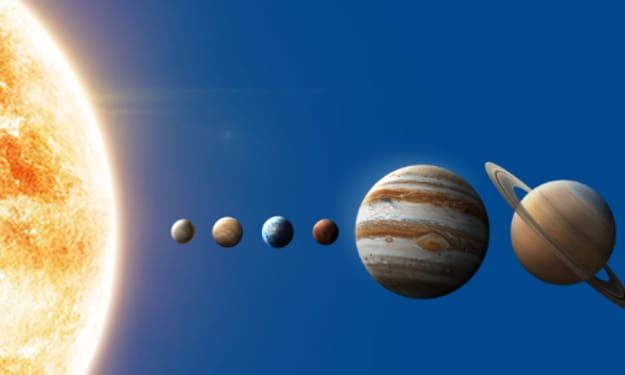
A Planetary Alignment will coincide with Mercury Retrograde
Double phenomena in the heavens Some people say in jest that the planets have aligned in their favor when life works the way they desire. Were you aware that there are seasons when things do line up in the heavens? There will be a planetary alignment AKA a planet parade, on February 28, 2026.
By Cheryl E Preston13 days ago in FYI
Silken Chains
Silhouettes of the female form were given flesh and bone. Silken skin glistened under the spotlight. Dry ice rose around our Icons as they danced atop their podiums in the Square. Heralded for their beauty, their movements were slight, powerful, and sensual.
By Paul Stewart4 days ago in Fiction



Comments
There are no comments for this story
Be the first to respond and start the conversation.