
Wormhole Theory: A Journey Through Space and Time
As human beings, we have always been fascinated by the mysteries of the universe. From the beginning of time, we have tried to unravel the secrets of the cosmos and understand the very fabric of space and time. One of the most intriguing concepts in this regard is the idea of wormholes. In this article, we will explore the wormhole theory, its history, its implications, and its potential for space travel.

What is a Wormhole?
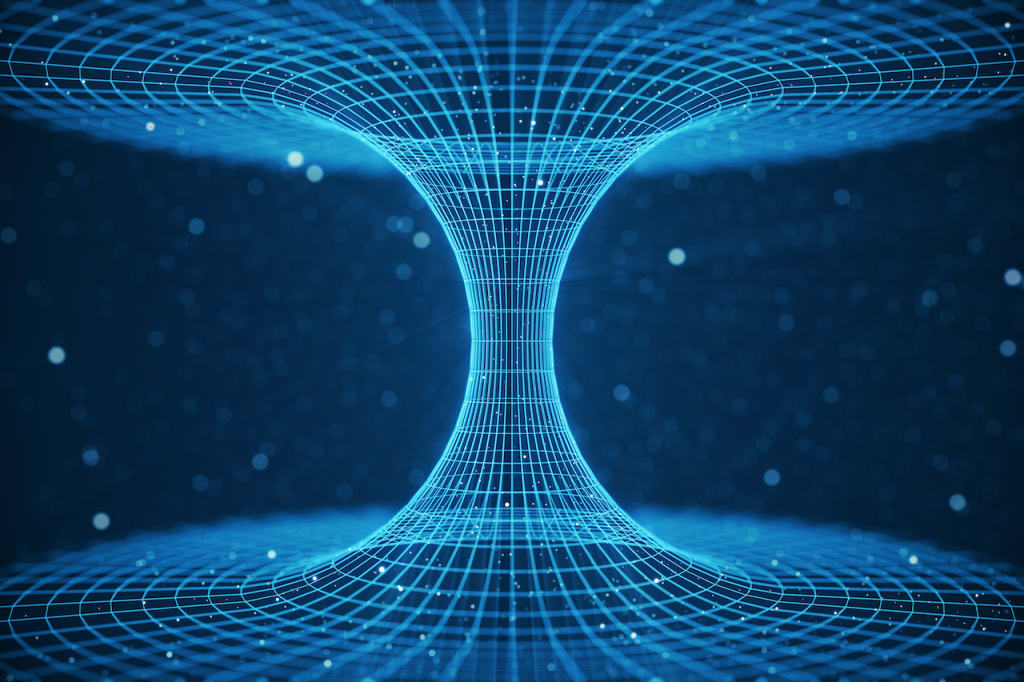
A wormhole is a hypothetical structure that connects two points in space-time, allowing for faster-than-light travel and potentially even time travel. The concept of wormholes was first proposed by Albert Einstein and Nathan Rosen in 1935 as a solution to the equations of general relativity.
The Anatomy of a Wormhole
Wormholes are often visualized as a tunnel or a bridge connecting two distant points in space-time. To understand the anatomy of a wormhole, it is helpful to imagine a piece of paper with two points marked on it. The shortest distance between these two points is a straight line. However, if we fold the paper in such a way that the two points come together, we create a wormhole. In other words, a wormhole is a shortcut through space-time.
Types of Wormholes
There are two types of wormholes: traversable and non-traversable. Traversable wormholes are hypothetical structures that could be used for travel, while non-traversable wormholes are just mathematical solutions to the equations of general relativity. Traversable wormholes require exotic matter with negative energy density to keep them open, which is currently not known to exist.
Wormholes and Time Travel
One of the most fascinating implications of wormholes is their potential for time travel. If a wormhole were to exist, it would be possible to enter one end of the wormhole and emerge from the other end at a different point in space-time. This could theoretically allow for travel back in time, although there are still many unanswered questions about the nature of time and causality.
Wormholes and Space Travel
Another potential application of wormholes is space travel. If we could find a way to create or locate a traversable wormhole, it would be possible to travel vast distances in space without the need for conventional propulsion systems. This could revolutionize space travel and make interstellar exploration a reality.
Wormhole Science Fiction
The concept of wormholes has long been a favorite of science fiction writers and filmmakers. From "Star Trek" to "Interstellar," wormholes have been used as a plot device to facilitate faster-than-light travel and time travel. While much of the science in science fiction is pure speculation, the idea of wormholes has captured the imagination of millions of people around the world.
The Search for Wormholes
Despite their theoretical existence, no one has yet found a wormhole. However, scientists are actively looking for evidence of wormholes using a variety of methods. Some researchers are looking for gravitational lensing, which could indicate the presence of a wormhole. Others are using advanced mathematical models to search for the telltale signs of a wormhole in the cosmic microwave background radiation.
Wormhole Controversies
Like many cutting-edge scientific concepts, wormholes have been the subject of controversy and debate. Some scientists argue that the very concept of wormholes is flawed, and that they could never exist in reality. Others are more optimistic, pointing to recent advances in our understanding of the universe and the potential for new discoveries in the future.
Wormholes and the Future of Science
Regardless of whether wormholes are ultimately proven to exist, the concept of wormholes has already had a profound impact on our understanding of the universe. The search for wormholes has spurred advancements in areas such as theoretical physics, cosmology, and astrophysics, as scientists attempt to understand the properties and potential implications of these hypothetical structures.
One potential application of wormholes is in the realm of interstellar travel. The vast distances between stars and galaxies make it difficult, if not impossible, to traverse the universe using conventional methods of propulsion. However, if a stable, traversable wormhole were to exist, it could potentially allow for rapid travel across vast distances, opening up new frontiers for exploration and discovery.
Wormholes also have the potential to provide insights into the fundamental nature of space, time, and gravity. The study of wormholes requires the integration of two of the most successful and yet incompatible theories in modern physics: general relativity and quantum mechanics. As such, the search for wormholes has led to new theoretical frameworks that seek to reconcile these two theories and to develop a more complete understanding of the universe at its most fundamental level.
The Ethics of Wormholes
The potential for wormholes raises ethical questions about the use of this technology. While the concept of faster-than-light travel and time travel is fascinating, it also has the potential to disrupt the natural order of the universe. Furthermore, the energy requirements for creating a wormhole may be enormous, leading to questions about the sustainability of this technology.
Conclusion
The theory of wormholes represents one of the most fascinating and complex concepts in modern physics. While much is still unknown about the nature of wormholes, the potential for faster-than-light travel and time travel is captivating. As we continue to explore the universe and push the boundaries of our understanding, the concept of wormholes will undoubtedly remain a topic of fascination and debate.
About the Creator
Void
Hi there! I'm a writer who loves exploring the intersection of fact and fiction through storytelling. Join me on my literary journey as I delve into the depths of the human experience and bring new worlds to life.
Digital Comic Market to Surpass USD 14,416.5 Million by 2034: Accelerating Digital Publishing Growth
The digital comic market has experienced steady expansion as readers increasingly consume visual storytelling through smartphones and online platforms. The market generated approximately USD 5,369 million in 2024 and is expected to reach nearly USD 14,416.5 million by 2034, reflecting a strong 10.4% CAGR during the forecast period. Digital publishing platforms have significantly transformed the comic industry by allowing readers to access stories instantly through mobile applications and web portals.
By Roberto Crum2 days ago in Futurism
Apple’s Power Move: Everything Announced in the Massive March 2026 Refresh
Apple has never been a company to do things quietly, but the first week of March 2026 will go down in tech history as one of its most aggressive hardware blitzes to date. Foregoing a traditional singular keynote, Apple opted for a "rolling" launch week, dropping bombshell announcements daily before culminating in a press "experience" in New York, London, and Shanghai.
By Mohammad Hamid2 days ago in Futurism




Comments
There are no comments for this story
Be the first to respond and start the conversation.