
Why Milwaukee Apps Fail After Launch More Than Expected?
A post-launch reality check on why Milwaukee apps struggle in production — and how hidden operational gaps undo otherwise solid builds

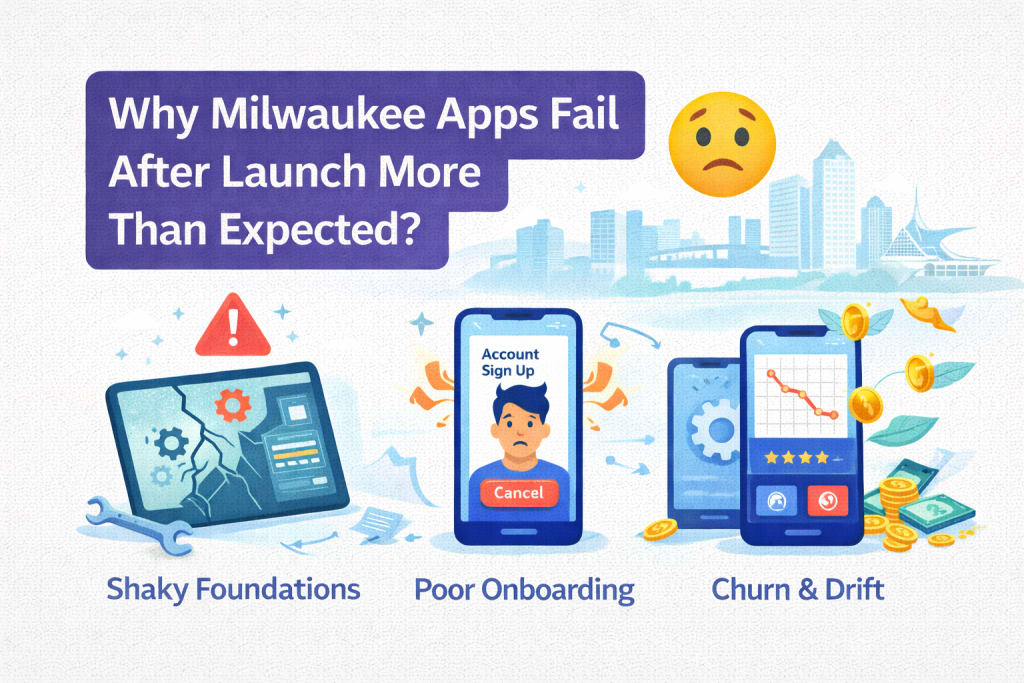
Launch day in Milwaukee often feels like a finish line. The app is approved, users can log in, stakeholders sign off, and teams finally breathe. Then something unexpected happens. Support tickets start arriving. Performance degrades under real traffic. A small edge case turns into a production issue. Within weeks, confidence erodes.
The pattern is familiar across markets, but Milwaukee teams feel it sharply because many apps here support real operations — manufacturing workflows, healthcare coordination, logistics tracking, internal enterprise tools. These apps are not experiments. When they fail after launch, the impact is immediate and visible.
Understanding why this happens requires looking beyond code quality and into how apps are prepared for life after release.
Launch success often hides readiness gaps
Most apps that fail after launch were not “badly built.” They passed QA. They met requirements. They worked in staging. What they lacked was exposure to real-world conditions.
According to a report by Gartner, a large share of application failures occur in production environments due to gaps in monitoring, capacity planning, and operational ownership rather than core functionality defects. The app works — until it meets real users, real data, and real timing pressure.
In Milwaukee, where many apps integrate with legacy systems or physical operations, these gaps surface faster than teams expect.
Real usage reveals problems test environments cannot
Test environments are controlled. Production is not.
After launch, apps encounter:
- unpredictable traffic spikes
- inconsistent data quality
- older devices and OS versions
- real user behavior that ignores ideal workflows
Research from Google’s Firebase team has shown that even small increases in crash rates can significantly increase user abandonment. Industry benchmarks often cite 99.5% crash-free sessions as a minimum acceptable standard for professional apps, with anything below that leading to noticeable churn.
Many Milwaukee apps technically “work” but fail this stability threshold once real usage begins.
Post-launch ownership is often undefined
One of the most common failure points is simple but uncomfortable to admit. No one clearly owns the app after launch.
- Who monitors performance daily?
- Who responds when something breaks at night?
- Who decides whether to roll back or push a hotfix?
When these questions are unanswered, small issues linger. Delays compound. Confidence drops.
According to a McKinsey analysis on software delivery, teams with clear post-launch ownership and incident response processes resolve issues significantly faster and experience fewer cascading failures than teams that treat launch as the endpoint.
Milwaukee projects that fail after launch often fail at ownership, not engineering.
Integrations become fragile under production load
Many Milwaukee apps rely on integrations — ERPs, CRMs, inventory systems, payment gateways, IoT feeds, or healthcare platforms. These integrations often behave well in testing but degrade in production.
APIs throttle unexpectedly. Data formats vary. Latency spikes. Error handling paths that were never triggered suddenly activate.
A study published through IEEE on mobile system failures highlighted that integration and backend dependencies are among the top causes of post-deployment instability, especially when error handling is under-tested.
When integrations fail, users blame the app — even if the root cause is external.
Performance expectations rise immediately after launch
Users are less forgiving than teams expect.
Research by Akamai has shown that even a 100–200 millisecond increase in response time can negatively impact user satisfaction and engagement. For operational apps used daily, that friction accumulates fast.
In Milwaukee, many apps are used by frontline staff or business teams under time pressure. A slow screen is not an inconvenience. It is a blocker.
Apps that were “fast enough” in QA often struggle once concurrency, data volume, and real network conditions hit.
Security and compliance issues surface late but hit hard
Security flaws rarely announce themselves during development. They appear after launch, when real data flows through the system.
Industry research consistently shows a gap between perceived and actual security readiness. One widely cited IT security survey found that while most development teams believe their apps are secure, a majority experience security incidents within the first year of production use.
In Milwaukee sectors like healthcare, manufacturing, and logistics, even minor security lapses can halt usage entirely. Fixing these issues after launch is far more disruptive and costly than building them correctly upfront.
Feature velocity replaces stability too early
Another post-launch failure pattern is cultural.
Once an app launches, teams feel pressure to add features quickly. Roadmaps accelerate. Stability work is postponed. Monitoring improvements are deferred. Technical debt grows quietly.
According to Forrester research on application modernization, organizations that prioritize feature velocity over stabilization in the first 90 days after launch experience higher defect rates and slower long-term delivery.
Milwaukee apps that fail often do so because teams move on too quickly instead of letting the system settle.
Documentation gaps slow recovery when issues arise
When problems hit production, documentation matters.
Teams without clear architecture diagrams, environment setup notes, or operational runbooks take longer to diagnose and fix issues. New engineers struggle to help. Knowledge stays trapped with a few individuals.
This delay turns minor issues into major disruptions.
Milwaukee teams increasingly recognize that documentation is not bureaucracy. It is insurance against post-launch failure.
Expert perspective on post-launch breakdowns
“Most application failures don’t happen because teams can’t build software. They happen because teams underestimate what it takes to run software.”
— Joachim Herschmann, VP Analyst at Gartner
His observation aligns with what Milwaukee teams experience firsthand. The gap between building and operating is where most failures live.
Another often-cited industry insight comes from Martin Fowler, who has long emphasized that software success is dominated by how systems evolve under change, not how they are initially written. Apps that cannot adapt calmly tend to break under real use.
Why this shows up clearly in Milwaukee
Milwaukee’s app ecosystem is practical. Apps support factories, hospitals, distribution centers, and internal business processes. There is little tolerance for instability.
When apps fail after launch here, it is not because teams are careless. It is because operational complexity is underestimated.
This is especially visible in mobile app development Milwaukee projects where teams optimize for delivery milestones but underinvest in post-launch readiness.
Closing thought
Apps rarely fail the moment they go live. They fail in the weeks that follow, when real users apply real pressure to systems that were never designed for life beyond launch.
Milwaukee teams that succeed do one thing differently. They treat launch as the beginning of responsibility, not the end of the project.
The apps that survive are not the flashiest or fastest to market. They are the ones prepared to live in production, quietly, reliably, every day.
About the Creator
Ash Smith
Ash Smith writes about tech, emerging technologies, AI, and work life. He creates clear, trustworthy stories for clients in Seattle, Indianapolis, Portland, San Diego, Tampa, Austin, Los Angeles, and Charlotte.
Australia Mining Equipment Market: Automation Adoption, Safety Focus & Sustainable Technologies
According to IMARC Group, the Australia mining equipment market reached USD 1.5 Billion in 2025 and is projected to expand to USD 2.3 Billion by 2034, exhibiting a compound annual growth rate (CAGR) of 5.15% during 2026–2034. This growth reflects the strategic modernization of mining operations across Australia, one of the world’s leading producers of iron ore, coal, lithium and gold. As global demand for critical minerals rises—particularly for renewable energy and electric vehicle supply chains—Australia’s mining sector is investing heavily in advanced equipment that enhances efficiency, safety and environmental performance.
By Kevin Cooper7 days ago in Futurism
L.A. School Board Delays Decision on Superintendent After FBI Raids
The Los Angeles Unified School District Board of Education met behind closed doors for four hours Thursday but reached no decision about the future of Superintendent Alberto Carvalho, one day after the FBI raided his home and district office.
By Behind the Tech4 days ago in Futurism
A Historic Declaration
We the People of the Husbands of the United States of America, in Order to form a more perfect Union, and I mean you...with me...establish Justice, insure domestic Tranquility, provide for the common defence, promote the general Welfare, and secure the Blessings of Liberty to ourselves, after Puberty, do ordain and establish this Declaration of Co-Dependence.
By Gerard DiLeo5 days ago in Humans




Comments
There are no comments for this story
Be the first to respond and start the conversation.