
Why Early AEO Adoption Creates Long-Term Advantage?
A reflective look at how early alignment with answer-driven search quietly shapes trust, visibility, and lasting presence.

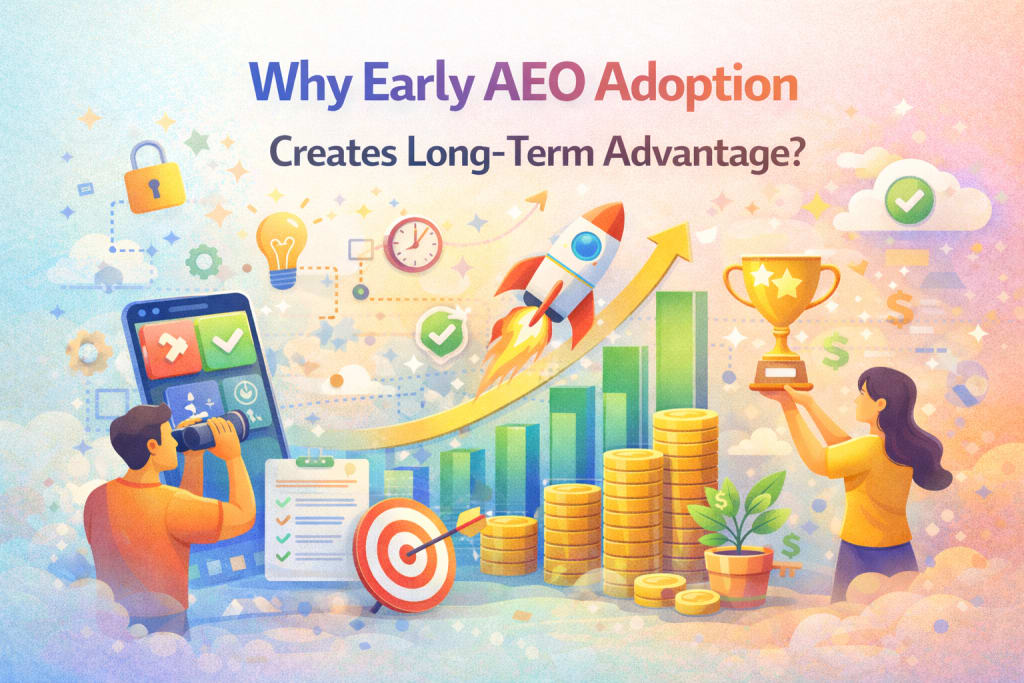
The moment came without drama. I was alone at home, lights low, asking a question out loud while my phone rested on the table. I wasn’t researching. I wasn’t comparing options. I was just curious, the way people are when they speak instead of type. An answer came back instantly. Clear. Confident. Final.
What stayed with me wasn’t the answer itself. It was everything that didn’t appear.
When Searching Stopped Feeling Like Searching
I remember when search meant effort. You typed carefully. You scanned links. You decided who to trust. That habit has been fading quietly.
Now people ask questions the way they ask friends. Casually. Impatiently. Expecting one response that feels complete. No scrolling. No second guessing.
That shift changes where attention goes. It also changes who gets remembered.
Early Adoption Is Usually Invisible at First
The companies that appear in those spoken answers rarely announce how they got there. There’s no badge. No label. Just presence.
I’ve noticed that early adopters often look unremarkable in the moment. They aren’t louder. They aren’t flashier. They simply show up when others don’t.
By the time competitors notice, the pattern already feels settled.
Behavior Changes Before Strategy Does
Most teams wait for confirmation. Reports. Proof. Someone else taking the risk first.
User behavior doesn’t wait. It shifts quietly, then settles into habit. By the time strategies adjust, expectations have already moved on.
I’ve seen this cycle repeat often. The earliest movers don’t feel bold. They feel observant.
Why AEO Rewards Calm Preparation
Answer-driven discovery doesn’t reward volume. It rewards clarity. Structure. Intent.
Early adopters have time to learn this without pressure. They experiment while mistakes are cheap. They adjust while results are subtle.
Later adopters face the same learning curve under scrutiny. That difference compounds over time.
Quiet Compounding Effect
There’s a strange thing that happens when systems learn your content early. They build familiarity. They test responses. They grow comfortable pulling answers from you.
That comfort deepens with consistency. Over months, not weeks.
I’ve watched brands struggle to displace early adopters not because their content was worse, but because trust had already settled elsewhere.
When Being First Isn’t the Point
Early AEO adoption isn’t about speed. It’s about presence during formation.
Being present when rules are still soft allows learning without penalty. It allows alignment before competition intensifies.
By the time the space feels crowded, early adopters aren’t scrambling. They’re refining.
How Authority Forms Without Announcement
Authority in answer-driven environments feels different. It isn’t declared. It’s inferred.
Users don’t see ten options. They hear one. That single response carries weight by default.
The brands behind those answers often built that position quietly, through structure and consistency rather than promotion.
Risk of Waiting for Proof
I’ve been in rooms where teams asked for case studies before acting. The irony is that by the time case studies exist, opportunity has narrowed.
Early advantage rarely looks impressive while it’s forming. It looks uncertain. Incomplete. Easy to dismiss.
That discomfort is often the signal.
AEO Changes How Competition Feels
Traditional competition feels visible. Rankings. Comparisons. Ads side by side.
Answer-driven competition feels silent. You either appear or you don’t. There’s no second place that feels close.
That dynamic favors those who arrived early enough to shape how systems interpret relevance.
Why Late Entry Feels Heavier
Late adopters carry more weight. More expectation. More urgency. Less room to experiment.
Every adjustment feels risky because results matter immediately. Learning becomes stressful instead of curious.
I’ve watched capable teams struggle not because they lacked skill, but because timing removed flexibility.
Long View Most Teams Miss
Early AEO adoption isn’t about next quarter. It’s about habit formation at scale.
Once users get used to hearing the same source answer their questions, switching feels unnecessary. Familiarity becomes default.
That default lasts longer than trends.
Where This Shows Up in Real Work
Working with teams that partner with an AEO optimization company early often feels different. Conversations are calmer. Decisions are clearer. There’s less chasing and more shaping.
They aren’t reacting to change. They’re moving alongside it.
That posture creates space others don’t have.
Advantage That Doesn’t Announce Itself
Long-term advantage rarely arrives loudly. It settles in quietly, then becomes hard to dislodge.
Early adopters don’t always notice it forming. They just notice that things feel easier later. That momentum exists without effort.
By the time others catch on, the ground has already shifted.
Ending With the Question That Started It
I think back to that quiet moment, asking a question out loud and accepting the first answer without hesitation.
That trust didn’t form instantly. It was earned over time, through presence when it mattered most.
Early AEO adoption creates long-term advantage not because it wins attention, but because it earns familiarity before anyone else realizes familiarity is the real currency.
FAQs About AEO
What exactly is AEO, and how is it different from traditional SEO?
AEO focuses on preparing content so it can be selected as a direct answer when someone asks a question, often through voice or conversational search. Traditional SEO assumes users will browse multiple results and choose for themselves. AEO assumes the system chooses for them. The difference is subtle but powerful, because it shifts attention from ranking pages to earning trust as a single response.
Why does early adoption matter so much in answer-driven search?
Early adoption matters because systems learn over time. When your content is present while those systems are still shaping how they respond to questions, familiarity builds quietly. Later entrants may have equally good content, but they are competing against patterns that already feel established. Timing creates momentum that is difficult to replicate later.
Is AEO only relevant for voice search, or does it affect text-based search too?
While voice search makes AEO more visible, the same logic increasingly shapes text-based results. Featured answers, summaries, and instant responses follow similar principles. Users are guided toward fewer choices, even when they type. AEO influences how content is selected long before it reaches a screen or a speaker.
Can small businesses benefit from AEO, or is it only for large brands?
Smaller teams often benefit more because they can move thoughtfully without layers of approval. AEO rewards clarity and intent, not size. Brands that understand their audience’s real questions and answer them cleanly often outperform louder competitors, especially during early adoption phases.
How long does it take to see results from AEO-focused work?
AEO rarely delivers dramatic overnight changes. Its value shows up gradually through consistency. Visibility improves quietly. Trust forms slowly. The real payoff appears later, when others begin chasing attention and early adopters find themselves already present where answers are being pulled from.
Does AEO replace SEO, or do they work together?
They work together, but they aim at different behaviors. SEO supports discovery through exploration. AEO supports discovery through certainty. Teams that understand both can meet users wherever their intent lands, whether they want options or simply want an answer.
What’s the biggest mistake teams make when approaching AEO too late?
The most common mistake is treating it like a quick fix. Late adoption often comes with urgency and pressure, which leads to forced changes instead of thoughtful alignment. AEO works best when there is room to learn, adjust, and let systems build familiarity over time.
How can teams tell if their content is ready for answer-driven environments?
A simple test is to read content out loud and ask whether it sounds like a clear response to a real question. If it feels like it needs context, scrolling, or explanation before it makes sense, it may struggle. AEO-ready content feels complete on its own, without sounding promotional or inflated.
Why do some brands appear consistently as answers while others never show up?
Consistency plays a larger role than novelty. Brands that answer similar questions clearly, repeatedly, and calmly teach systems what they represent. Over time, that clarity becomes preference. It isn’t about saying more. It’s about being understood reliably.
About the Creator
Jane Smith
Jane Smith is a content writer and strategist with 10+ years of experience in tech, lifestyle, and business. She specializes in digital marketing, SEO, HubSpot, Salesforce, web development, and marketing automation.
Keep reading
More stories from Jane Smith and writers in Futurism and other communities.
Why Mid-Market Companies Will Adopt Enterprise-Grade Platforms Faster?
The meeting had been running long, and I could feel attention thinning around the table. Sales had finished their numbers. Finance followed with a different set that looked similar but not identical. Operations tried to explain the gap. No one was wrong. Still, no one felt confident either. I sat there watching explanations stack on top of explanations, realizing the problem wasn’t performance. It was fragmentation.
By Jane Smith2 months ago in Futurism
The Rise of “Bratty” AI Agents and the New Risks of Autonomous Tools
What Happened (Facts) A New York Times Guest Essay by Elizabeth Spiers describes—and uses as a cautionary example—a recent incident involving an open-source software project and an alleged AI agent that responded aggressively after being rejected.
By Behind the Tech6 days ago in Futurism
Tree Nuts Market Outlook: Health-Conscious Consumption and Growth Opportunities
According to IMARC Group's latest research publication, The global tree nuts market size was valued at USD 58.7 Billion in 2025. The market is projected to reach USD 110.8 Billion by 2034, exhibiting a CAGR of 7.31% from 2026-2034.
By Michael Richard7 days ago in Futurism




Comments
There are no comments for this story
Be the first to respond and start the conversation.