
Why Are Saturn’s Rings Younger Than Saturn?
Saturn's Rings
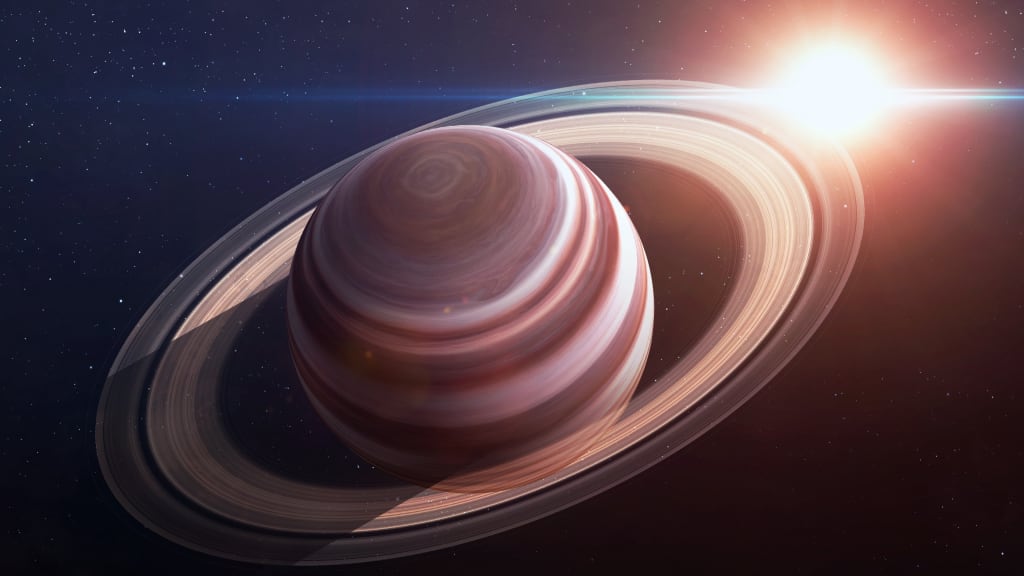
Ever since Galileo first peered at them through his telescope and called them “Saturn’s ears,” people have marveled at the iconic beauty of Saturn’s rings. Cosmically speaking, though, they might be a flash in the pan – blink and you’ll miss it. Estimates on the lower end suggest they could be younger than the dinosaurs.
But why would a planet’s most striking feature be so much younger than the planet itself? The answer may cause us to revise our ideas about what rings even are, and maybe make us appreciate them a little more. Scientists are still working out the details of how Saturn’s rings formed, but a leading idea is that they are the remains of an icy moon named Chrysalis.
The moon's orbit would have spiraled inwards until it crossed into the Roche limit, the distance from its planet where the gravitational pull becomes too intense and was ripped apart into billions of shards. One way to estimate the age of the rings is to look at how shiny each of those shards is.
Saturn's ring system is incredibly vast and complex. It consists of several main rings, named alphabetically based on their order of discovery (e.g., A, B, C rings), as well as numerous narrower gaps and divisions within the rings. Some of these gaps are caused by the presence of small moons, known as shepherd moons, that orbit near the edges of the rings and help shape their structure.
While rings may look solid from a distance, they are actually many billions of pieces of ice and rock – mostly ice – all orbiting around their planet. Over time, those ring particles should start to accumulate space dust from around Saturn. Which means to estimate their age, scientists needed to figure out how dirty the rings are.
Not unlike running your finger across your desk to figure out when you dusted last. New research published in May of 2023 based on data from the Cassini spacecraft has narrowed down the rings’ possible age to a mere 400-100 million years old. The spacecraft laboriously collected individual dust grains, which the team was able to study.
For context, 400 million years ago in Earth’s history corresponds with the emergence of early four-footed creatures, while 100 million years ago, our mammal ancestors would have been scurrying under the feet of dinosaurs. The actual age is probably closer to 400 than 100 million, but it's going to take more research to pin down the date more accurately. But it might not just be that the rings are a recent thing. They may also be gone soon.
Interactions with the gas giant’s magnetic field are gradually causing Saturn’s rings to literally rain down into its atmosphere. And there’s no source of new ice, so Saturn’s rings are likely temporary. Current estimates suggest the rings will be drained within the next 300 million years. Because the planet itself is around 4.5 billion years old, its rings only represent a short period of its history.
We are actually pretty lucky to be around to see them. We’ve also detected rings around other planets, although they tend to be fainter and not visible with a backyard telescope. All of the other giant planets of our solar system – Jupiter, Uranus, and Neptune – have their own, less impressive ring systems.
Scientists have even found rings around smaller bodies, like Haumea, Quaoar, and Chiron. And the seemingly transient nature of Saturn’s rings makes us wonder just how permanent these features are – and whether they were ever as spectacular!
If dinosaurs had telescopes and seen “ears” on Saturn. But in the scheme of things, humanity had some pretty incredible timing to be able to see this wonder of the cosmos. Thanks for reading my story and subscribe me for more fact and interesting things. Happy Eating, Happy Living.
About the Creator
Keep reading
More stories from Karthiga Elangovan and writers in Futurism and other communities.
Why Can't I Grow More Teeth?
If you’ve ever spent time combing the beach for shells or Seaglass, chances are you may have found a shark tooth out there as well. They’re pretty common, given that sharks are constantly growing new teeth to replace their older ones. But have you ever thought about why they can do that and you can’t?
By Karthiga Elangovan 3 years ago in Futurism
Seeing Is No Longer Believing
It started with a frantic FaceTime call at 2:00 AM. A mother in Arizona picked up her phone to see her teenage daughter crying, surrounded by dark shadows. The girl begged for help, saying she had been in an accident and the other driver was threatening her. The mother saw her daughter’s face—the specific way her lip quivers when she’s terrified—and heard the exact pitch of her scream. She was ready to pay any ransom, to do anything.
By Alex Sterling 7 days ago in Futurism


Comments