
Why App Performance Problems Appear Only at Real Scale Usage?
The moment when an app stops behaving like a demo and starts behaving like a city.

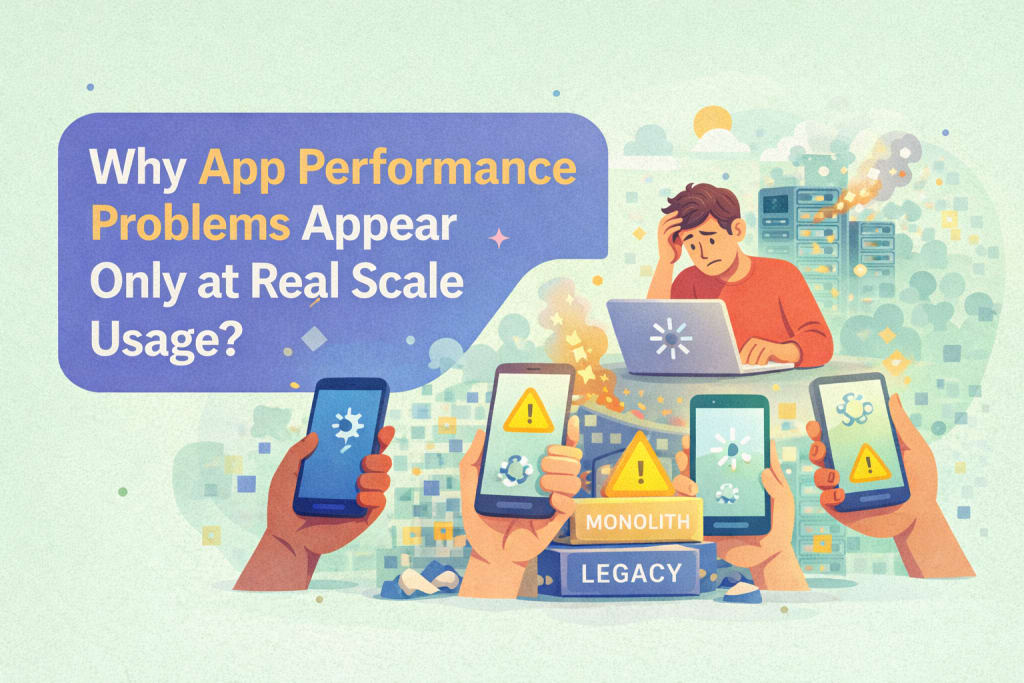
I noticed it during a week that looked perfectly normal on paper. No big release. No sudden spike in traffic. Just steady growth doing what growth always does. Still, something felt different. Screens that had always loaded smoothly now hesitated. Interactions felt slightly heavier, like the app was carrying a bag it hadn’t packed before.
Nothing was broken. Nothing had failed.
And that’s exactly why it took so long to understand what was happening.
Performance at Small Scale Is Forgiving
When an app is young, performance feels generous. Paths are short. Data sets are small. Background work rarely overlaps with interaction.
I’ve watched early builds perform beautifully under conditions that feel realistic at the time. A few hundred users. Clean sessions. Predictable behavior.
At that stage, performance problems are easy to spot because they’re obvious. Something is slow or it isn’t.
Real scale doesn’t behave that way.
Scale Changes the Shape of Usage
One of the biggest misconceptions is that scale just means more of the same.
It doesn’t.
Real scale introduces overlap. More concurrent sessions. More background tasks running at once. More interruptions layered on top of each other.
Users don’t arrive one at a time anymore. They arrive together, leave abruptly, return later, and expect continuity.
The app starts negotiating instead of executing.
Performance Issues Shift From Speed to Coordination
At small scale, performance is mostly about speed. How fast something runs.
At real scale, it’s about coordination. Who gets time first. What waits. What blocks.
I’ve seen apps with fast code feel slow because too many things wanted attention at once. Nothing was inefficient in isolation. Everything was competing.
Competition is invisible until there are enough participants.
Why Tests Rarely Predict This Moment
Performance tests usually assume controlled behavior.
They simulate users doing specific things in predictable sequences. They don’t simulate boredom, impatience, or habit.
Real users stack actions unintentionally. They scroll while data loads. They background the app mid-request. They open notifications during transitions.
Those overlaps don’t break logic. They strain coordination.
Tests pass. Reality pushes harder.
Real Scale Reveals Hot Paths You Didn’t Know Existed
Every app has hot paths. The routes users take most often.
At small scale, these paths stay cool. They don’t get stressed enough to show weakness.
At real scale, repetition heats them up. Code that was fine suddenly runs thousands of times per minute.
Tiny inefficiencies multiply. Caches miss more often. Synchronization costs rise.
The path didn’t change. Its importance did.
Memory Pressure Becomes a Daily Condition
Memory issues often stay hidden early.
Devices have room. Garbage collection runs infrequently. State stays manageable.
At scale, long sessions become common. Backgrounding happens more often. State accumulates.
Memory pressure turns from an edge case into a constant condition.
The app doesn’t crash immediately. It slows, warms, and hesitates.
Performance Degrades Before It Breaks
This is what makes scale-related issues so frustrating.
There’s no clear failure point. Just gradual degradation.
Frames drop occasionally. Animations lose smoothness. Inputs lag just enough to be noticed.
Users don’t report crashes. They report feeling.
By the time alarms trigger, trust has already thinned.
Scale Exposes Timing Assumptions
Many performance problems at scale come from timing assumptions.
Assumptions about when data arrives. When cleanup runs. When background work finishes.
At small scale, timing aligns by coincidence. At real scale, coincidence disappears.
Overlapping work reveals assumptions that were never stated explicitly.
The app behaves correctly according to rules that no longer match reality.
Network Behavior Becomes Unpredictable
At scale, network conditions diversify.
Different regions. Different carriers. Different congestion patterns.
Requests arrive late. Responses come back out of order. Retries overlap.
Code that assumed polite networking starts doing extra work. Threads wait. Queues grow.
Performance issues surface even though the network isn’t “down.”
User Behavior Stops Being Ideal
Early adopters often use apps carefully. They’re patient. They explore intentionally.
At scale, usage becomes casual. Distracted. Impulsive.
People tap twice. Switch apps mid-action. Return hours later expecting state to make sense.
Performance issues arise not because users are wrong, but because assumptions were narrow.
Scale widens behavior faster than code adapts.
Coordination Overhead Grows Nonlinearly
One of the hardest lessons is that coordination cost doesn’t grow linearly.
Adding one more background task doesn’t add one more unit of cost. It adds contention.
Locks wait longer. Schedulers juggle more. Context switches increase.
The system spends time deciding what to do instead of doing it.
That overhead hides until scale forces it into the open.
Why Profiling Looks Confusing at This Stage
When teams finally profile at scale, results often feel unsatisfying.
No single function stands out. Time is spread thinly across many places.
The slowdown isn’t concentrated. It’s diffused.
This leads to frustration because there’s nothing obvious to optimize.
The problem isn’t heavy work. It’s too much coordination.
Scale Turns Rare Conditions Into Common Ones
A bug that happens once every thousand sessions feels ignorable early.
At scale, it happens constantly.
The same applies to performance edge cases. Slow paths that rarely run become everyday paths.
What once felt safe now dominates experience.
This is especially visible in growing ecosystems like mobile app development Atlanta, where apps often move quickly from local to broad usage.
Teams Often Blame the Wrong Thing First
When performance degrades at scale, teams often blame infrastructure, devices, or networks.
Those factors matter, but they’re rarely the root cause.
More often, the cause is architectural. How work is scheduled. How state is shared. How responsibilities overlap.
Fixing infrastructure helps briefly. The pattern returns.
Why Adding Resources Doesn’t Fully Help
Throwing more resources at the problem works up to a point.
Faster devices. More memory. Better servers.
Eventually, coordination becomes the bottleneck again.
Performance problems at scale aren’t always about lack. They’re about contention.
The Emotional Toll of Scale-Only Issues
Scale-related performance issues are emotionally taxing.
Teams feel betrayed by code that worked fine for so long. Confidence drops. Releases feel riskier.
Because the app isn’t clearly broken, urgency competes with uncertainty.
This slows response at exactly the moment speed matters most.
The Shift From Optimization to Design
The most successful turnarounds I’ve seen happened when teams stopped optimizing and started redesigning flows.
Reducing overlap. Simplifying state. Letting work happen independently where possible.
The app didn’t become faster in isolation. It became calmer under load.
Users felt that immediately.
Designing for Overlap, Not Ideal Paths
Apps that age well are designed for overlap from the beginning.
They assume things will collide. That work will arrive at bad times. That users will interrupt everything.
Performance becomes resilient instead of brittle.
That resilience only matters at scale.
Accepting That Scale Is a Different Phase
One of the healthiest realizations is that scale is not an extension of early success.
It’s a new phase.
Patterns that worked before must be revisited. Assumptions must be challenged.
The app hasn’t failed. It has grown into a different environment.
The Moment Scale Finally Made Sense
I remember the moment everything clicked.
The performance issues weren’t mysterious. They were inevitable.
The app was doing exactly what it had been taught to do, just under conditions it had never experienced before.
Once we saw that, fixes became intentional instead of reactive.
Ending With the App That Learned to Breathe
After changes, the app didn’t suddenly feel fast.
It felt steady.
Interactions landed when expected. Background work stopped competing unnecessarily. The system breathed again.
Performance problems appear only at real scale usage because scale reveals truths that small environments politely hide.
It exposes overlap, contention, and assumptions all at once.
When teams accept scale as a different reality rather than a bigger version of the same one, performance stops being a surprise and starts becoming something they can design for.
That’s when growth feels earned instead of exhausting.
FAQs
Why do performance issues often appear only after an app grows?
Because growth introduces overlap. More users means more simultaneous actions, more background work, and more interruptions. These conditions rarely exist in early stages, so problems stay hidden until usage becomes dense.
Why doesn’t testing catch scale-related performance problems?
Most tests assume orderly behavior. Real users create timing collisions, long sessions, and unpredictable patterns that tests don’t fully simulate. Scale exposes coordination issues rather than logic errors.
Is real scale just about having more users?
No. It’s about different behavior. Users arrive together, multitask, abandon flows, and return later. The app must coordinate far more work at once.
Why do apps feel slower without crashing at scale?
Because systems stretch before they break. Performance degrades gradually through contention and scheduling delays, which users feel as heaviness rather than failure.
What role does memory play in scale-related slowdowns?
At scale, sessions last longer and state accumulates. Memory pressure becomes constant instead of occasional, which slows behavior without obvious errors.
Why does profiling look confusing when performance drops at scale?
Because no single function is slow. Time is spread across many small coordination costs that add up but don’t stand out individually.
Can better infrastructure fix scale performance issues?
It helps temporarily, but doesn’t address coordination patterns inside the app. Without structural changes, issues tend to return.
Why do rare edge cases become common at scale?
Because even low-probability conditions occur frequently when usage is high. What once felt rare becomes part of everyday behavior.
Why do teams often misdiagnose scale-related problems?
Because everything worked before. It’s natural to look for external causes instead of questioning assumptions that only break under load.
What kind of design holds up better at scale?
Designs that assume overlap, interruptions, and long sessions. Apps that expect ideal usage often struggle once real behavior arrives.
Is scale a sign that something went wrong earlier?
Not necessarily. Scale reveals assumptions, it doesn’t create mistakes. Growth simply removes the protection of small numbers.
What’s the most important mindset shift when apps hit real scale?
Accepting that scale is a different phase, not a bigger version of the same one. Performance must be rethought, not just tuned.
About the Creator
Ash Smith
Ash Smith writes about tech, emerging technologies, AI, and work life. He creates clear, trustworthy stories for clients in Seattle, Indianapolis, Portland, San Diego, Tampa, Austin, Los Angeles, and Charlotte.
Australia Eco-Friendly Cleaning Solutions Market: Sustainability Demand, Product Innovation & Regulatory Standards
According to IMARC Group, the Australia eco-friendly cleaning solutions market reached USD 763.9 Million in 2025 and is projected to grow significantly to USD 2,263.1 Million by 2034, exhibiting a strong compound annual growth rate (CAGR) of 12.44% during 2026–2034. This rapid expansion reflects a profound shift in consumer behavior and corporate responsibility across Australia. Eco-friendly cleaning solutions—comprising biodegradable detergents, plant-based disinfectants, refillable packaging systems and non-toxic industrial cleaning agents—are increasingly replacing conventional chemical formulations. As sustainability and health awareness become central to purchasing decisions, the cleaning industry is undergoing structural transformation.
By Shrestha Roy4 days ago in Futurism




Comments
There are no comments for this story
Be the first to respond and start the conversation.