
Why 3D Printed Shoes Are the Future of Fashion
3D Printed Shoes Are Becoming Popular
The footwear industry stands at the precipice of a technological revolution. 3D printing technology has begun reshaping how we conceptualize, design, and manufacture shoes. This convergence of technology & fashion represents more than just innovation—it signals a fundamental transformation in how consumers interact with footwear.
Traditional shoe manufacturing has remained largely unchanged for decades. Mass production methods create standardized sizes that rarely accommodate individual foot variations. The new paradigm shifts from this one-size-fits-all approach to personalized manufacturing that responds to each consumer's unique needs.
The transformative potential extends beyond individual consumers to entire brand ecosystems. Companies can now prototype faster, iterate designs more efficiently, and respond to market demands with unprecedented agility. This shift promises to democratize shoe design while simultaneously elevating the craftsmanship possible through digital manufacturing techniques.
"3D fashion will allow us to print clothes at home in the future. Although there is still a long way to go, it is a scenario that will be real in the not too distant future," explains Estel Vilaseca, Head of Fashion at LCI Barcelona.
The Current Landscape of 3D Printed Footwear
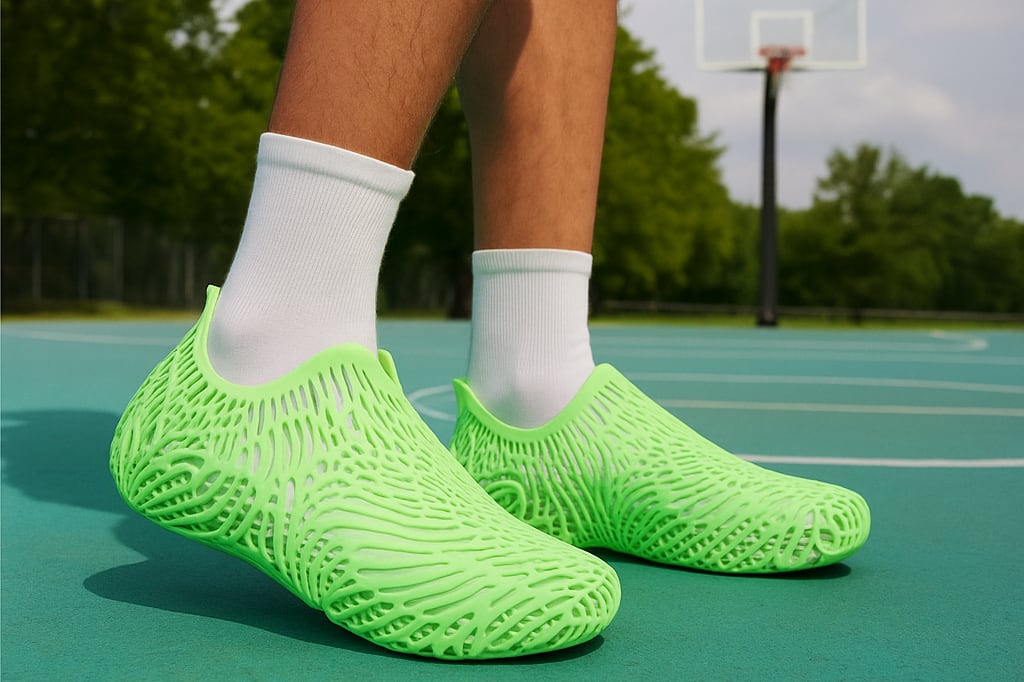
Several pioneering brands have already established themselves in the 3D printed footwear market. Companies like Zellerfeld have demonstrated the commercial viability of fully 3D printed shoes. Their products showcase intricate lattice structures that would be impossible to achieve through traditional manufacturing methods.
ARKKY is a consumer-oriented 3D printed shoe brand based on its B2B business. In 2025, it collaborated with industry designers to launch their new series of 3D printed shoes, including Daily Ease, Sport Form, and Avant Garde. With its powerful cluster of intelligent printing equipment and the industry's most advanced printing technology, the brand has quickly risen to prominence, and internet influencers are vying to experience it.
Asics made significant waves with their Actibreeze 3D Sandal in 2022. The product received overwhelmingly positive reviews from users who praised its innovative mesh design & superior breathability. The sandal's 360-degree airflow system keeps temperature & humidity levels lower than any comparable traditional sandal.

Consumer reception has been remarkably positive across early adopters. Users consistently highlight the superior comfort, unique aesthetic appeal, and environmental consciousness of these products. The price points currently range from accessible options like the Adidas Adilette 22 to premium custom-fit offerings from boutique manufacturers.
Early adoption trends show strongest growth among tech-savvy consumers aged 18-35 who value both innovation & sustainability. These demographics are willing to pay premium prices for cutting-edge technology combined with environmental responsibility.
The Technology Powering the Revolution
Additive manufacturing forms the technological backbone of 3D printed shoes. This process builds objects layer by layer from digital designs, enabling complex geometries that traditional molding cannot achieve. The precision of modern 3D printers allows for intricate internal structures that optimize both performance & material usage.
Material science has evolved dramatically to support footwear applications. Thermoplastic polyurethane (TPU) provides flexibility & durability essential for shoe construction. Advanced elastomers offer spring-back properties crucial for sole performance. Bio-based polymers are emerging as sustainable alternatives to traditional petroleum-based materials.

Different printing techniques serve various footwear applications. Selective Laser Sintering (SLS) creates strong, detailed structures perfect for soles & structural components. Fused Deposition Modeling (FDM) works well for rapid prototyping & less demanding applications. Stereolithography (SLA) produces incredibly detailed surfaces ideal for aesthetic elements.
Quality control processes have become increasingly sophisticated. Manufacturers employ real-time monitoring systems that track each layer's deposition. Post-processing techniques ensure surface finish quality while durability testing validates performance under real-world conditions.
Sustainability: Walking Toward a Greener Future
The environmental benefits of 3D printed shoes represent a compelling argument for widespread adoption. Traditional shoe manufacturing generates significant material waste through cutting patterns from larger sheets. 3D printing eliminates this waste by depositing only the material needed for the final product.

Recyclable & biodegradable materials are becoming standard in 3D printed footwear. Zellerfeld's products are nearly 100% recyclable, allowing old shoes to become raw material for new ones. This circular approach dramatically reduces the industry's environmental footprint.
Energy efficiency comparisons favor 3D printing for small to medium production runs. While traditional manufacturing becomes more efficient at massive scales, 3D printing maintains consistent efficiency regardless of quantity. This characteristic supports on-demand production models that eliminate overproduction waste.
Circular economy principles are naturally embedded in 3D printing processes. Shoes can be designed for easy disassembly at end-of-life. Materials can be recaptured & reprocessed into new products. This approach transforms waste streams into resource flows.
Personalization Like Never Before
Custom-fit shoes represent the most immediate consumer benefit of 3D printing technology. Smartphone apps now enable accurate foot scanning, capturing dimensional data that informs perfectly fitted shoe production. This technology addresses the reality that very few people have feet that match standard sizing conventions.
Individual foot variations extend far beyond simple length & width measurements. Arch height, toe box volume, heel width, and instep height all contribute to proper fit. 3D printing accommodates these variations without additional manufacturing complexity or cost.
Medical applications demonstrate the technology's potential for addressing specific conditions. Diabetic patients require shoes that prevent pressure points & accommodate foot deformities. Traditional custom orthotics are expensive & time-consuming to produce. 3D printing enables rapid, affordable custom solutions.
Real-time design modifications allow consumers to participate actively in the creation process. Online platforms enable customers to adjust aesthetic elements, modify functional features, and preview their designs before production. This level of engagement creates deeper emotional connections between consumers & their footwear.
Performance and Comfort Innovations
Advanced cushioning systems leverage 3D printing's ability to create complex internal geometries. Lattice structures can be optimized for specific compression & rebound characteristics. Different zones within the same sole can provide varying levels of support & cushioning where needed most.
Enhanced breathability emerges from intricate ventilation patterns impossible to achieve through traditional manufacturing. The ARKKY CozLite 300 this approach with its 360-degree airflow design. Perforated patterns can be customized to climate conditions & individual preferences.
Lightweight construction benefits from topology optimization algorithms that remove material where it isn't needed structurally. This approach maintains strength while reducing weight. The result is shoes that feel almost weightless while providing full protection & support.
Smart material integration represents an emerging frontier in 3D printed footwear. Shape-memory alloys can provide adaptive support that responds to temperature changes. Phase-change materials can regulate foot temperature throughout daily activities. These innovations are becoming increasingly feasible as material costs decrease.
Industry Giants Leading the Charge
Nike has invested heavily in 3D printing technology for both prototyping & production applications. Their Flyknit line utilized 3D printing for initial development & refinement. The company continues exploring applications for performance athletics where marginal gains in weight & fit can determine competitive outcomes.
Adidas has perhaps been the most aggressive in bringing 3D printed products to market. Their Futurecraft 4D collaboration with Carbon showcases advanced printing techniques that create complex midsole structures. The Futurecraft series demonstrates how 3D printing can reduce plastic waste while improving performance.
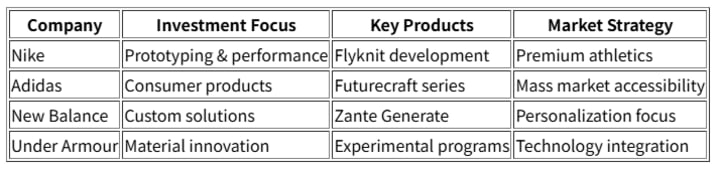
Emerging startups are disrupting traditional footwear brands through pure-play 3D printing approaches. Companies like ARKKY build their entire business model around additive manufacturing. This focus enables rapid innovation & direct consumer relationships that established brands struggle to match.
Collaborations between tech companies & fashion houses are producing unexpected innovations. Technology providers contribute manufacturing expertise while fashion brands provide design sensibility & market access. These partnerships accelerate development timelines & reduce barriers to market entry.
Manufacturing Revolution: Speed, Efficiency, and Cost
Production time reductions represent one of the most significant advantages of 3D printing in footwear manufacturing. Traditional shoe production requires weeks or months from design to finished product. 3D printing can produce custom shoes in hours, enabling same-day delivery in some markets.
Traditional tooling & molding processes require significant upfront investments that only pay off at large production volumes. 3D printing eliminates these requirements, making small batch production economically viable. This change enables niche products & rapid market testing without massive capital commitments.
On-demand manufacturing reduces inventory costs dramatically. Brands no longer need to forecast demand months in advance or maintain large warehouses of finished goods. Products can be manufactured when orders are received, eliminating overstock waste & reducing working capital requirements.
Local production capabilities transform global supply chains. 3D printers can be deployed in major metropolitan areas, enabling rapid delivery while reducing shipping costs & environmental impact. This distributed manufacturing model provides greater resilience against supply chain disruptions.
Unleashing Creative Design Possibilities
Complex geometries impossible with traditional manufacturing become routine with 3D printing. Internal lattice structures, impossible overhangs, and integrated components can all be produced in single print jobs. These capabilities enable entirely new approaches to shoe architecture & performance optimization.
Artistic collaborations are pushing fashion boundaries in unprecedented ways. The collaboration between Chris Brown, Nos Ailes, and The Auracles on the Nami slide demonstrates how musicians, artists, and technologists can create products impossible through traditional manufacturing.
Functional & aesthetic elements can be integrated seamlessly in 3D printed designs. Ventilation patterns can serve decorative purposes while providing performance benefits. Structural elements can incorporate brand messaging or personalized details without compromising functionality.
Consumer participation in design processes creates new forms of co-creation. Online platforms enable customers to modify existing designs or create entirely new concepts. This democratization of design transforms consumers from passive recipients to active collaborators in the creative process.
Market Trends and Consumer Adoption Patterns
Demographic analysis reveals strongest adoption among millennials & Gen Z consumers who prioritize both technology & environmental responsibility. These groups demonstrate willingness to pay premium prices for innovative products that align with their values. Urban consumers show higher adoption rates than rural populations, likely due to greater technology exposure & environmental awareness.
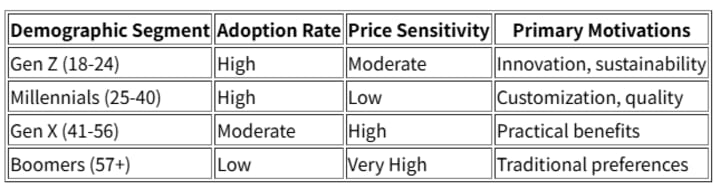
Price evolution shows clear trajectories toward mainstream accessibility. Early 3D printed shoes commanded premium prices due to novelty & limited production. As technology matures & production scales increase, prices are declining rapidly. Industry analysts predict price parity with traditional premium footwear within five years.
Consumer education campaigns are addressing knowledge gaps about 3D printing technology. Many potential customers lack understanding of the benefits & capabilities of additive manufacturing. Successful brands invest heavily in educational content that demonstrates value propositions clearly.
Regional differences in acceptance reflect varying levels of technology adoption & environmental awareness. European markets show strongest growth due to high environmental consciousness. Asian markets demonstrate rapid adoption driven by technology enthusiasm. North American markets fall between these extremes with steady, consistent growth.
Overcoming Current Challenges and Limitations
Material limitations remain the most significant constraint on widespread 3D printed shoe adoption. Current materials, while improving rapidly, still lack some properties of traditional shoe materials. Durability, flexibility, and breathability continue requiring optimization for demanding applications.
Production speed constraints limit mass market appeal despite dramatic improvements over traditional manufacturing. Current 3D printers require several hours to produce a single pair of shoes. Multiple printers can address volume requirements, but this approach increases capital costs & complexity.
Cost barriers persist for mainstream consumer adoption despite declining trends. Premium pricing reflects both technology costs & limited competition. As the market matures & competition increases, prices should decline to levels accessible to broader consumer segments.
Quality consistency challenges arise from the complexity of 3D printing processes. Variables including material quality, environmental conditions, and machine maintenance can affect output quality. Standardization efforts are addressing these issues through improved process controls & quality management systems.
The Next Frontier: Future Innovations on the Horizon
Internet of Things (IoT) integration promises to transform 3D printed shoes into smart devices. Embedded sensors could monitor gait patterns, track physical activity, and even provide navigation guidance. This convergence of footwear & wearable technology creates entirely new product categories & value propositions.
Advances in bio-compatible materials are enabling revolutionary approaches to shoe construction. Living materials that adapt to environmental conditions or self-repair minor damage represent emerging possibilities. These biomimetic approaches could produce shoes that improve with use rather than degrading.
In-store & home 3D printing stations could revolutionize retail experiences. Customers could design, customize, and manufacture shoes during single store visits. Home printing capabilities could enable personal shoe manufacturing, though material & quality challenges currently limit this possibility.
Augmented reality fitting & design experiences are enhancing consumer engagement with 3D printed footwear. Virtual try-on capabilities enable accurate fit assessment without physical samples. Design tools allow real-time visualization of customization options, improving customer satisfaction & reducing returns.
Economic Transformation of the Footwear Industry
Traditional manufacturing jobs face disruption as 3D printing adoption accelerates. Assembly line workers may need retraining for digital manufacturing roles. However, new opportunities are emerging in design, technology operation, and customer service roles that require different skill sets.
New business models are emerging throughout the footwear sector. Direct-to-consumer brands leverage 3D printing's customization capabilities to differentiate from traditional retailers. Service-based models offer shoe subscriptions with regular updates & replacements. Platform businesses connect consumers directly with designers & manufacturers.
Investment flows reflect strong confidence in 3D printing's footwear future. Venture capital firms are funding startups at unprecedented levels. Traditional footwear companies are acquiring 3D printing capabilities through partnerships & acquisitions. Technology companies are expanding into footwear applications.
Global supply chain restructuring implications extend far beyond footwear manufacturing. Reduced reliance on Asian manufacturing could reshape international trade patterns. Local production capabilities could strengthen domestic manufacturing sectors while reducing transportation-related environmental impacts.
Environmental Impact: Beyond Sustainability
Carbon footprint reduction through localized production represents a significant environmental benefit beyond material waste reduction. Eliminating global shipping requirements can reduce transportation-related emissions by up to 80% for some products. Local manufacturing also enables renewable energy utilization more easily than traditional manufacturing centers.
Water usage minimization benefits from 3D printing's dry manufacturing processes. Traditional shoe manufacturing requires significant water usage for material processing & waste treatment. Additive manufacturing eliminates most water requirements, providing significant benefits in water-stressed regions.
Toxic chemical elimination from production cycles improves both worker safety & environmental protection. Traditional shoe manufacturing employs various adhesives, dyes, and treatment chemicals that can be harmful. 3D printing processes typically use safer materials & eliminate many chemical processing steps.
End-of-life product disposal & recycling programs are being designed into 3D printed shoes from conception. Products can be created for easy disassembly & material recapture. Some companies accept used shoes for recycling into new products, creating closed-loop systems that eliminate waste streams entirely.
Stepping Into Tomorrow's Footwear Landscape
The inevitable shift toward 3D printed shoes as the norm appears unstoppable given current technology trajectories & consumer preferences. Environmental pressures, customization demands, and manufacturing efficiency advantages all favor additive manufacturing adoption. Traditional manufacturing will likely persist for basic products, but premium & specialized applications will increasingly migrate to 3D printing.
Consumers can prepare for the 3D footwear revolution by familiarizing themselves with available products & technologies. Early adoption provides access to cutting-edge products while supporting innovative companies driving industry transformation. Understanding personal foot characteristics through scanning technology enables better utilization of customization capabilities.
Fashion education must embrace new technologies to remain relevant in rapidly evolving markets. Design schools are incorporating 3D printing & digital manufacturing into curricula. Understanding both traditional craftsmanship & emerging technologies enables designers to leverage the best aspects of each approach.
The vision for a fully personalized, sustainable footwear future encompasses broader societal benefits beyond individual consumer advantages. Reduced environmental impact supports climate goals. Local manufacturing strengthens communities. Customized products improve health & comfort outcomes. This transformation represents progress toward more human-centered & environmentally responsible manufacturing approaches.
Frequently Asked Questions (FAQ)
How long do 3D printed shoes last compared to traditional shoes?
Durability testing shows comparable or superior longevity depending on materials used. High-quality 3D printed shoes using advanced materials like TPU can last as long as traditional shoes. The elimination of weak points like glue joints & stitching often improves durability. However, material quality varies significantly between manufacturers, so purchasing from reputable brands like ARKKY remains important.
Are 3D printed shoes comfortable for daily wear?
Advanced cushioning systems & custom-fit capabilities often provide superior comfort compared to traditional shoes. The ability to customize fit based on individual foot scans eliminates common pressure points & sizing issues. Lattice structures can be optimized for specific cushioning characteristics. Many users report 3D printed shoes as the most comfortable they've ever worn.
What is the current price range for 3D printed shoes?
Prices range from $100-500+ depending on customization level & brand. Basic models from established brands like Adidas start around $100-150. Custom-fitted shoes from specialized manufacturers typically cost $200-400. Premium artistic collaborations or highly customized products can exceed $500. Prices are declining rapidly as technology matures & competition increases.
Can I design my own 3D printed shoes?
Many companies offer design customization tools & some allow full creative control. Platforms like Zellerfeld provide extensive customization options for colors, patterns, and sizing. More advanced tools enable modification of structural elements & performance characteristics. Some companies offer completely open design platforms where customers can upload their own 3D models for printing.
How environmentally friendly are 3D printed shoes?
Significantly more sustainable due to reduced waste, local production, and recyclable materials. 3D printing eliminates 90%+ of material waste compared to traditional manufacturing. Local production reduces shipping-related emissions. Many 3D printed shoes use recyclable or biodegradable materials. End-of-life recycling programs enable circular economy approaches that eliminate waste entirely.
What materials are used in 3D printed shoes?
Common materials include TPU, recycled plastics, bio-based polymers, and innovative sustainable compounds. TPU provides flexibility & durability essential for footwear applications. Recycled ocean plastics demonstrate environmental commitment. Bio-based polymers offer biodegradability benefits. Advanced materials like shape-memory alloys & phase-change materials are being integrated for smart shoe capabilities.
About the Creator
3DPrinting
I am a technician in the 3D printing industry, and I am interested in the application of 3D printing in various fields.
Keep reading
More stories from 3DPrinting and writers in Futurism and other communities.
Artemis II: Nasa targets early April for Moon mission
The mission represents a crucial milestone in NASA’s broader Artemis program, which aims to return humans to the lunar surface and establish a long-term presence on the Moon. If successful, Artemis II will pave the way for future missions that could eventually support lunar bases and deeper exploration into the solar system. Artemis II will be the first crewed flight of the powerful Orion spacecraft launched aboard the massive Space Launch System rocket. The spacecraft will carry four astronauts on a journey that will take them thousands of kilometers beyond the Moon before returning safely to Earth. The mission follows the success of Artemis I, which flew in late 2022 and successfully tested the Orion spacecraft in deep space without astronauts on board. That mission orbited the Moon and returned valuable data about the spacecraft’s performance, heat shield durability, and onboard systems. According to NASA officials, Artemis II will take astronauts on a roughly 10-day journey. During the mission, the Orion spacecraft will perform a flyby of the Moon, traveling farther from Earth than any human mission has gone before. The astronauts will also test key navigation systems, life-support technology, and communication equipment needed for long-duration space travel. The crew selected for the historic mission includes commander Reid Wiseman, pilot Victor Glover, mission specialist Christina Koch, and Canadian astronaut Jeremy Hansen. Together, they will represent a new era of international cooperation in space exploration. Christina Koch’s participation is particularly significant, as she will become the first woman to travel to the Moon. Meanwhile, Jeremy Hansen will be the first Canadian astronaut to take part in a lunar mission, highlighting the role of international partnerships in NASA’s long-term exploration strategy. The Artemis program itself is part of a broader effort to establish sustainable human exploration beyond Earth. Unlike the earlier Apollo missions, which focused on short lunar visits, the Artemis program aims to build infrastructure that will support repeated missions and long-term scientific research. Future plans include the construction of the Lunar Gateway, a small space station that will orbit the Moon and serve as a staging point for missions to the lunar surface. From there, astronauts could travel down to the Moon using specialized landers designed for repeated use. NASA officials say the Artemis program will also help prepare astronauts for future missions to Mars. By testing deep-space systems near the Moon, engineers and scientists can learn valuable lessons about life-support systems, radiation protection, and long-duration spaceflight. Despite the excitement surrounding Artemis II, the mission has faced multiple delays as engineers worked to ensure the safety of both the spacecraft and the launch system. Issues related to hardware testing, battery components, and environmental control systems required additional time for inspection and redesign. NASA administrators have emphasized that safety remains the agency’s top priority. Crewed missions beyond low Earth orbit carry significant risks, and officials have insisted that all systems must be thoroughly tested before astronauts are launched into deep space. The early April target represents a tentative launch window rather than a fixed date. Weather conditions, final technical checks, and launch readiness reviews will ultimately determine the exact day when the rocket lifts off from Kennedy Space Center. If the mission proceeds as planned, Artemis II will become the first crewed lunar flyby mission since Apollo 17 in 1972. That historic mission marked the end of the Apollo era, after which human exploration of the Moon paused for decades. Now, with Artemis II approaching launch, NASA is preparing to usher in a new chapter of lunar exploration. The mission is expected to capture global attention as astronauts once again venture into deep space, retracing a path last traveled by the Apollo generation. For space enthusiasts, scientists, and engineers around the world, the upcoming mission represents more than just a technological achievement. It symbolizes humanity’s renewed determination to explore beyond Earth and expand our understanding of the universe. If Artemis II succeeds, it will not only demonstrate the readiness of NASA’s next-generation spacecraft but also bring humanity one step closer to returning astronauts to the lunar surface for the first time in the 21st century.
By Fiaz Ahmed 3 days ago in Futurism
Cyber Security Market to hit USD 7,473.05 billion by 2034
Cyber Security Market Overview The Global Cyber Security Market accounted for approximately USD 284.60 Billion in 2024 and is projected to expand significantly during the forecast period. The market is expected to grow steadily, reaching substantially higher levels by 2034, supported by the increasing digitalization of business operations, rising cyber threats, and the growing importance of data protection across industries. Cyber security solutions protect digital infrastructure, networks, applications, and sensitive information from unauthorized access, cyberattacks, and data breaches.
By Roberto Crum3 days ago in Futurism
A Transparent Look at Vocal Challenges and Top Stories
Almost three years ago, we shared a resource article that served as a place for people to suggest new challenge prompts. We thought it would be a good idea to refresh that thread, and take the opportunity to answer a few common questions about top stories, how challenges are judged and how submissions are reviewed.
By Vocal Curation Team4 days ago in Resources



Comments
There are no comments for this story
Be the first to respond and start the conversation.