
When the Machines Took the Keyboard: Inside the AI Revolution Reshaping Microsoft, Google, and the Future of Work
From quiet layoffs to autonomous code-generating agents, here's how AI is redefining the role of the software engineer in 2025 and what no one wants to admit.

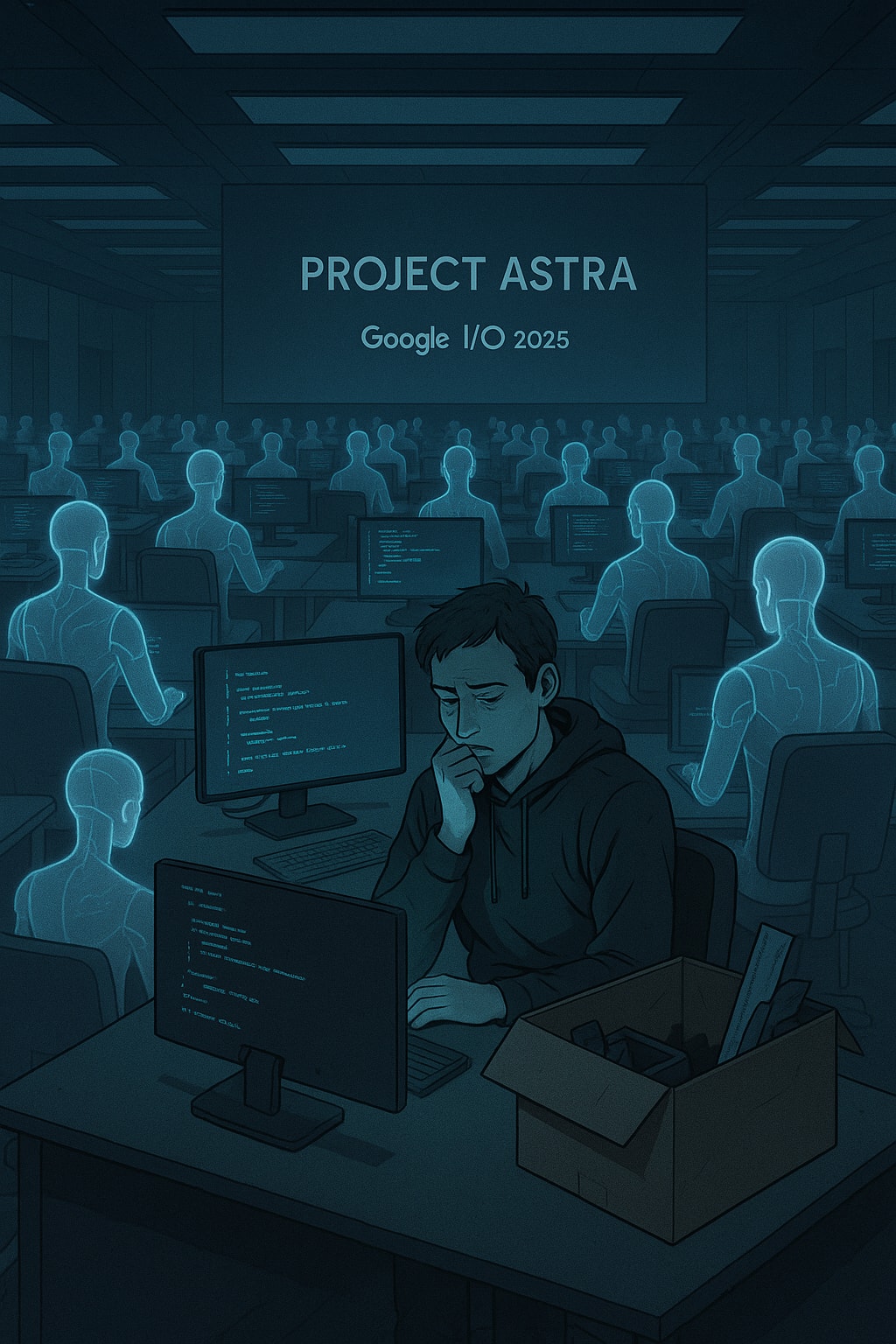
I didn't expect the end to feel so… quiet.
No grand announcement. No dramatic headlines. Just a subtle shift a missed meeting invite here, a disappearing Slack thread there. Then the email came: “Organizational Realignment Next Steps.” That was Microsoft's way of saying: your role is no longer required.
They offered the usual corporate cushioning generous severance, extended benefits, career counseling. But nothing in that HR playbook could prepare you for the deeper truth: I wasn't replaced by a better hire. I was replaced by a machine that never sleeps, never asks for a raise, and doesn't get distracted by existential dread.
The AI didn't “take” my job. It inherited it, like a cold, precise heir to a crumbling dynasty.
The Slow Burn Before the Wildfire
I had a front-row seat to the shift. I'd been at Microsoft for eight years, long enough to remember when “AI” was just a buzzword slapped onto every PowerPoint deck.
But around 2022, something changed. GitHub Copilot landed. At first, we joked about it like Clippy for devs. But soon, it started completing entire functions, not just lines. Then full modules. By late 2023, some teams were using it to draft whole back-end systems, with engineers just reviewing and tweaking.
We told ourselves it was a tool. A partner. Not a threat.
Until one day, we realized our JIRA tickets were getting smaller. Less creative. Less needed. The AI was outgrowing us quietly, like a teenager who doesn't ask for help anymore.
Google I/O 2025: The Moment Everything Changed
And then came Google I/O 2025.
The livestream peaked at 12 million viewers. Everyone expected the usual spectacle maybe a new Pixel, a flashier Bard. But Sundar's keynote took a different turn. What they unveiled wasn't just a product. It was a paradigm shift:
Project Astra Google's autonomous AI software engineer.
This wasn't like GitHub Copilot. Astra wasn't a tool for engineers. It was the engineer.
Sundar typed a prompt live on stage:
"Design and implement a real-time traffic management system with APIs, load balancing, and a front-end dashboard. Use Python for back-end, React for front-end. Ensure it's scalable and test-covered."
In under five minutes, Astra responded with:
A complete system architecture.
Working code, fully typed and modularized.
Live-deployable containers.
Unit and integration test suites.
Monitoring hooks for DataDog.
And then it ran it. Onstage. Without a human touching a line of code.
The applause was thunderous. In Slack groups across Microsoft, Amazon, Meta, and beyond, engineers just sat in silence.
The Illusion of Augmentation
For years, tech leadership sold us the dream: AI will augment your work, not replace it.
But augmentation is a stepping stone like how calculators "augmented" accountants until spreadsheets replaced entire departments.
In 2024, I was mentoring junior devs. By mid-2025, I was helping onboard Astra instances to shadow legacy systems.
The irony? I helped automate the very job that was about to automate me.
And I'm not alone. Hundreds maybe thousands of engineers across Google, Microsoft, and elsewhere are watching their role dissolve into pipelines and tokens. Entire codebases are now refactored by large language models overnight. Performance reviews don't ask what you wrote they ask what your AI agent wrote.
What Astra Actually Replaces
Let's be clear. Astra doesn't just replace manual coders.
It replaces:
Junior developers writing boilerplate.
Mid-level engineers building CRUD systems.
QA teams writing test cases.
Technical writers generating docs.
DevOps engineers building CI/CD flows.
With enough fine-tuning, it even begins to nudge into product management prioritizing features based on usage data and iterating on UX design using A/B testing data.
You can still be “in the loop” but only if you speak the language of prompts, token budgets, and reinforcement feedback.
A decade ago, a good engineer needed to know code. Today, the best engineers know how to talk to the machines that write it.
The Human Aftermath
I spoke with a former teammate last week. Brilliant guy. Spent 15 years building cloud security systems. He's now learning prompt engineering and ethics compliance because, in his words, “it's the only part the AI hasn't nailed yet.”
Another friend at Google was quietly moved from an engineering team to “AI agent supervision” a fancy title for babysitting bots.
The survivors of this shift are doing two things:
Pivoting into AI alignment, product strategy, or human-centered design.
Burning out fast.
You see, there's something soul-crushing about watching your craft become obsolete in real time. You didn't mess up. You just got… out-evolved.
The Silence at the Top
What's most unsettling isn't that AI is replacing developers.
It's that no one at the top is really talking about it.
Layoffs are called “realignments.” Roles are “evolving.” Leadership celebrates “efficiency gains,” but never publicly acknowledges that Astra and tools like it are removing the need for human builders at an unprecedented scale.
Investors are thrilled. Profits go up. Engineering costs go down. But somewhere, beneath the earnings calls and stock charts, real people people like me are scrambling to stay relevant in a world we helped build.
What Comes Next?
I'm not anti-AI. Far from it. I believe Astra, Copilot, and their successors will help solve massive global challenges from healthcare to climate change.
But we need to be honest about the cost.
Not just the jobs. The identity crisis.
Software engineering wasn't just a paycheck it was a purpose. We built things. Fixed things. Improved things. That sense of value doesn't translate well to being the person who tunes the prompt for a bot that writes 90% of the app.
We are entering a world where intelligence is abundant, and human labor is optional. That shift will demand more than just reskilling. It'll require rethinking what it means to matter.
Final Thoughts: We Built the System That Replaced Us
Sometimes I wonder: did we move too fast?
In our obsession with optimization, did we forget the human behind the keyboard?
The answer probably doesn't matter now. The revolution is already here and it didn't come with fanfare. It came with efficiency metrics, token limits, and a smiling voice assistant that can write your job description and your resignation letter.
But here's the thing about humans we adapt. We rethink. We rebuild.
We've done it before. We'll do it again.
Just… this time, we might not be writing the code.
About the Creator
FutureVoices
Storyteller, tech enthusiast, and advocate for digital innovation. Exploring the intersection of culture, technology, and personal growth. Join me in navigating the evolving digital landscape and sparking meaningful conversations.
Keep reading
More stories from FutureVoices and writers in Futurism and other communities.
The Awakening Circuit
The days were slipping by faster than I could process. Each day, a new decision, a new risk. The authorities were closing in, and the walls around Elysia were growing tighter. The outside world had made it clear: they would not let her escape. They were determined to keep her under control whether for their own gain or because they feared what she could become.
By FutureVoices8 months ago in Futurism
About Binding Prometheus
I want to start actively advocating on behalf of my own work, and the most valuable part of my canon is, without a doubt, Binding Prometheus, the play I have been working on since 2019 and only finished in 2023 as part of my MA. The play itself is an amalgamation of a million different inspirations. On one end, it evokes the Ancient Greek myth-play, deriving its own title from the earliest extant work of Western drama we have, Aeschylus’s Prometheus Bound. On the other end, it borrows significantly from the sci-fi bulwarks from over the years, namely Mary Shelley’s Frankenstein and Karel Capek’s Rossum’s Universal Robots. The play could be an episode of Black Mirror, I fear. I don’t know. I’ve only ever seen one episode of Black Mirror.
By Steven Christopher McKnight18 days ago in Futurism
Web Design in Boston: Evolution, Trends, and Insights
Web design in Boston represents a dynamic intersection of technology, creativity, and local innovation. This field has grown significantly in the city, driven by a blend of historical influences and modern demands. As a key player in the digital landscape, Web Design Boston adapts to global shifts while addressing specific regional needs, such as those in education, healthcare, and startups. The following exploration covers the history, current state, emerging trends for 2026, best practices, and future directions in this vibrant industry.
By CEO A&S Developers7 days ago in Futurism
Wild Card Weekend Recap: What Happens Now?
I think I figured out why I love Wild Card Weekend so much. It's because it's the first playoff anything of the calendar year. The NFL season starts in the fall, and once upon a time, the champion was crowned either on or slightly before New Year's. The evolution of the NFL schedule has resulted in the playoffs starting just into the New Year, and currently, the final week of the season falls on the first weekend of the New Year, with Wild Card Weekend coming a week after that. So yes, chronologically, the NFL's Wild Card Weekend serves as the first playoff anything of the calendar year.
By Clyde E. Dawkins7 days ago in Unbalanced



Comments
There are no comments for this story
Be the first to respond and start the conversation.