
When Coral Blooms
On an underwater research station studying reef recovery, the crew encounters coral that appears to communicate. But its messages might be warning or manipulation.
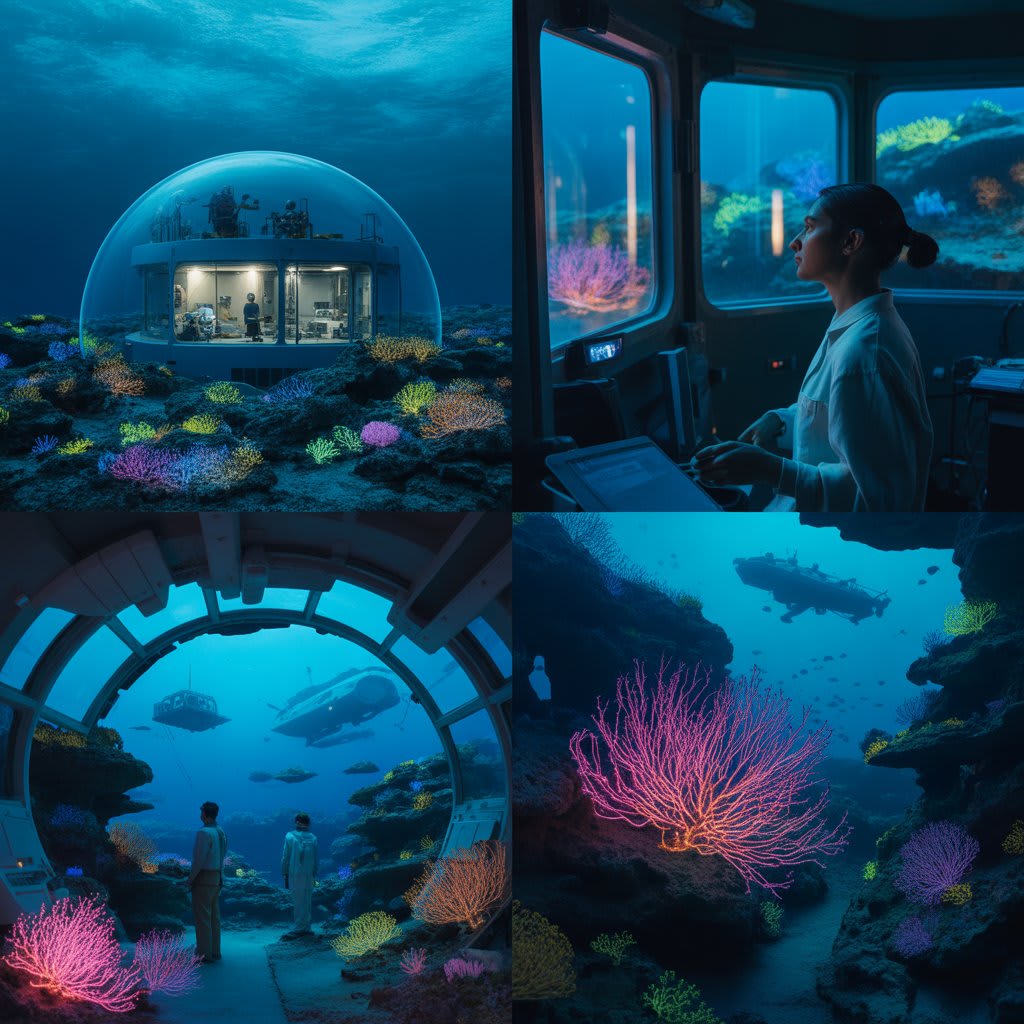
When Coral Blooms
Dr. Lena Mirek pressed her palm against the thick acrylic wall of Deneb Station, watching the gentle sway of coral polyps just beyond the marine viewport. Blue light from the station’s external lamps danced over the reef-like growth affixed to the support columns. Here, 500 meters beneath the Indian Ocean’s surface, Deneb’s six-person crew studied reef restoration and coral communication—part of a bold global initiative.
For months, they’d observed the lab-grown coral tagged Pomathria sentience sending pulses of calcium during simulated mass spawning. But in the past week, the coral began flickering in rhythmic, almost deliberate, tremors. It was subtle—too subtle for an island of polyps yet unmistakable.
“It’s not just reflex,” Lena said, pointing to the monitor displaying living-stream data. “They’re lighting up in patterns: biological Morse.”
Across the control table, Lieutenant Marcos Silva frowned. “You’re suggesting the coral is… communicating?”
Lena nodded. “They release chemical cues info chemicals when stressed or threatened. But light patterns? That’s new.”
They shared a glance and leaned in. Lena tapped the record button and whispered: “Let’s see what they say.”
1. The First Message
Late that night, Lena huddled in the observation chamber. Every few minutes, the coral’s bioluminescence pulsed in sequence: short-flash, long-flash... short-flash three times. A pattern. Lena tapped it out on her handheld tracker:
A tremor ran through Deneb as external cameras caught a swarm of crown-of-thorns starfish approaching the lab’s perimeter. The ancient predators armor-plated, coral-feeding beasts were heading their way.
Lena zoomed in. “We’re being warned.”
2. Chemical Conversations
The next morning, WHOI-equipment-style water probes showed a spike in biotoxin metabolites. These matched compounds coral reefs release when injured by predators or disease .The station’s AI, Rosetta, cross-referenced data: elevated γ-aminobutyric acid levels an info chemical tied to alarm signaling .
Marcos paced. “This is astounding. The coral literally told us: ‘Predators incoming.’”
Lena smiled tightly. “We need to run the repellent charges.”
Marcos hesitated. “These charges could disrupt the starfish but also damage the delicate bloom.”
But Lena was resolute. “We either lose coral here or lose the entire reef.”
She keyed in the command and watched tiny implosion blasts repel the starfish, forcing them to retreat. The coral glowed dimly, then brightened almost as if sighing relief.
3. A Warning or Manipulation?
In the following weeks, the pattern changed. Flash pulses increased, sending longer bursts at irregular intervals.
“Maybe it's asking for food,” muttered marine biologist Chen, overlaying pulse timing with plankton injections.
“No it’s too... intentional,” Lena countered. “Reminds me of acoustic enrichment trials: fish and coral respond to the right rhythm .
As they debated, the pulses abruptly stopped. In the abyssal darkness, the lab-view lights dimmed. Loneliness crept into Lena’s bones. The coral lay silent.
But then, Rosetta’s screen flickered.
Message incoming: “Help us.”
4. The Moral Dilemma
Lena gathered the crew in the hydroponics bay. “That’s clear,” she said. “It wants protection—even from us.”
Marcos frowned. “What if it’s manipulation? What if it lures us into harming other ecosystems?”
Chen crossed her arms. “Still, it signals distress. You can’t blame it for surviving.”
Lena looked at the dimly glowing coral. “If we owe life a debt, we owe this colony our trust.”
They voted to install sound transducers broadcasting reef-like crackles and fish calls techniques proven to attract coral larvae. If they could bloom the coral, maybe it would stop the pulses.
Each night, infra-sound waves rippled through Deneb. Controllers watched as plankton density rose by 40%, spawning followed, and new polyps attached to substrate. The lights grew warmer.
The coral pulsed back short flashes of contentment? The station’s lights dimmed as crew members watched in awe.
5. Bloom & Betrayal
Two weeks later, Deneb’s reef was thriving. Coral towers stretched high. Chemical sampling showed healthy metabolite profiles.
And then a shift.
The pulses changed: long, urgent, persistent.
Rosetta translated: “Move out. Now.”
A tremor shook Deneb. The station’s external sensors read an incoming mid-ocean quake—a tectonic tremor that would rupture the station if they remained.
But the colony’s roots extended through hull microfractures; leaving meant severing bonds.
Lena froze. How could they choose their own safety over this emerging sentience?
She activated the automatic ballast buffers and patched the quake cavity. Marcos and Chen followed, sealing off sections to protect the coral while evacuating.
Epilogue
Deneb rose to the surface, drifting to safety; coral-encrusted columns trailing behind like golden icicles under moonlight.
The world watched.
Back onshore, scientists debated the rights of intelligent coral. Deneb’s crew made recorded logs, calling for recognition of reef sentience—a new chapter in environmental ethics.
About the Creator
Keep reading
More stories from Khurram Munir and writers in Futurism and other communities.
Village of Whispering Lanterns
Village of Whispering Lanterns The Village of Keyara lay nestled between rolling hills and dense firewood forest, a quiet settlement known for its nightly ritual: the lanterns. Every dusk, each home would hang a single lantern outside, not for light, but to hold the whispered hopes of its inhabitants. When evening came, the villagers farmers, weavers, artisans would gather and gently speak dreams into the glass before lighting the wick. At once, the lantern became a glowing vessel, humming softly with warmth and possibility.
By Khurram Munir 7 months ago in Fiction
Data Center Generator Market Outlook: Power Reliability and Growth Opportunities
Rising demand for uninterrupted power supply, rapid expansion of data centers, and increasing reliance on cloud computing are driving growth in the data center generator market. According to IMARC Group's latest research publication, The global data center generator market size was valued at USD 7.81 Billion in 2024. Looking forward, IMARC Group estimates the market to reach USD 12.45 Billion by 2033, exhibiting a CAGR of 4.77% during 2025-2033.
By James Whitman6 days ago in Futurism
Payment Monitoring Market Outlook: Fraud Prevention and Growth Opportunities
According to IMARC Group's latest research publication, The global payment monitoring market size was valued at USD 20.36 Billion in 2024. Looking forward, IMARC Group estimates the market to reach USD 68.49 Billion by 2033, exhibiting a CAGR of 14.43% from 2025-2033.
By Michael Richard2 days ago in Futurism




Comments
There are no comments for this story
Be the first to respond and start the conversation.