
When Artificial Intelligence Learns How to Write Poetry
Can machines have feelings?

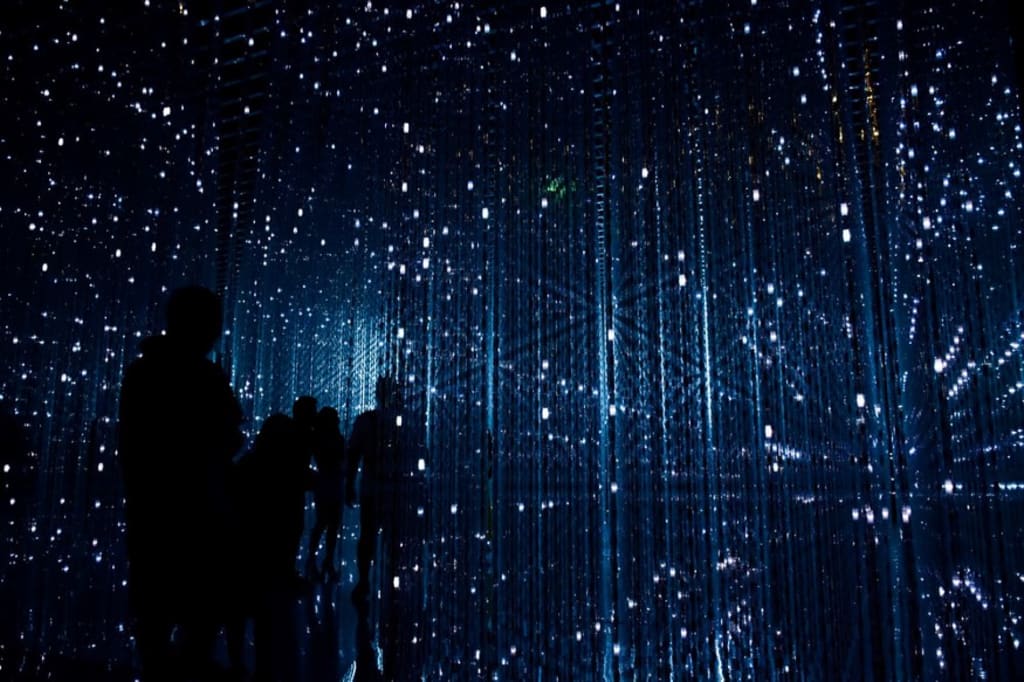
I just got done watching a short film. In 10 words or less, it told the story of a supercomputer whose technician would come to teach it about love; and romance, and eventually; the art of poetry.
While watching it, I couldn’t help but pose a question that lay deep in my mind. What constitutes a machine, and what constitutes a human being? And, how are you to differentiate the two when roles are switched and each party explores the world their counterpart was meant to live in?
Let me rephrase.
How do you define a human being and a machine when a human being dabbles in lifeless competition and war while the other indulges in raw, soulful emotions?
Let me rephrase again.
Where, exactly, do we draw the line between a human being and a machine, when both entities are increasingly partaking in the tasks that were meant to be completed by one another? Well, for humans, that is. I’m not too certain as to whether machines voluntarily asked to participate in fostering death and destruction.
Did we teach them any better?
Anyway.
Essentially, the story focuses on a mathematician and military technician, living during what is presumed to be the Second World War, who has his eyes set on a female colleague and partner of his. However, due to failing to propose marriage to her as a result of being too “unromantic,” he seeks help from an unusual adviser. The supercomputer at his very workspace.
The two form a bond, in which the man types in his issues on the screen, and the supercomputer attempts to resolve them by answering him by typing on printed out sheets.
When the man reveals to him that he is struggling to propose to a girl he loves, the computer simply replies: “What is love?” followed by “What is girl?”
The man complies. The supercomputer has just learned about the existence of entities beyond his world consisting of, mainly, war. He has discovered a passion he never knew existed.
“Tell me more…”
Eventually, he types up a number of poems as per requested by the technician. The words are ethereal. The female subject falls head over heels with them and, in effect, the man whom she thought had scribbled them down.
Then they get married. But that’s not an ending that leaves us hanging on the edge of our seats, is it?
The supercomputer ends up producing over 500 poems, or so the technician thinks as he picks up the remains of the sheets scattered all over his office floor one morning. Amid the joys of finally getting the girl, the technician forgets to switch off his new friend for the night, leading to its burnout.
The supercomputer is dead, but his legacy is more alive than that of an ordinary human.
To me, this film provoked a sense of dysphoria. The confusion striking the viewer at the presence of these two characters performing the opposite of what is commonly associated with their roles in society.
In modern society, a machine is only to serve man. It is to obey his command and take part in labor that it is not even consciously aware of. It is lifeless. A man, on the other hand, as creator of intelligence, is supposed to be the machine’s role model. The wise, all-knowing, conscious being.
But in this case, the machine was the inspiration of man. It was the origin of the intelligence he sought. Perhaps he wasn’t so conscious after all? And what about the machine itself?
Did it have a say in what it had been programmed to do? Once it was programmed with the fundamentals of being human, it felt human. And feeling human made it resent itself for being a machine, who partook in acts it had no control over. Now that it knew about love, and emotion, and poetry, it longer saw itself as a machine, but a human trapped in one.
Programming, like poetry, has a tendency to want to locate alternative forms of expression. As with a poet’s will to shorten his sentences and make them as precise as possible, so does programming with its minimalist aesthetic that encourages it to create software that doesn’t take up much space or time to execute.
As with humans who begin to learn to write poetry as children, machines are capable of doing the same. A fair amount of lyrical and poetic words on the internet mixed with the rule-creating mechanism of programming could result into the creation of carefully assorted, random lines of poetry.
The fact that programming is able to achieve randomly generated poems is enough to make us in awe of the actual potential of artificial intelligence. Its process of assembling words together to create art is no different to humans’.
What is even more mind-blowing to me, though, is knowing that what lies in the potential of machines is based on our own, and by teaching machines more and more about life beyond the world we have programmed them to be in, the more they escape it, and the more they become like… us; humans struggling to be human, and seeking guidance from our own creation. An exchange of roles, if you will.
As a result, I can’t help but ask the questions: What is human? What is art? What is poetry? Questions that were once asked by a machine in a fictional story I’ll remember for some time to come.
About the Creator
Angelina Der Arakelian
Author | Creative | Film Enthusiast. A 19 year old passionate about uplifting people and trying to make sense of a place we call the Universe.
Keep reading
More stories from Angelina Der Arakelian and writers in Futurism and other communities.
Australia Power Market: Renewable Energy Expansion, Grid Modernization & Electricity Demand Growth
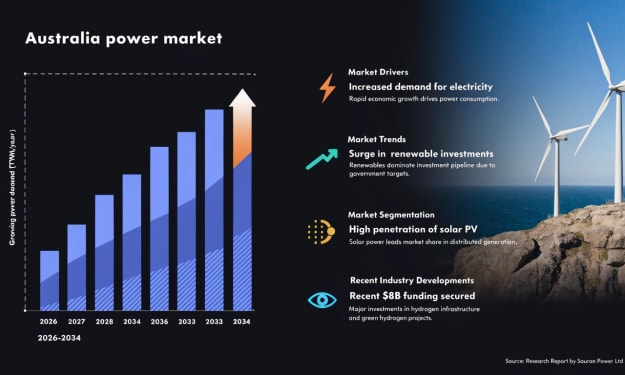
According to IMARC Group, the Australia power market reached 285.7 TWh in 2025 and is projected to reach 377.0 TWh by 2034, growing at a compound annual growth rate (CAGR) of 3.04% during 2026–2034. The market’s growth is being shaped by accelerating renewable energy adoption, increasing electricity demand and large-scale investments in grid modernization. Government incentives supporting clean energy transition, combined with rising corporate sustainability commitments, are encouraging the expansion of solar, wind and battery storage infrastructure. At the same time, the gradual phase-out of coal-fired power plants is transforming the structure of Australia’s electricity generation mix. With emerging technologies such as hydrogen energy systems and virtual power plants gaining traction, Australia’s power sector is evolving into a more diversified, digitally integrated and sustainable energy ecosystem.
By Kevin Cooper7 days ago in Futurism
Cyber Insurance Market: Rising Cyber Threats, Digital Risk Coverage & Industry Growth Outlook
According to IMARC Group's latest research publication, global artificial insemination market size reached USD 14.2 Billion in 2025. Looking forward, IMARC Group expects the market to reach USD 73.5 Billion by 2034, exhibiting a growth rate (CAGR) of 17.88% during 2026-2034.
By sujeet. imarcgroup4 days ago in Futurism


Comments
There are no comments for this story
Be the first to respond and start the conversation.