
What Would Change If We Lived for 300 Years
Exploring the Implications of Living for 300 Years

Contemplating the possibilities of an extended lifespan brings to mind our fascination with ageless legends like the Sorcerer's Stone, the mythical Fountain of Youth, and even the enigmatic existence of vampires. The common thread that runs through these tales is our innate curiosity about what it would be like to possess eternal life. While some researchers argue that there are no limits to our potential lifespan, proponents of the "No Limit Camp" maintain that as long as we continue making scientific advancements and prioritize self-care, we could potentially live indefinitely, or at least until we exhaust our financial resources. On the other hand, skeptics of eternal life argue that our bodies possess an inherent expiration date, and while we can take measures to delay it, there are inherent limitations. A recent study suggests that the maximum human lifespan may hover around 150 years. Analyzing data on the world's oldest individuals over the past few decades, researchers concluded that there is an ultimate expiration date for our lives. This study provides valuable insights into the boundaries of human longevity, guiding future research on aging biology and the development of novel treatments for age-related diseases.
Let us delve into the hypothetical scenario where we can successfully push back the inevitability of our finite lifespan and extend it to a remarkable 300 years. Although still confined within a finite timeframe, it grants us a considerably longer life experience. The prospect of living forever might not be as appealing as it initially seems, as the fear of monotony and boredom could eventually surface, leading us to appreciate the value of a finite life. However, living for 300 years would undeniably revolutionize every aspect of our existence.
Firstly, let us contemplate the concept of aging and how it would be redefined in a world where lifespans triple. In our current lifespan, we often consider ourselves middle-aged at around 50 years old. If our lifespan were extended to 300 years, reaching 50 would merely mark the beginning of our teenage years, since we have over two centuries ahead of us. It is akin to experiencing a sudden shift in the perception of time, where every minute becomes the equivalent of three. This fundamental shift in our perception of aging and life stages would reshape our understanding of personal growth and milestones.
Moreover, we need to explore the potential implications for education and personal development. Currently, our adolescent brains continue developing and do not reach full maturity until approximately 25 to 30 years of age. In this extended lifespan scenario, the duration of our education would likely be significantly prolonged, allowing us ample time to acquire a multitude of skills and knowledge. We might find ourselves attending school for an extended period, mastering various subjects, learning multiple languages, and delving into emerging fields like organ replacement and AI technologies. The education system and curriculum would naturally adapt to accommodate the expanded timeline, fostering continuous growth and intellectual exploration throughout our extended lives.
Furthermore, the impact of an extended lifespan would extend beyond personal growth and education. It would necessitate a reevaluation of societal structures, workforce dynamics, and economic systems. With more time at our disposal, career paths might evolve into more diverse and nonlinear trajectories. We could engage in multiple professions, gaining expertise in various fields over the course of our extended lives. The retirement age would likely be pushed further into the future, as individuals seek fulfillment and purpose in their prolonged careers. These societal changes would have significant implications for workforce planning, social security systems, and the distribution of resources.
Additionally, the development of medical advancements and treatments would become crucial to sustain a prolonged lifespan. As we strive to maintain our physical and emotional well-being over the course of three centuries, healthcare systems would need to adapt to cater to the unique needs of an aging population. Breakthroughs in regenerative medicine, anti-aging therapies, and personalized healthcare would become paramount in maintaining quality of life and mitigating age-related ailments. Our understanding of genetics, cellular rejuvenation, and the biology of aging would undergo significant advancements, leading to novel interventions and treatments.
In conclusion, imagining a world where we live for 300 years invites us to ponder the profound transformations that would unfold in every facet of our lives. While the desire for eternal life might hold allure, the prospect of an extended but finite lifespan offers a balance between longevity and the appreciation of the preciousness of our existence. It would redefine our perception of aging, necessitate changes in education and career paths, and drive advancements in healthcare and societal structures. As we contemplate these possibilities, we are reminded of the importance of cherishing the time we have and making the most of our ever-changing journey through life.
About the Creator
Keep reading
More stories from writers in Futurism and other communities.
Australia E-Pharmacy Market: Telehealth Integration, AI-Driven Prescription Management & Digital Healthcare Access
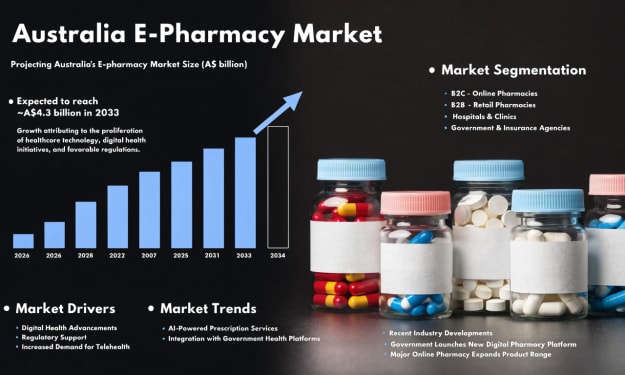
According to IMARC Group, the Australia e-pharmacy market reached a value of USD 3.4 Billion in 2025 and is projected to reach USD 10.5 Billion by 2034, growing at a compound annual growth rate (CAGR) of 12.93% during 2026–2034. The market is expanding rapidly as digital technologies transform how healthcare services are accessed and delivered across the country. E-pharmacy platforms allow consumers to purchase prescription medicines, over-the-counter drugs and health products through online channels while benefiting from doorstep delivery services. Rising internet penetration and widespread smartphone adoption are enabling consumers to access digital healthcare services more conveniently. Additionally, the expansion of telehealth consultations is creating integrated healthcare ecosystems where patients can receive digital prescriptions and order medicines online seamlessly. Increasing awareness of chronic disease management and regulatory emphasis on prescription authentication are also supporting the growth of the e-pharmacy sector across Australia.
By Shrestha Roy3 days ago in Futurism
Saudi Arabia E-commerce Market: Digital Payments, Logistics Expansion & Growth Outlook
According to IMARC Group's latest research publication, Saudi Arabia e-commerce market size reached USD 222.9 Billion in 2024. The market is projected to reach USD 708.7 Billion by 2033, exhibiting a growth rate (CAGR) of 12.8% during 2025-2033.
By Shubham Sharma 3 days ago in Futurism
Author’s Advice
If you would’ve asked me 20 years ago did I know I’d become a writer and an author, I would’ve said “nope, ain’t happening”. As fate would have it I did become an author and I can honestly say I’m loving it so far. It really does feel good to be a writer. I’ve learned a lot on this journey and I feel like with even me being as new to this world as I am, there’s some wisdom I need to share with every other aspiring author.
By Joe Patterson4 days ago in Journal



Comments
There are no comments for this story
Be the first to respond and start the conversation.