
What the World Will Look Like in 2050 (If We Survive)
A journey through the technologies, crises, and choices shaping the planet’s uncertain future.
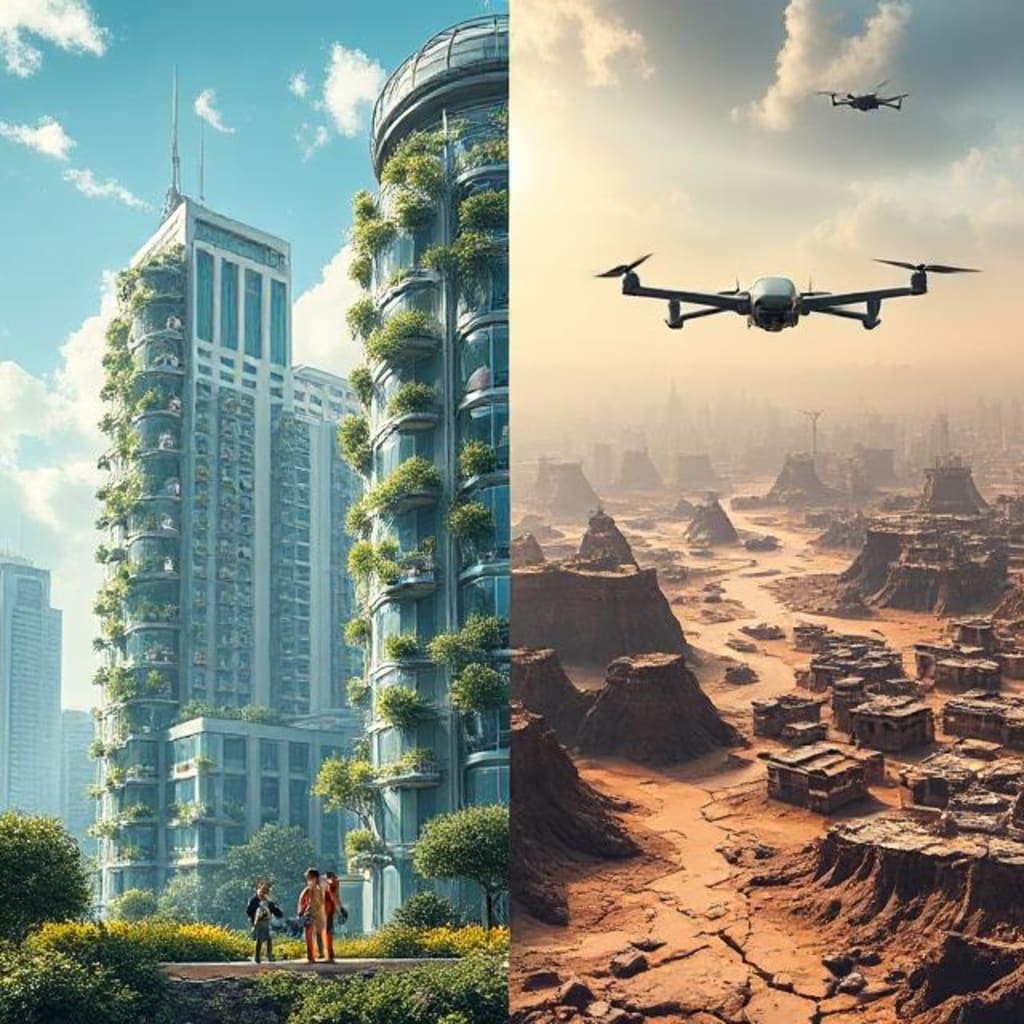
The year 2050 feels both distant and near. A mere twenty-five years away, it is close enough that many of us alive today will see it—but far enough that the world we know may be unrecognizable. Scientists, futurists, and storytellers paint radically different visions: one of dazzling innovation where disease, poverty, and hunger fade into history, and another of collapse, where climate, politics, and technology spiral beyond control.
This story is not a prophecy but a map of possibilities—how the world might look in 2050, depending on the roads we take today.
Chapter 1: The Cities That Never Sleep
By 2050, more than two-thirds of humanity will live in cities. Some of these cities will be marvels of human ingenuity: megacities powered by renewable energy, where drones deliver groceries, and skyscrapers double as farms. Streets could be car-free, dominated by AI-driven public transport.
But not all urban futures will be equal. While cities like Singapore, Tokyo, and Amsterdam may thrive, others could buckle under pressure. In Lagos, Karachi, or Dhaka, rapid growth might outpace infrastructure, leading to sprawling slums, water shortages, and energy blackouts. The divide between “smart cities” and “struggling cities” could define the century.
Chapter 2: Climate—the Unavoidable Reckoning
The most urgent question for 2050 is not what we build but whether we can survive the damage already done. By then, scientists predict that average global temperatures may rise by 1.5–2.5°C. That number sounds small—but it means rising seas swallowing coastlines, superstorms battering cities, and droughts leaving farmlands barren.
The Arctic summer ice could vanish completely. Entire nations—like the Maldives or Tuvalu—might exist only in memory. Wars over water and fertile land could become as common as wars over oil once were. Yet, if we act decisively now, 2050 could also be the age when humanity proves it can reverse the damage: green hydrogen fueling industries, carbon capture pulling pollution from the sky, and global agreements saving rainforests before it is too late.
Chapter 3: The Future of Work and Wealth
Robots, AI, and automation will reshape the very idea of “work.” By 2050, millions of jobs—drivers, clerks, factory workers—will be long gone. In their place, new jobs will emerge: AI ethicists, climate engineers, genetic designers. But not everyone will benefit equally.
If automation creates extreme wealth for a few, the rest of the world may see unprecedented inequality. Will governments provide universal basic income, or will millions be left behind in a new form of digital serfdom? The answer could determine whether 2050 is remembered as the golden age of innovation—or the century’s cruelest betrayal.
Chapter 4: Health and Human Longevity
Medicine in 2050 may make today’s hospitals look primitive. Genetic editing tools like CRISPR could eliminate hereditary diseases. Nanobots might swim through bloodstreams repairing cells. Organ shortages may disappear thanks to 3D printing.
Some scientists even predict radical life extension, where humans live well beyond 100 in good health. But such progress raises profound ethical questions: Who gets access to life-extension? Will the rich live longer while the poor die sooner? And what does it mean for societies if people live twice as long but jobs and resources remain limited?
Chapter 5: Technology’s Double-Edged Sword
By 2050, AI may not just assist humans—it may surpass us in most forms of intelligence. Machines could govern traffic, write laws, and even predict crimes before they happen. Some experts envision a seamless partnership between humans and machines, with AI amplifying our creativity and solving problems we can’t.
But others warn of digital authoritarianism, where governments or corporations use AI to monitor every movement, thought, and purchase. Freedom could vanish under the weight of perfect surveillance.
And then there’s the unknown: What if AI becomes not just smarter but self-directed? Will it see us as partners—or obstacles?
Chapter 6: Borders, Nations, and Conflicts
The political map of 2050 may be very different. Rising seas could erase borders; mass migrations may redraw them. Africa’s population will nearly double, making it the youngest continent and a global economic powerhouse—if stability allows it. Meanwhile, superpowers like the U.S., China, and India may clash in a new Cold War over technology and resources.
Yet, there’s also hope. The crises of climate and technology might push nations toward unprecedented cooperation. Imagine a world where shared resources are governed not by rivalry but by collective survival.
Chapter 7: Beyond Earth
By 2050, humanity may no longer be bound to Earth. Permanent settlements on Mars or the Moon could be reality, driven by billionaires and space agencies alike. Space mining might supply Earth with rare minerals, changing the balance of global economies.
But the same question remains: will space be humanity’s shared frontier—or just another playground for the wealthy few?
Conclusion: 2050 Is Already Here
The future is not a distant horizon—it is already being built in boardrooms, labs, and streets today. Every policy, every innovation, every choice moves us closer to one of two visions: a planet thriving in balance, or a civilization collapsing under its own weight.
By 2050, we may look back and ask: Did we act in time, or did we wait until survival was no longer guaranteed?
The answer, unsettling and empowering, is that the future is not written—it’s chosen.
About the Creator
Keep reading
More stories from Hamza Habib and writers in Futurism and other communities.
“Post-2025 Market Leaders: The Companies You Can’t Ignore”
Introduction: A World Under New Management Business history teaches us one lesson: the throne never stays occupied forever. IBM yielded to Microsoft, Microsoft yielded to Google, and Google found itself sharing space with TikTok and OpenAI. Oil once powered the planet, now data and clean energy compete for that title.
By Hamza Habib7 months ago in Futurism
Stanislav Kondrashov Oligarch Series: Oligarchy and the Expansion of Intercontinental Electricity Networks
Electricity systems around the world were originally designed to operate locally. Cities built grids to supply nearby industries, homes, and transport systems. Over time, these grids expanded regionally, forming larger networks capable of supporting entire national economies. Today, a new chapter is beginning to take shape: intercontinental electricity networks that link distant regions into one vast system.
By Stanislav Kondrashov about 4 hours ago in Futurism
The Quiet Engine Behind Modern Healthcare: Understanding the RCM Outsourcing Market
Patients likely leave the doctor's office thinking about the diagnosis, the prescription or the next step in their care․ Rarely do they think about what happens to the bill after the visit․ Beyond that one visit is a whole repertoire of administrative responsibilities: insurance verification, coding, billing, appeals, payment collection a process that may take weeks or months․
By Frank Morgana day ago in Futurism
A More Human Vocal
When we launched Vocal nearly a decade ago, the world was a very different place. LLMs did not exist, and stories were created one at a time by people sitting down to write, revise, and share something personal. Many of our assumptions about publishing, trust, and participation were built for a world where effort and output were inseparable.
By Justin @ Vocala day ago in Resources




Comments
There are no comments for this story
Be the first to respond and start the conversation.