
what the SEC's Regulatory Approach Means for Crypto's Future
A Crossroads for Crypto

The cryptocurrency industry stands at a critical juncture in 2025. While mainstream adoption continues to rise through institutional investments, retail access, payment integrations, and ETF listings, regulatory uncertainty still casts a shadow over innovation. At the heart of this regulatory tug-of-war sits the U.S. Securities and Exchange Commission (SEC), a government agency whose actions increasingly shape the global crypto narrative. The question is no longer if the SEC will act on crypto—but how, and what it means for the future of this rapidly evolving industry.
The stakes are higher than ever. As decentralized finance (DeFi), NFTs, and tokenized real-world assets expand their presence, the demand for regulatory clarity has become louder from both crypto-native developers and traditional financial institutions. The SEC's approach will either enable sustainable growth or push innovation offshore. Understanding their motivations and tactics is essential to anyone hoping to navigate or invest in this space.
The SEC's Expanding Reach
Over the past five years, the SEC has broadened its interpretation of securities laws to encompass a wide range of crypto assets. Under the leadership of Chair Gary Gensler and his successor, the Commission has aggressively pursued cases involving token offerings, staking-as-a-service platforms, decentralized exchanges, and centralized trading platforms that fail to register. The landmark Ripple Labs case, although partially resolved, set a precedent for how courts may view the distinction between utility and security tokens.
In addition to Ripple, lawsuits against Coinbase, Binance, and smaller DeFi protocols have further signaled the SEC's intent to exert comprehensive oversight. These cases often hinge on the application of the Howey Test—a decades-old legal standard—to modern blockchain-based assets. Critics argue that applying this outdated framework to decentralized protocols is not only flawed but also dangerous to innovation.
Impact on Innovation and Investment
Crypto developers and venture capitalists often express concern that the SEC's heavy-handed approach may stifle innovation. Many argue that applying outdated securities laws from the 1930s to decentralized technologies creates friction that discourages domestic entrepreneurship. For example, the threat of enforcement actions has chilled initial coin offerings (ICOs) and token launches in the U.S., even as Web3 fundraising thrives in regions like the EU, Dubai, and Singapore.
Moreover, developers fear that aggressive regulation will discourage experimentation with governance tokens, DAOs (Decentralized Autonomous Organizations), and new models for community ownership. These are some of the most promising components of Web3 innovation, and regulatory uncertainty may delay their growth or push them into underground markets. Investors, meanwhile, face greater due diligence burdens as they assess not only a project's fundamentals but also its regulatory risk.
As a result, American crypto investors are increasingly limited to secondary markets or offshore platforms. Several promising startups have relocated to crypto-friendlier jurisdictions to avoid regulatory minefields in the U.S. This brain drain is a growing concern for those hoping to see the U.S. maintain its role as a leader in technological advancement.
Winners, Losers, and the Regulatory Arbitrage
Some players benefit from this regulatory ambiguity. Major exchanges like Coinbase have taken a proactive stance by engaging with lawmakers and even suing the SEC for clarity. While these legal battles are ongoing, they serve to pressure Congress to step in with comprehensive legislation. Meanwhile, smaller decentralized platforms operate in legal gray areas, relying on protocol-level autonomy and governance decentralization to sidestep jurisdictional reach.
This dynamic creates an uneven playing field where regulatory arbitrage favors projects with the resources to hire legal teams or relocate. Large companies can adapt quickly or lobby for tailored rules, while smaller innovators struggle with compliance costs or abandon their projects entirely. Additionally, users are often caught in the middle, unsure of what protections they have or which platforms they can trust.
The irony is that regulation intended to protect consumers can sometimes end up driving them toward less regulated, higher-risk alternatives. This paradox is one of the thorniest challenges in crafting a smart crypto policy framework.
International Ripple Effects
The SEC’s actions don’t happen in a vacuum. Other regulators around the world often take cues from the U.S. approach, either emulating or countering it. The EU has responded with the Markets in Crypto-Assets (MiCA) regulation, creating clear and actionable rules for stablecoins, exchanges, and wallet providers. MiCA has been widely praised for its clarity and has already attracted firms seeking a predictable regulatory landscape.
In contrast, China maintains a hardline ban on crypto trading but paradoxically supports blockchain innovation through state-sponsored initiatives. Countries like Brazil, Japan, and South Korea are crafting middle-ground policies, balancing innovation with investor protection. These international contrasts highlight the urgent need for global coordination—or at least mutual recognition—of crypto regulations.
Projects that can adapt across jurisdictions and demonstrate compliance readiness are better positioned for long-term success. This may explain the growing demand for crypto legal experts and the rise of platforms offering compliance-as-a-service.
Navigating the Uncertain Future
The SEC's current posture signals that regulatory clarity may not come through new legislation, but through precedent-setting enforcement. For builders, investors, and users alike, this means the path forward requires caution, compliance, and strategic jurisdictional planning. While some view the SEC's approach as an attack on crypto, others argue that legal boundaries are necessary to legitimize and mature the space.
Yet the silver lining is that regulation—however imperfect—also brings legitimacy. As legal frameworks mature, crypto could finally shed its reputation as a speculative Wild West and evolve into a mainstream financial pillar. If regulators and innovators can find common ground, the next chapter of crypto won't just be about price speculation or market cycles—it will be about building infrastructure that lasts.
For now, the industry must live in two worlds: one foot in innovation, the other in legal compliance. Whether the SEC ultimately supports or stifles progress will depend on how well both sides can communicate, compromise, and collaborate. Until then, the future of crypto remains uncertain—but full of potential.
About the Creator
Ethan Caldwell
Crypto strategist and former fintech analyst with 8+ years in DeFi, blockchain, and macro trends. Focused on helping Web3 investors navigate markets through clear insights and accessible research.
Keep reading
More stories from Ethan Caldwell and writers in Futurism and other communities.
Dalpy Coin Is Catching Fire Before Launch as Solana’s Meme Coin Ecosystem Explodes
Something is happening on the Solana blockchain and if you have been watching closely, you have likely already seen it. Meme coins are not just making a return. They are evolving, getting smarter, more strategic, and in some cases, far more culturally relevant. And right now, one project is beginning to break through the noise before it has even launched. Its name is Dalpy Coin.
By Ethan Caldwell8 months ago in Trader
About Binding Prometheus
I want to start actively advocating on behalf of my own work, and the most valuable part of my canon is, without a doubt, Binding Prometheus, the play I have been working on since 2019 and only finished in 2023 as part of my MA. The play itself is an amalgamation of a million different inspirations. On one end, it evokes the Ancient Greek myth-play, deriving its own title from the earliest extant work of Western drama we have, Aeschylus’s Prometheus Bound. On the other end, it borrows significantly from the sci-fi bulwarks from over the years, namely Mary Shelley’s Frankenstein and Karel Capek’s Rossum’s Universal Robots. The play could be an episode of Black Mirror, I fear. I don’t know. I’ve only ever seen one episode of Black Mirror.
By Steven Christopher McKnight15 days ago in Futurism
Gaming Peripherals Market Size and Forecast 2025–2033
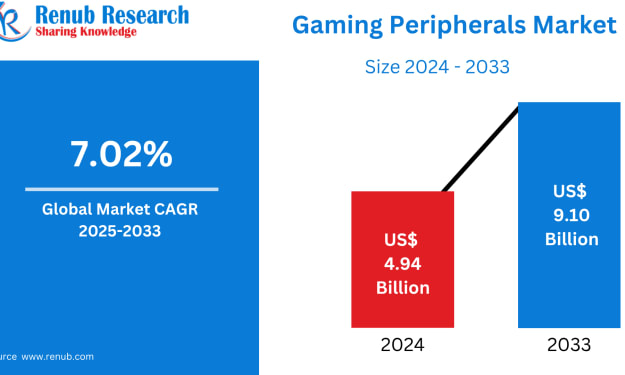
Gaming Peripherals Market: An Industry in Rapid Transformation The global gaming peripherals market is entering a decisive growth phase as gaming continues to evolve from a leisure activity into a mainstream form of digital entertainment and professional competition. According to Renub Research, the Gaming Peripherals Market is expected to grow from US$ 4.94 billion in 2024 to US$ 9.10 billion by 2033, registering a compound annual growth rate (CAGR) of 7.02% from 2025 to 2033. This expansion reflects not only the surging popularity of gaming worldwide but also the rising demand for high-performance devices such as gaming mice, mechanical keyboards, headsets, controllers, and other immersive accessories.
By Aaina Oberoi3 days ago in Futurism



Comments
There are no comments for this story
Be the first to respond and start the conversation.