
What is legacy System modernization
Legacy System Transformation: Overview

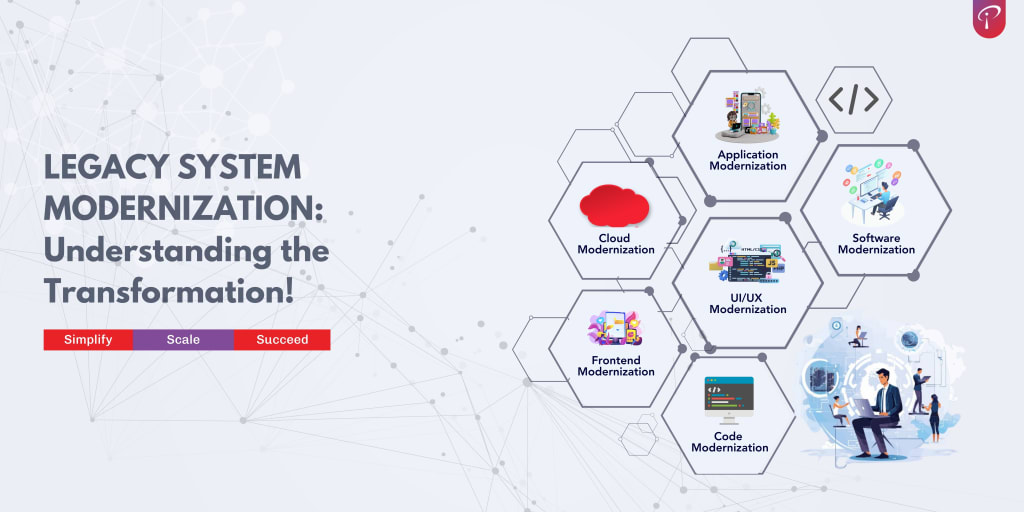
What is Legacy System Modernization?
IT Legacy System Modernization is an open-ended path leading to digital transformation. It is a continuous process of transforming your old legacy applications & software for better performance & reduce IT environment complexity and costs. It uses technology to migrate the legacy code to the modern platforms allowing organization to increase data security, platform integration & flexibility.
We notice companies work with their ongoing systems for years on years cutting them off with the new technologies, latest upgradations, integrations etc. In the current business era, change is constant, quickly adapting to the customers demands to create new products is crucial. Legacy System Modernization not only unlock company’s legacy systems potential but also modernize to better respond to the emerging technologies.
While approaching Legacy System Modernization developing a solid Modernization strategy is the primary focus.
Lets understand Legacy System Modernization with an example:-
iProgrammer rebuilt a sales and leads tracking mobile app in flutter replacing the previous Ionic framework (frontend). It offers more real-time updates, smart notifications, lead scoring, and seamless CRM integration, boosting productivity and sales outcomes. The transition from Ionic to Flutter addressed key pain points such as lagging performance, inconsistent UI/UX across platforms, andlimited access to native features. Debugging was complex and time-consuming, while customization and fragmentation issues affected overall app performance. Compatibility problems with outdated Cordova plugins further contributed to user frustration and hindered effective lead management, making the upgrade to Flutter essential.
Benefits of Legacy Frontend Modernization:
– Improved app responsiveness and smooth user interactions across both Android and iOS platforms.
– Full access to native device functionalities (e.g., camera, push notifications) for a more efficient and feature-rich experience.
– Smoother app maintenance.
– More user retention and engagement because of reduction in apps initial load time.
– Scalable frontend that supports future growth and additional feature requirements without performance degradation.
Benefits of Legacy System Modernization
Cost Advantage – You can re-write your code with modern languages which helps you to reduce the cost of hiring developers to maintain code that only few can work with. As we speak with our clients, Legacy System Modernization reduces the IT Budget by 50% which is incurred from growing support tickets and managing old code.
Productivity – The basic idea of the iProgrammer is to shift your developers to the cloud and make them more productive in day to day activities. For e.g., rewriting your code for the cloud cleans up various technical limitations of your earlier code, hence your development team is more familiar with the latest trends and technologies to address the issue or add new features.
Data Consistency and Security – Modernizing ensures your data is readily available for flow by integrating it to various platforms & improving Data Management practices. You also get regular security updates to prevent advanced cyber threats, old systems are generally targeted by hackers as they get access without much resistance.
User Experience – Legacy System Modernization gives your customers best possible user experience by altering web and mobile applications to make the end users journey more smooth. System Modernization integrates your existing systems with latest technologies such as artificial intelligence, big data, blockchain and machine learning to personalize client queries.
Regulatory Compliance – Data privacy and security regulations continuously evolve and Legacy Systems may not keep up with these regulations. Not updating the older systems may lead to serious compliance issues and legal challenges especially in the finance and healthcare sector. For e.g. If in a banking industry you handle customer’s sensitive data and use Legacy Systems you may unknowingly or unknowingly violate one or more regulations, potentially subjecting your company to substantial fines and reputation damage.
Flexibility and Mobility – Many legacy programs are device-specific, making it difficult for users to access and interact with the system using current devices such as smartphones. For e.g if your Software Development team uses outdated device-centric software, it will be difficult for them to complete the task in the remote working phase or if there is some problem with the device the work may stop. Modernizing Legacy systems can help you to make your code device compatible so that there is no halt in task completion.
Competitive Advantage – Imagine being in a banking industry where other banks deploy modern generative AI, digital banking experience to customers, cloud computing technologies, ticketing systems, automation in risk management etc. If you are using the same outdated systems you risk losing customers to your most immediate competitors.
Why do companies go for Legacy System Modernization Services
Stability & Reliability – Legacy systems are vulnerable to crashes and failures as a result of poorly maintained software, sporadic maintenance, and complex or outmoded architectures that are difficult to manage and diagnose. As a result, firms are vulnerable to operational disruptions and security breaches. They are also built on old wireframes and architecture which does not cater to scalability requirements which can result to downtimes and low response times. This becomes a problem when systems are not able to handle big data, customer requirements, data integrity and compliance. When the cloud comes in the picture with modernization it allows scalability and improved system performance which can handle big data without manual intervention without any risk of security.
Integration Issues – Companies that use Legacy Systems often face compatibility issues with new platform integration. Consequently, substantial time and financial resources go towards maintaining the legacy system. Legacy System Modernization Services keep your system up to date for integration introducing next-gen technologies that can boost functionality and ease the software’s user-friendliness and compatibility.
Technical Dept – Technical dept occurs when the project owner chooses a quick solution to a problem instead of going with a comprehensive and responsible approach. Technical dept often occurs because it can be time-consuming to effectively update system quality. These shortcuts can result in poor code quality or fixes that do not always address the underlying cause of the problem. Hence Legacy system modernization comes into the picture when reducing technical dept by reconstructing and refactoring the code.
Comfort Trap – Over a period of time we found out that the legacy systems are continuously running without major failures. This fear of disruption makes businesses cautious of implementing changes. Thus to upgrade the employee’s Legacy System Modernization is necessary as even the employees working on a particular system may resist switching to newer technologies even when its more flexible and stable.
Skills Shortage – When more advanced systems are used the demand for the skillsets for new systems becomes higher while the requirements for the legacy systems skillsets diminish. Companies working on Legacy Systems might face the issues of skill shortages & may be difficult to find people to maintain, secure and update their system capabilities. Modernizing legacy systems not only ensures that organizations have enough resources to maintain their systems, but it also ensures that businesses can remain competitive, meeting high client demands and remaining ahead of the curve in a fast-paced sector.
How to modernize legacy systems without disruption?
Technological Analysis – Examine programming languages, codes, database that may pose risk or limitations in the implementation process. Based on evaluation identify if your tech stack can handle the upcoming challenges. In the technical analysis also go for Code Review and UI/ UX Review – Identify bugs and areas where code can be improved but evaluate how easily the code can be understood, modified, and extended. Outdated UI UX design makes the system difficult to use, especially when new features are added. That’s why the UI UX design needs to be evaluated to ensure the software is user-friendly and accessible to everyone.
Modularity – Design the system into smaller, unconstrained each responsible for their own functionality. This strategy is critical for ensuring the system’s agility, whether you choose a microservices or monolithic architecture. Begin the transfer with smaller, simpler, and more isolated services, such as email, authentication, and document management. Successfully moving these components boosts confidence and gives a clear roadmap for dealing with larger, more linked domains.
Leveraging API – Our experience suggests achieving a smooth transition is through the adoption of APIs and microservices architecture. Both these technologies play a crucial role in ensuring that legacy systems can integrate with modern solutions without requiring a complete overhaul of the system. API allows the older systems to integrate with the newer ones minimizing the risk of significant downtime and disruptions to ongoing processes.
Stakeholders Training – Stakeholders, including managers, customers, and higher management must be engaged throughout the modernization journey to reduce resistance, and facilitate smooth transitions. In the entire process of modernization ensure that the it teams have regular access to feedback and encourage open dialogue communication regarding the issues.
Using Agile and DevOps Methodology – Key benefits of Agile in Modernization is it converts the modernizing into smaller parts rather than full scale overhaul. Each path can focus on specific modernization tasks, such as upgrading a particular module, refactoring code, or improving system performance, ensuring that progress is measurable and consistent. DevOps fosters a culture of collaboration between these traditionally separate teams, leading to more streamlined workflows, automation, and continuous delivery.
Read Full Blog here
About the Creator
Iprogrammer Solutions
We offer world-class IT solutions for your business and online needs, encompassing Web & Mobile App Development, UI & UX Engineering, Cloud Consulting, Staff Augmentation, AI Chatbot development, Devops Consulting, Blockchain Technology.
Keep reading
More stories from Iprogrammer Solutions and writers in Futurism and other communities.
Progressive Web Applications: Your Ultimate Guide to Modern Web Development
Progressive Web Applications: An Overview Progressive web apps are standalone applications that can be installed using offline cache. They can be installed on all the devices on a single codebase providing you native like experience. Introduced in 2016, they were built as an alternative to device-specific applications but now can be used on a range of different systems, including desktop and mobile devices. The main goal of developing a Progressive web application is to help developers create cross-platform apps more easily than they would with native apps and eliminate slow network issues or lack of connectivity. They are built on languages like HTML, Javascript and CSS which combine the technologies of a normal app with that of the web application. Progressive Web Apps were originally proposed by Google in 2015 with an aim to create more user experience and ease of development for mobile and web. We will discuss more examples further but think of a website you are planning to visit and when you open the same website you feel like you are using a desktop Application. The first thing that comes to your mind is GMAIL which is one of the best examples of Progressive Web application where you can select emails, mark as read, delete marks, label them and attach a signature which cannot be done without the use of PWA technology.
By Iprogrammer Solutions10 months ago in Geeks
About Binding Prometheus
I want to start actively advocating on behalf of my own work, and the most valuable part of my canon is, without a doubt, Binding Prometheus, the play I have been working on since 2019 and only finished in 2023 as part of my MA. The play itself is an amalgamation of a million different inspirations. On one end, it evokes the Ancient Greek myth-play, deriving its own title from the earliest extant work of Western drama we have, Aeschylus’s Prometheus Bound. On the other end, it borrows significantly from the sci-fi bulwarks from over the years, namely Mary Shelley’s Frankenstein and Karel Capek’s Rossum’s Universal Robots. The play could be an episode of Black Mirror, I fear. I don’t know. I’ve only ever seen one episode of Black Mirror.
By Steven Christopher McKnight20 days ago in Futurism
Global Household Cleaners Market Size and Forecast 2025–2033
Introduction The household cleaners market has evolved from being a low-involvement consumer category into a strategically important segment of the global fast-moving consumer goods (FMCG) industry. Rising health awareness, changing lifestyles, rapid urbanization, and the growing demand for eco-friendly and non-toxic formulations have significantly reshaped how consumers choose cleaning products. From disinfectant sprays and multi-surface cleaners to biodegradable detergents and refillable packaging, household cleaners are no longer just about cleanliness—they represent safety, sustainability, and innovation.
By Aaina Oberoi7 days ago in Futurism
How to Succeed at the Benson Directory®
Congratulations and welcome to the Benson Directory® employee #22391! As our newest call handler, you will have the privilege of speaking with dozens of unique and interesting people on a daily basis as well as the opportunity to earn bonuses for high performance. Contained within this handbook you will find a set of ease to follow instructions designed to help you settle in to your new role and begin paving the way to success.
By S. A. Crawford4 days ago in Fiction



Comments
There are no comments for this story
Be the first to respond and start the conversation.