
What if we have two suns
Will you enjoy to live like this planet?
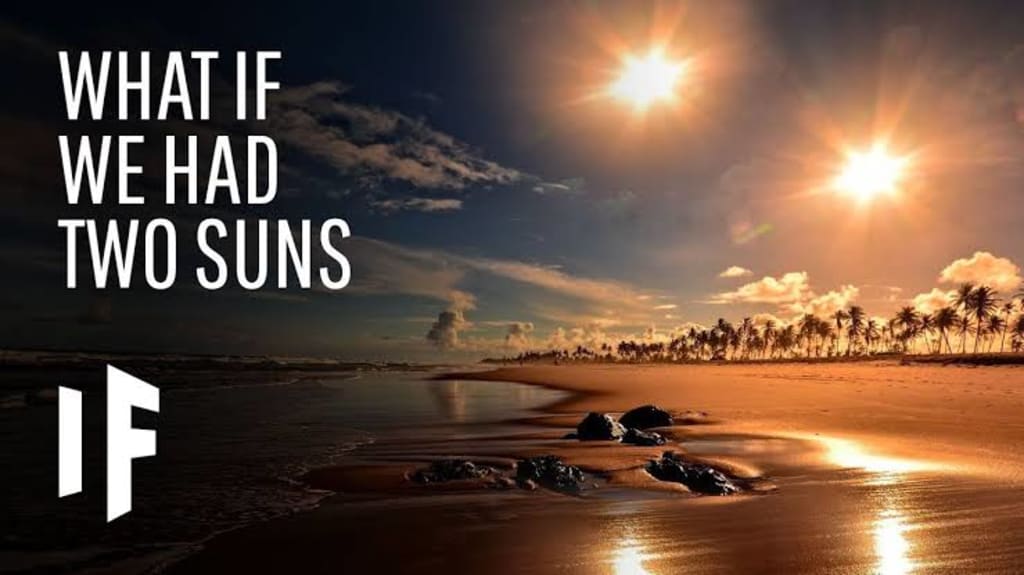
There are sunsets on other planets even more spectacular than the ones on Earth. What if we could see not just one, but two suns falling below the Earth’s horizon? Would our planet get much warmer with two stars heating it up? Would we ever experience nighttime again? Could our binary star system be able to sustain life?
Not all star systems form around a single star. In fact, binary or multiple star systems appear to be more common than the ones with a single star.
Some scientists even suggest that our Sun once had a star companion – a long-lost dwarf star called Nemesis. It broke free of the Sun’s gravity and merged into the Milky Way billions of years ago.
It looks like the Earth could sustain life with two suns, instead of just one. But only under certain conditions.
In a binary star system, Earth’s fate would depend on many factors – from the masses of the stars to their position relative to Earth and each other.
If one of the suns was bigger and brighter and had a much stronger gravitational impact on us, that Sun could pull the planet towards itself. We’d get pretty crispy before disappearing in its solar flares.
On the other hand, if neither stars’ gravitational pull were strong enough, the Earth would fly out into space. We would become one of those rogue planets that travel the Universe all alone with no star system to call home.
Let’s assume that the Earth’s orbit would be stable. After this there will be i.e.
Case 1: If the Earth orbited just one of the suns. But with two suns, each on the other side of the Earth will complicate life on the planet. Because at some point the stars would face both sides of the Earth at the same time.
Not only that would that take away our nights, but it would also increase the Ultraviolet radiation and solar winds. Two suns will burn all human lives.
Case 2: If the planet rotated around the two stars in the centre. The stars would have to be close together, and the Earth’s orbit would be further away.
Just how far away? Most likely, beyond the habitable zone, where the heat of the suns would not be enough to keep our water in a liquid state. The planet would turn into a frozen, lifeless rock.
Feeling hopeless yet? Well, we have some good news for you. Let’s consider a simple scenario. Suppose we replaced the sun with two closely matched stars, each half as bright as the Sun. In that case, the amount of energy reaching the Earth would be nearly same, and life would still be possible here. Such equal-mass binaries are not uncommon, so this scenario seems perfectly plausible.
So in this case the mass of our new suns would be 85% of mass of our current sun. That may surprise you but luminosity of star is extremely sensitive to mass, roughly luminosity goes as the 4th Power of mass, so double the mass will increase its brightness by a factor of 16. So we have to cut the brightness of star. A 15% mass reduction is enough to cut the brightness half.
But the combined gravity of two suns would be stronger, so the length of a year would be a bit less; about 280 days instead of 365 days.
The distance between the stars would have to be less than 15 million kilometers apart (9 million miles). So far so good. To orbit stable around the star's center of mass, the planet has to be at least at a distance of 4 times as great as the separation between two stars.
But let’s play safe and let's puts the stars closer about 5 million kilometers (3 million miles).In that scenario, the two stars would orbit each other once every ten days, which make them a little more active than our current sun. And in this new star system one star would pass in front of other in every five days. From Earth, that would look like a solar eclipse, but instead of our Moon blocking the Sun, it would be one star blocking another one. And instead of 7.5 minute, that eclipse would last about 6 hour. At the pick of eclipse tye amount of energy reaching on our earth would reduced by 30% to 40%, depending upon the geometry. ( Eclipse days would be chilly, but the periods of reduced sunshine would be brief enough to average out smoothly into Earth’s overall climate. The double suns would not even look all that strange in the sky. At maximum separation, Sun 1 and Sun 2 would be only 2 degrees apart in the sky, just enough to give shadows a double edge. For about a half day on either side of an eclipse they’d seem to merge, though if they slipped behind a cloud you’d see an odd, oval shape from the overlapping disks). Sunsets would be pretty, a little different each night.
Under those conditions, the Earth could be just fine orbiting two suns. There’s really just one huge unsettled question: Could such a planet form in the first place?
As far as we know, the smallest known planet circling two suns is a gas giant much bigger than Earth.
Maybe there is a small, rocky planet like Earth orbiting two suns somewhere in the Universe. We just haven’t found it yet.
It might even sustain life, intelligent enough to send a signal to our planet.
About the Creator
Keep reading
More stories from writers in Futurism and other communities.
About Binding Prometheus
I want to start actively advocating on behalf of my own work, and the most valuable part of my canon is, without a doubt, Binding Prometheus, the play I have been working on since 2019 and only finished in 2023 as part of my MA. The play itself is an amalgamation of a million different inspirations. On one end, it evokes the Ancient Greek myth-play, deriving its own title from the earliest extant work of Western drama we have, Aeschylus’s Prometheus Bound. On the other end, it borrows significantly from the sci-fi bulwarks from over the years, namely Mary Shelley’s Frankenstein and Karel Capek’s Rossum’s Universal Robots. The play could be an episode of Black Mirror, I fear. I don’t know. I’ve only ever seen one episode of Black Mirror.
By Steven Christopher McKnight20 days ago in Futurism
Coco Coir Market: Natural Fibers, Sustainable Agriculture & Growth Path
According to IMARC Group's latest research publication, The global coco coir market size was valued at USD 393.75 Million in 2024. Looking forward, IMARC Group estimates the market to reach USD 628.55 Million by 2033, exhibiting a CAGR of 5.07% from 2025-2033
By James Whitman7 days ago in Futurism
How to Succeed at the Benson Directory®
Congratulations and welcome to the Benson Directory® employee #22391! As our newest call handler, you will have the privilege of speaking with dozens of unique and interesting people on a daily basis as well as the opportunity to earn bonuses for high performance. Contained within this handbook you will find a set of ease to follow instructions designed to help you settle in to your new role and begin paving the way to success.
By S. A. Crawford4 days ago in Fiction




Comments
There are no comments for this story
Be the first to respond and start the conversation.