


It would be fantastic if we could manipulate individual atoms.
Just consider what would happen if we could "switch" them on and off to store information, change the color of their illumination, or manipulate them in a variety of other ways.
Unfortunately, that isn't feasible, but using quantum dots—also referred to as "artificial atoms," scientists have learned how to achieve the best alternative.
Simply defined, they are examples of nanotechnology: atomic clusters made of semiconductor materials that have the potential to change everything from solar cells and biological warfare detectors to home lighting and computer displays.
How do they function and what are they?
Let's look more closely!
What are quantum dots?

The term "quantum dot" refers to a microscopic particle of matter that is zero-dimensional and essentially focused into a single point.
Because of this, the electricity-conducting particles inside it (electrons and holes, which are regions where electrons are missing), are trapped (or "constrained") and have distinct energy levels in accordance with the laws of quantum theory (imagine rungs on a ladder), somewhat like individual atoms.
Quantum dots are crystals that are a few nanometers wide, making them typically a few dozen atoms across and containing anywhere from a hundred to a few thousand atoms. When we say tiny, we truly mean tiny.
They are made from a semiconductor, such as silicon, which can be chemically altered to function either as an insulator or conductor. They also behave more like individual atoms while being crystals, earning them the moniker "artificial atoms."
Who Invented Quantum Dots?
Russian scientist Alexei Ekimov discovered quantum dots in solids (glass crystals) in 1980 while working at the Vavilov State Optical Institute.
The similar phenomena was found in colloidal solutions by American chemist Louis E. Brus in late 1982 while he was working at Bell Laboratories (he is now a professor at Columbia University), he discovered the same phenomenon in colloidal solutions(where small particles of one substance are dispersed throughout another; milk is a familiar example).
He came to the conclusion that the quantum features of a quantum dot were due to the confinement of electrons when he noticed that the wavelength of light emitted or absorbed by a quantum dot changed over the course of days as the crystal grew.
For their groundbreaking work, these two researchers shared the R.W. Wood Prize from the Optical Society of America in 2006.
How do quantum dots work?

Quantum dots perform the same trick as atoms and have quantized energy levels, however depending on their size, quantum dots made of the same material (such as silicon) will emit different colors of light.
In reality, this implies that large dots produce red light, little dots produce blue light, and middle-sized dots produce green light (and the familiar spectrum of other colors too).
This has a fairly straightforward explanation. It takes more energy to excite a small dot because it has a larger band gap (roughly, that's the minimum energy it takes to free electrons so they can carry electricity through a material).
Applications Of Quantum Dots
The unique size and composition, tunable electronic properties of these nano structures make them appealing for variety of applications and new technologies such as electronics like single electron transistors, optical applications like TV displays , solar cells, information storage, imaging, medicine and even sensing . Let me show show some of the examples of quantum dots .
Quantum Dot TVs And Displays

The most commonly known use of quantum dots now may be TV screens. Some time LG launched their QDs LED TV in 2015 , and few other companies followed long after . Because of the unique physical properties of QDs , they will be the core of next- generation displays.
Compared to organic luminescent materials used in organic light emitting diodes(OLEDs),QD- based materials have purer colors, longer life time, lower manufacturing cost , and lower power consumption.
Another key advantage is that because QDs can be deposited virtually on any substrate you can expect printed, flexible, and rollable QD display of all sizes
Biological and Chemical Applications
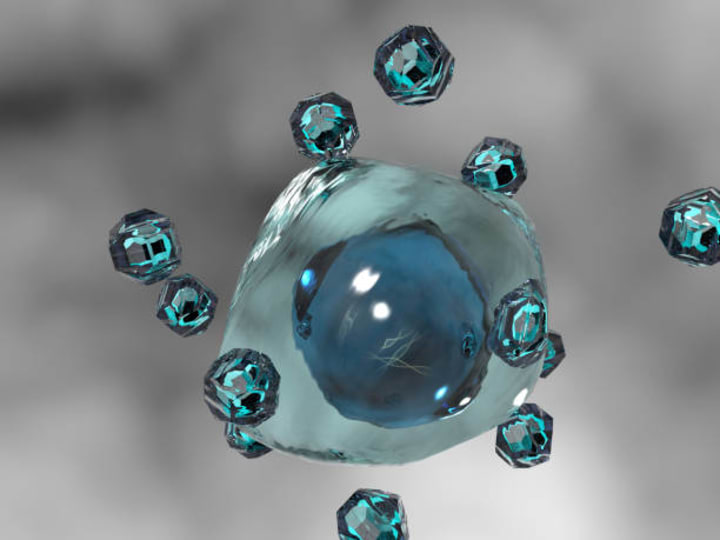
QDs are finding important medical applications including potential cancer treatments . Their main advantage is that they can be targeted at single organs, such as the liver, much more precisely than conventional drugs.
QDs are being used in place of organic dyes in biological research; for example they can be used like nanoscopic light bulbs to light up and color specific cells that can be studied under microscopes.
They are also being tested as sensors in chemical and biological warfare agents. Unlike organic dyes which operate over limited range of colors and degrade relatively quickly, QD dyes are little bright and can be used to produce any color of visible light.
About the Creator
Aisha Shamim
I am Aisha Shamim, a professional teacher, researcher, and content writer specializing in pets, fitness, and science. My work blends research and creativity to produce engaging, SEO-optimized content.
Keep reading
More stories from Aisha Shamim and writers in Futurism and other communities.
Samsung Galaxy Unpacked 2026: What to Expect From the Galaxy S26 Event
What Happened (Facts) Samsung’s first Galaxy Unpacked event of 2026 is scheduled for Feb. 25 in San Francisco, with the presentation set to begin at 1 p.m. ET / 10 a.m. PT, according to the live coverage preview shared by Gizmodo’s team (Raymond Wong, Kyle Barr, and James Pero).
By Behind the Tech6 days ago in Futurism
Australia Smoothies Market: Health & Wellness Trends, Retail Expansion & Product Innovation
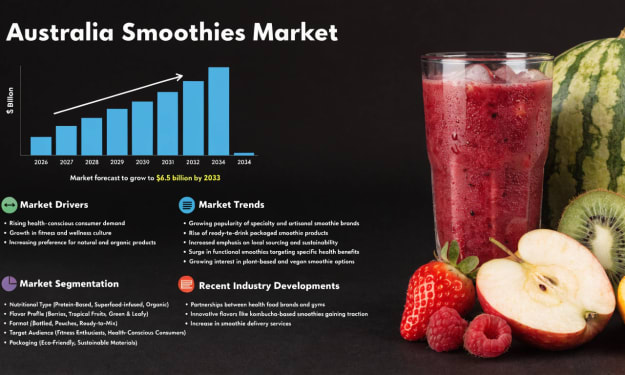
According to IMARC Group, the Australia smoothies market reached USD 504.6 Million in 2025 and is projected to grow to USD 749.1 Million by 2034, exhibiting a compound annual growth rate (CAGR) of 4.26% during 2026–2034. The market’s expansion reflects increasing consumer focus on health, nutrition, and convenience across Australia. Rising demand for nutrient-rich beverages, growing availability of ready-to-drink (RTD) options, and the proliferation of smoothie bars in urban centers are collectively strengthening Australia smoothies market share. As consumers prioritize balanced diets and functional ingredients, smoothies are becoming a mainstream component of daily nutrition.
By Shrestha Roy3 days ago in Futurism
Pearl
1980 something. we all hung out at Pearl and you and i were nothing special, or so i thought. i mean we all danced, drenched in our own sweat, our own saline solution of fear, too many beers, shots, laughter, tears, fucks in the bathroom and i don't know when we began to be afraid. do you?
By ROCK aka Andrea Polla (Simmons)4 days ago in Fiction



Comments
There are no comments for this story
Be the first to respond and start the conversation.