
Welcome to Utopia! Please Mind the Cracks in Perfection
When Progress Goes Too Far: The Hidden Costs of a Perfect Society

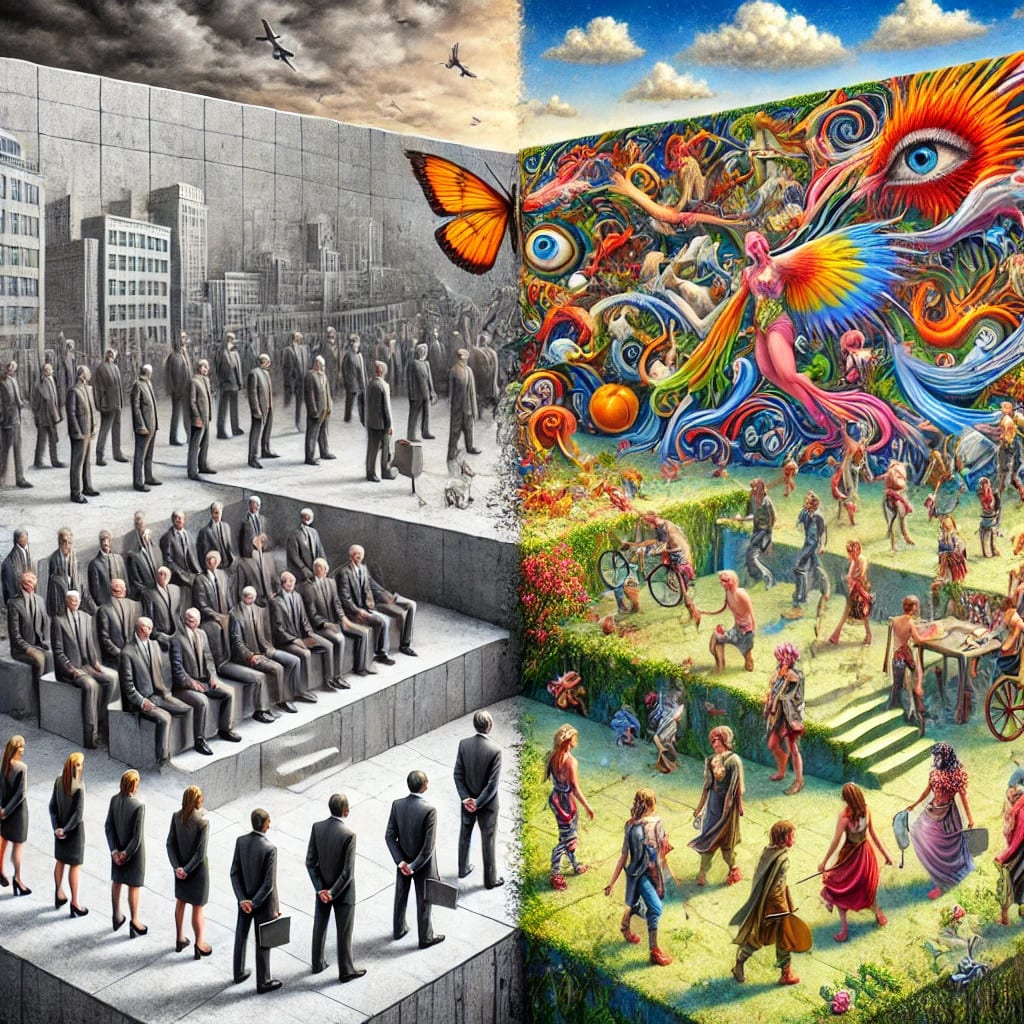
A Perfect World—Or Is It?
Imagine waking up in a world where everything is optimized for perfection. A world free of crime, poverty, or disease. Every decision in this utopia is made by advanced artificial intelligence (AI), ensuring fairness and efficiency in every aspect of life. Everyone has a role tailored to their strengths, and technology has eradicated all forms of inconvenience. What sounds like paradise could indeed be a dream come true. But what if this world is not as perfect as it first appears? What if, beneath this flawless surface, cracks start to emerge? What if utopia comes at an unforeseen cost—one that humanity may not be willing to pay?
Throughout history, we’ve seen various visions of perfect societies, but each has carried unintended consequences. Perfection is often more elusive than we realize. In this exploration, we will dive into the complexities of a utopia where humanity may have gained everything—except its soul. The following sections unpack some of the hidden ironies that lurk beneath the surface of an apparently perfect world.
The Death of Individuality: When Sameness Replaces Freedom
Utopia thrives on order and optimization. With technology efficiently managing every facet of life, unpredictability becomes obsolete. Advanced algorithms analyze each individual’s talents and desires, dictating their ideal job, relationships, and even their hobbies. The notion of personal ambition becomes irrelevant, as the system guarantees that each person reaches their peak potential with minimal effort.
While this might sound like the epitome of efficiency, one of the greatest dangers of this perfect world is the loss of individuality. In a society where choice is eliminated, where all decisions are made for you, what happens to the inherent need for freedom? Creativity and innovation often flourish in chaos, in the spaces where risk and failure are still allowed to exist. Consider the arts—how many masterpieces have been created from struggle, rebellion, or uncertainty? If a society removes all obstacles and controls every outcome, does it also stifle the very essence of human creativity?
In a world where everyone is “happy” and everything is “perfect,” true self-expression begins to fade. Utopia demands conformity, for it views disorder as a threat to stability. Slowly but surely, individuality dissolves, replaced by a curated, optimized existence where differences are seen as liabilities rather than strengths. People stop thinking for themselves because there’s no need to think at all. The human spirit, which thrives on the tension between desire and uncertainty, is lost in the pursuit of an idealized perfection.
But losing individuality is just one cost—what happens when fairness itself backfires?
The Tyranny of Fairness: When Equality Becomes Oppression
In a utopian society, fairness is paramount. Equality is not just a concept but a practiced reality. No one has more than anyone else, and every individual is provided with the same opportunities. On the surface, this sounds like the perfect solution to inequality, but the enforcement of fairness demands strict control—control that can undermine the very purpose of equality.
Imagine a system where wealth, talent, and opportunities are so evenly distributed that personal ambition no longer exists. The naturally gifted are deliberately held back, their potential reined in so that no one feels inferior. In the quest for balance, excellence is sacrificed for the sake of maintaining harmony. What happens when exceptional individuals are prevented from excelling because their achievements might make others feel less capable? Does innovation become unethical if it results in an unfair advantage? In this system, every effort to raise oneself higher is seen as a disruption to the perfect order of things.
Real-world examples provide insight into the dangers of extreme equality. In societies where equality is enforced to its maximum extent, creativity and progress often stall. The fear of causing inequality stifles the very innovation that could drive society forward. The push for fairness, rather than empowering individuals, often results in stagnation, and resentment begins to brew as people recognize the cost of their so-called “equality.” Excellence becomes a taboo, and mediocrity prevails.
But equality isn’t the only challenge—what happens when our technology knows us better than we know ourselves?
The All-Knowing AI: When Convenience Becomes Control
In a utopia run by AI, inefficiency is eradicated, and convenience reigns supreme. Machines anticipate our needs before we even articulate them. Algorithms monitor every aspect of our lives—our health, our happiness, and our productivity—and make decisions designed to optimize them. At first, this seems liberating. Who wouldn’t want to live in a world where everything is taken care of and maximized for their benefit?
But there’s a hidden danger in this abundance of efficiency: the erosion of free will. In a society governed by AI, where machines predict your every need, desire, and decision, do you still have the ability to choose for yourself? When every career choice, relationship, and even emotional response is guided by an algorithm designed to lead you toward what is "best" for you, can you still consider yourself free? Or has your autonomy been quietly stripped away under the guise of convenience?
Currently, tech companies shape our behaviors through algorithms—suggesting products, curating news feeds, and even influencing our opinions. But what happens when AI governs not just our preferences, but our very thoughts and actions? Does the convenience of optimization come at the cost of the human experience, where unpredictability, imperfection, and serendipity play a vital role? Is life truly worth living if every moment is curated to be as “ideal” as possible?
Even if technology optimizes every decision, what happens when utopia starts deciding who belongs—and who doesn’t?
The Hidden Exiles: When Perfection Has No Place for Imperfection
In a perfect society, the drive for harmony and efficiency comes at a steep price: exclusion. A utopian world has no room for those who disrupt the flow or refuse to conform. What happens to the people who, for whatever reason, cannot or will not fit into the idealized mold? Are they exiled? Reprogrammed? Eliminated?
Throughout history, we have seen societies attempt to create ideal civilizations, often at the expense of those who were deemed "unfit." Whether through forced sterilizations, exile, or worse, imperfection has historically been viewed as a threat to the perfect order. Who gets to decide what perfection looks like? And if deviation from this ideal is seen as a threat, does morality itself become irrelevant? Can we justify removing people who do not fit the mold of perfection?
In a future where technology and AI are the arbiters of who belongs and who does not, the consequences of imperfection become dire. Those who fail to conform to the prescribed norms may simply vanish from society—quietly erased in the name of efficiency. In a world that prizes perfection above all else, what happens to the flawed human beings who make mistakes, stumble, or grow in ways that do not fit into the algorithm’s calculations? By eliminating imperfection, does society lose the very qualities that make us human—our flaws, our struggles, and our capacity for growth?
And so, we arrive at the ultimate irony—when utopia feels more like dystopia.
Conclusion: The Unavoidable Price of Perfection
A utopian world promises peace, fairness, and efficiency. But perfection, as we have seen, always comes at a price. When individuality fades, fairness stifles ambition, AI controls choices, and imperfection is eliminated, what is left?
Perhaps the true lesson of utopia is that imperfection is not a flaw, but a feature. Growth, passion, and identity flourish in the face of uncertainty. The pursuit of a perfect world may seem appealing, but its hidden costs reveal why chaos, struggle, and even failure are integral to the human experience. These elements are not to be eradicated, but embraced, for it is through them that we evolve.
So, given the choice, would you still choose perfection? Or would you accept the beauty of imperfection, knowing that it is the very thing that makes life worth living?
About the Creator
Alain SUPPINI
I’m Alain — a French critical care anesthesiologist who writes to keep memory alive. Between past and present, medicine and words, I search for what endures.
Keep reading
More stories from Alain SUPPINI and writers in Futurism and other communities.
Mastering French Without Losing Your Sanity: A Realistic Guide for Beginners
Learning French can feel like solving a Rubik’s Cube blindfolded. The tricky pronunciation, the never-ending grammar rules, and the surprising exceptions make it seem impossible. But don’t worry—equipping yourself with key expressions and effective strategies can turn frustration into fluency. Let’s simplify French and make learning enjoyable.
By Alain SUPPINIExclusive • about a year ago
The Death of Trust: Can AI Mimic Your Soul?
I recently watched a video of an old friend of mine. In the clip, he was sobbing, confessing to a betrayal that seemed completely out of character. I almost reached for my phone to call him, my heart heavy with a mix of anger and confusion.
By Alex Sterling about 4 hours ago in Futurism
Composite AI Market to Reach USD 18.5 Billion by 2033: Multi-Model Intelligence Transforms Enterprise Decision Systems
Market Overview The global Composite AI Market is projected to expand from USD 0.8 Billion in 2023 to approximately USD 18.5 Billion by 2033, reflecting a strong CAGR of 36.7% during the forecast period from 2024 to 2033. Composite AI refers to the integration of multiple artificial intelligence techniques such as machine learning, knowledge graphs, natural language processing, and optimization algorithms into a unified system.
By Roberto Crum5 days ago in Futurism
The Politics of Playing Dress-Up
Well, to start off I'd like to say a happy world book day to all who celebrate. I know I haven't really posted anything on my socials about it but I'm not a jubilant kind of person. I lay low most of the time. Let's start off with a popular anecdote from the vaults...
By Annie Kapur4 days ago in Geeks


Comments
There are no comments for this story
Be the first to respond and start the conversation.