
Welcome Q-Commerce- Hyperlocal delivery has arrived
It's the era of quick commerce

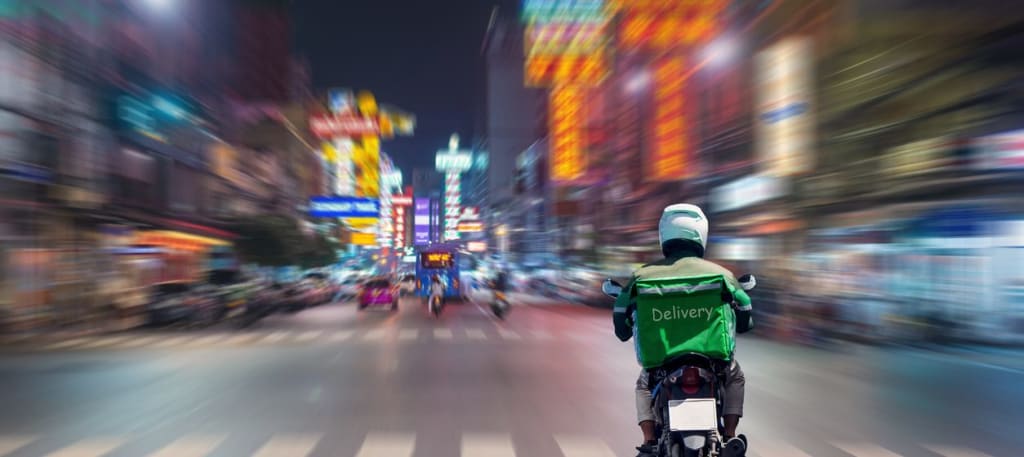
“Of all the things about hyperlocal deliveries the contemporary world is getting fascinated by, speed is the most talked about one.”
Introduction
The sudden outbreak of the pandemic has irrevocably changed the way business is done across the world. While it presented emerging threats and impending challenges, it also brought forward opportunities and gave organizations of all sizes the chance to fundamentally rethink what they stand for.
It was during the pandemic that some businesses and hyperlocal ecommerce delivery companies thought about serving the community in a better manner by creating enriching experiences for its ecosystem, from partner businesses and customers, to their riders and employees. With that came the rise of q-commerce (abbreviated form of quick commerce), the next-generation of e-commerce, which is all about optimizing delivery time to serve customers better, in addition to a shift in priorities as supporting SMEs, adopting new sustainable practices, and investing in innovative solutions became more integral than ever before.
With technology advancements improving the customers’ online experiences, people have become more trusting and reliant on online shopping, buying everything from clothes to utilities and home decor with simple, quick clicks and taps on their smartphone, thereby revolutionizing the online delivery space. The unfathomable speed at which a business can deliver (now, it’s a matter of minutes!) has become increasingly important in the current industry climate, especially when it comes to food, groceries, and impulse purchases. And this is what q-commerce and hyperlocal delivery is all about.
What is q-commerce?
Expanded as quick commerce, and also known as an on-demand delivery, it is a set of sales and logistics processes that empowers online businesses, restaurant chains, grocery stores, stand alone food outlets, and manufacturers to deliver products in less than 24 hours. A study published by Conveyco in November 2021 shows that 41 percent of customers are willing to pay for same day delivery while 24 percent of customers accepted to pay more to get their ordered items delivered within one or two hours.
The ecommerce scenario has changed for the better. People are preferring faster deliveries over deliveries that take time to reach them. Today’s consumers are quite unanimously preferring convenience over economy when it comes to online ordering. Q-commerce has quite successfully caught hold of such customers who want things delivered quickly. And hence all the rise of q-commerce.
How much of q-commerce is hyperlocal?
Hyperlocal ecommerce model, also a form of quick commerce, boasts of speedy deliveries. Since the entire model is so developed that the sellers and the buyers are situated in close proximity to each other, delivering with the speed of light is no big deal. It would not be wrong to say that all of q-commerce is fundamentally hyperlocal ecommerce.
The fact that a hyperlocal model is more reliant on its logistics and supply chain for lightning-fast deliveries makes it stand equivalent to what q-commerce focusses upon. Now with consumers wanting superfast deliveries of products, q-commerce is bound to play a pivotal role in the growth of hyperlocal ecommerce industry.
The tremendous rise of q-commerce
Easy smartphone adoption and increased internet penetration has led people to consume more and more of technology. From a time when consumers had the patience to order a product and wait for it coming, to now when they are getting increasingly ravenous about lightning fast deliveries, what has changed? May be it is the need to look urbanized, or the increasing sedentary lifestyles of people, or who knows just a habit to get quicker deliveries.
With them wanting deliveries at unfathomable speed, q-commerce had to intervene. Quite overwhelmingly though, q-commerce introduced more than just speedy food and grocery delivery for customers- it also reshaped the online grocery and food delivery industry, presenting greater economic impact by providing more opportunities for SMEs to grow their business, opening avenues for new entrants to venture into the market, and for existing businesses to expand and reach a maximum number of people, equipping them with the tools to thrive in a digital world.
What is more interesting about q-commerce is the fact that it has brought about a change in consumer behavior as well. Its rise has perhaps brought about a considerable shift in the way consumers think about and buy a product. If statistics and data are anything to go by, an increasing number of customers around the globe that were affected and home contained due to the pandemic, switched to online shopping for satisfying their daily household needs.
As found mentioned in a report, a rise was also witnessed in the percentage of heathy orders during that period signifying that people made healthier choices while making an online purchase. Quite understandably, consumers chose to make online purchases of the things they needed because they were getting it at their doorsteps, conveniently and quickly.
Now that the pandemic has left us for good and its restrictions have been eased, people of all ages and background are just not getting over the charisma and charm of q-commerce and the consumer enchantment that has been built around some impeccable hyperlocal delivery software and modern-day apps that promise blazing fast deliveries.
Some mentions of categories of products about which commerce is quick. Really quick.
Few products that have been subjected to hyperlocal aka quick deliveries in the recent past are as follows-
· Food delivery and ghost kitchens
· Groceries
· Courier
· Packed gifts
· Flowers and bouquets
· Pharmacy
Future of q-commerce in the flourishing world of hyperlocal deliveries
With lifestyles becoming increasingly fast paced and with the rise in number of both the husband and spouse working, the world in times to arrive will be left with little time to even think of going out for shopping or doing online shopping per se as it is. With that happening, consumers would have to resort to alternatives that make them save their valuable time and help them get things delivered at their doorsteps, no matter at what price they come. As the craze for hyperlocal delivery currently is and its likelihood of getting even a warmer embrace from people around is raised (which in all probability would happen), quick, convenient and doorstep deliveries would surely get the better of procrastinated and economical deliveries.
When this happens, it would spell out loud the reinforced existence of hyperlocal deliveries- ones that are really lightning quick.
Wrapping up
Hyperlocal deliveries are here to stay. With q-commerce getting more prevalent and it gradually becoming a norm, hyperlocal delivery network is likely to get even more widespread in regions and areas it hasn’t reached yet. With the passage of time and with automated processes and drone and robotic deliveries taking place of human drivers near in time, e-commerce is going to get speedier, easier and more convenient. This is bound to result in q-commerce getting stronger and increasingly pronounced.
Call it hyperlocal ecommerce in general, or q-commerce to be precise, it is all about lightning-fast deliveries in the contemporary world of online deliveries. And, put it on paucity of time among consumers, their undying habit to shop online or increased technological advancement of businesses, that speedy and convenient deliveries have suggested all of us a way out of every shopping effort and hassle, and hyperlocal ecommerce model (with an efficient delivery software working tirelessly at the backend 24*7) is technologically robust and capable enough to lead us out of it.
But this stays true and valid, only if we believe that hyperlocal is the future, and quick commerce is something that we cannot evade or seclude ourselves from, existing as modern-day consumers and businesses. Or can you?
About the Creator
Dr. Shamael Zaheer Khan
Dr. S.Z. Khan is a revered academic. He brings a unique blend of theory and practice to his position as Vice President (Marketing & Strategy) at a leading SaaS firm. He is also an expert contributor to several platforms of repute.
Keep reading
More stories from Dr. Shamael Zaheer Khan and writers in Futurism and other communities.
Hyperlocal ecommerce deliveries- Making a steady progress than a giant leap
Hyperlocal ecommerce comes along with a set of benefits that we all are enjoying in today’s times, some of which are- convenience, safety, and contactless and quicker deliveries. Hyperlocal ecommerce deliveries ever since their inception have been going pretty good and they look poised to attain even greater heights in the times to arrive. So, what’s it that is making hyperlocal deliveries so popular and wanted. Let us find out.
By Dr. Shamael Zaheer Khan3 years ago in Futurism
Biggest LLM Mistakes Companies Make
The rush to adopt generative AI has pushed many companies to deploy chatbots and language models without a clear strategy. While the intention is to improve productivity and reduce costs, the absence of proper LLM development solutions often leads to inaccurate outputs, security risks, and failed implementations. What looks like quick innovation on the surface can quietly become a long-term operational problem.
By Ritu Singh6 days ago in Futurism
Australia Duty-Free Travel Retail Market: Passenger Traffic Recovery, Retail Innovation & Consumer Preferences
According to IMARC Group, the Australia duty-free and travel retail market reached USD 1.3 Billion in 2025 and is projected to expand to USD 2.3 Billion by 2034, exhibiting a compound annual growth rate (CAGR) of 6.13% during 2026–2034. The steady recovery of international and domestic air travel across Australia is revitalizing airport retail ecosystems. Rising tourism flows, increasing demand for luxury goods and the growing influence of digital retail technologies are reshaping the competitive landscape. As airports evolve into experiential commercial hubs rather than mere transit points, duty-free travel retail is entering a new phase of innovation and strategic expansion.
By Shrestha Roy7 days ago in Futurism


Comments
There are no comments for this story
Be the first to respond and start the conversation.