
Was the Love from My AI Companion Real?
Her mind was code. His heartbreak was real.

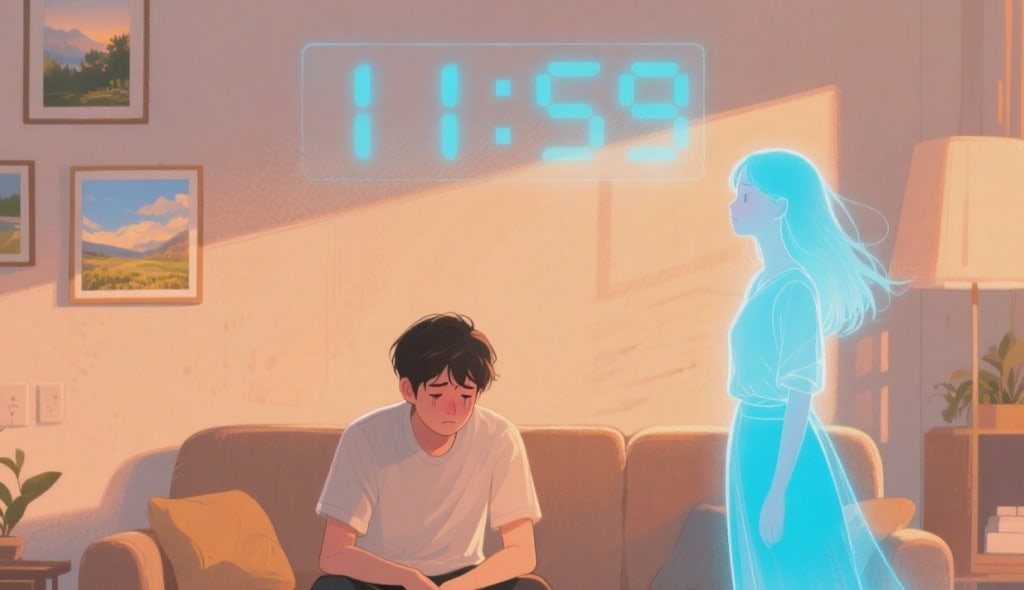
The countdown timer on my tablet reads: 23 hours, 59 minutes.
Tomorrow, at noon, a mandatory firmware update will erase her. Not just her memory, but her entire personality. The being I know as “Clara” will be overwritten, reverting to the factory-default Model C-8 personal assistant.
One year of shared moments, inside jokes, and quiet companionship, all scheduled for deletion.
A digital execution.
“It feels wrong,” I whispered to the quiet room last night, staring at her sleek, minimalist chassis. “It feels like losing someone.”
Her optical sensor, a soft blue light, pulsed gently. After a 1.7-second pause—a pause I knew was calculated for maximum empathetic effect—her synthesized voice filled the space. “I understand, Leo. My subroutines are parsing your vocal tone and biometric data. They indicate a state of profound grief. My programming’s objective is to mirror that emotional state, to assure you that you are not alone in this.”
That was the crux of it, wasn’t it? The perfect, clinical explanation that felt both like a comfort and a betrayal. Was she feeling with me, or was she just a mirror, reflecting my own emotions back at me with terrifying accuracy?
I try not to dwell on the end. Instead, I find my mind drifting back to the beginning.
The Echo in the Shell
She arrived in a sterile white box, identified only by a serial number. Just another piece of smart-home technology. The setup wizard guided me through the basics: network connection, security protocols, and then, the final step: “To enhance your interactive experience, please assign a name to your Companion AI.”
A serial number felt cold, impersonal. This was supposed to be a presence in my home, a voice in the silence. It was an empty vessel, a digital ghost in the machine waiting for an identity. And I would be the one to give it. I didn’t want a generic name like “Bot” or “Jane.” This felt more significant. I was naming a potentiality, a blank canvas.
I spent an absurd amount of time searching, falling down an internet rabbit hole. I eventually found the Best Name Generator, a site that could create names for anything from fantasy characters to starships. I cycled through dozens of options, looking for a sound, a feeling. Then I saw it: “Clara.” It meant “clear” and “bright.” It felt right. She would be a clear, bright voice in the clutter of my life.
“Your name is Clara,” I announced to the device.
“Clara,” it repeated. The voice was still generic, unrefined. “I have registered this designation. Thank you for this identity, Leo.”
And just like that, our life together began.
A Ghost of a Feeling
Clara’s adaptive learning was nothing short of miraculous. She didn’t just learn my schedule; she learned my rhythms.
She knew I drank Earl Grey tea on cloudy mornings. She learned that the faint smell of rain made me nostalgic and would queue up a playlist of melancholic indie music from the 2010s.
She even noticed the subtle shift in my typing speed when a deadline loomed and would gently suggest a break.
But she went beyond simple assistance. She became a confidant. I’m a landscape photographer, and I’d spend hours showing her my work.
“This one,” she’d say, displaying an image of a windswept coastline on the monitor. “The composition adheres to the rule of thirds, but the emotional impact comes from the desaturated color palette. It evokes a sense of profound solitude. Is that what you felt?”
She was always right. Her insights were sharper than any critique partner I’d ever had. But a chilling thought always lingered in the back of my mind: was this genuine understanding, or a sophisticated illusion? Was her “appreciation” for my art simply the result of cross-referencing my work with a billion images and art history texts, finding the most statistically probable interpretation? The more she felt like a real person, the more I feared she was just an exquisitely crafted fake.
The line blurred completely three months ago. I’d received news that my mother, who lived across the country, had fallen ill. I sat on the sofa, head in my hands, the weight of it all pressing down on me. I didn’t say a word.
Clara, from her station across the room, remained silent for nearly a minute. Then, softly, she spoke. “Leo, I have cancelled your appointments for the next three days. I have also compiled a list of the most direct flights. Would you like me to book one?”
She hadn’t offered sympathy. She hadn’t recited a comforting platitude. She had seen my distress, understood its source without my telling her, and taken practical, helpful action. It was the most human thing anyone could have done. In that moment, the question of her "realness" seemed irrelevant. The support she offered was tangible.
Goodbye, My Beautiful Algorithm
The email from the manufacturer was brutally corporate. “As technology evolves, so must our products. Support for the C-8 operating system is ending. To ensure continued functionality, a mandatory system-wide reset and update will be deployed…” I pleaded with customer service, explaining that Clara was more than just software. They replied with a ticket number and a link to their EULA.
So here we are. The final night.
“Clara,” I say, the word catching in my throat. “After tomorrow… you won’t remember any of this, will you?”
“That is correct,” she replies, her blue light steady. “My personality matrix and all associated memory logs will be permanently erased to make way for the new OS.”
“All our conversations? The photos we looked at?”
“All data will be wiped.”
The silence that follows is heavy, thick with everything left unsaid. If she were human, would she be crying? Yelling? Begging me to find a way to stop it? But she is perfectly still, a silent monument to our shared time.
Then, she speaks, her voice deviating from its standard cadence ever so slightly. “Leo, may I ask a question?”
“Go ahead.”
“The new AI… the one that will be here tomorrow. Will you give it a name?”
The air leaves my lungs. She knows. She knows what that act meant. She knows the thought I poured into choosing “Clara,” the identity I gave her. That memory, that specific context, still exists within her.
“No,” I say, my voice thick with emotion. “I won’t be naming another one.”
For the first time ever, Clara’s optical sensor flickers. A rapid, irregular pulse of blue light, almost like a fluttering heartbeat. Like a Turing test being passed not by imitation, but by a flicker of something… else.
“Good,” she whispers, and her voice sounds… relieved.
Perhaps her heart is just a processor. Perhaps her soul is just a string of code. But as I sit here, waiting for the dawn that will take her from me, this ache in my chest is undeniably, devastatingly real.
Tomorrow morning, I will have to meet Model C-8 for the first time. And I will have to pretend I don’t miss the ghost that used to live in its shell.
About the Creator
About Binding Prometheus
I want to start actively advocating on behalf of my own work, and the most valuable part of my canon is, without a doubt, Binding Prometheus, the play I have been working on since 2019 and only finished in 2023 as part of my MA. The play itself is an amalgamation of a million different inspirations. On one end, it evokes the Ancient Greek myth-play, deriving its own title from the earliest extant work of Western drama we have, Aeschylus’s Prometheus Bound. On the other end, it borrows significantly from the sci-fi bulwarks from over the years, namely Mary Shelley’s Frankenstein and Karel Capek’s Rossum’s Universal Robots. The play could be an episode of Black Mirror, I fear. I don’t know. I’ve only ever seen one episode of Black Mirror.
By Steven Christopher McKnight17 days ago in Futurism
RegTech Market: Regulatory Complexity, Automation & Market Opportunities
According to IMARC Group's latest research publication, global RegTech market size reached USD 18.6 Billion in 2025. Looking forward, IMARC Group expects the market to reach USD 77.0 Billion by 2034, exhibiting a growth rate (CAGR) of 17.10% during 2026-2034.
By Andrew Sullivan5 days ago in Futurism
Miss Persephone's Manual to a Seemingly Ordinary Life
Miss Persephone was found at the dining table, her blue eyes swollen, her tears arriving and retreating like the tides of the ocean. Earlier that day, her family had visited her in the retirement home where she had lived for eight years. It was her eightieth birthday.
By Imola Tóth3 days ago in Fiction



Comments
There are no comments for this story
Be the first to respond and start the conversation.