
Virtual Reality Market Trends: Immersive Technologies, Enterprise Adoption & Outlook to 2033
How immersive hardware innovation, enterprise digital transformation, and expanding content ecosystems are accelerating adoption and reshaping demand patterns across the virtual reality market

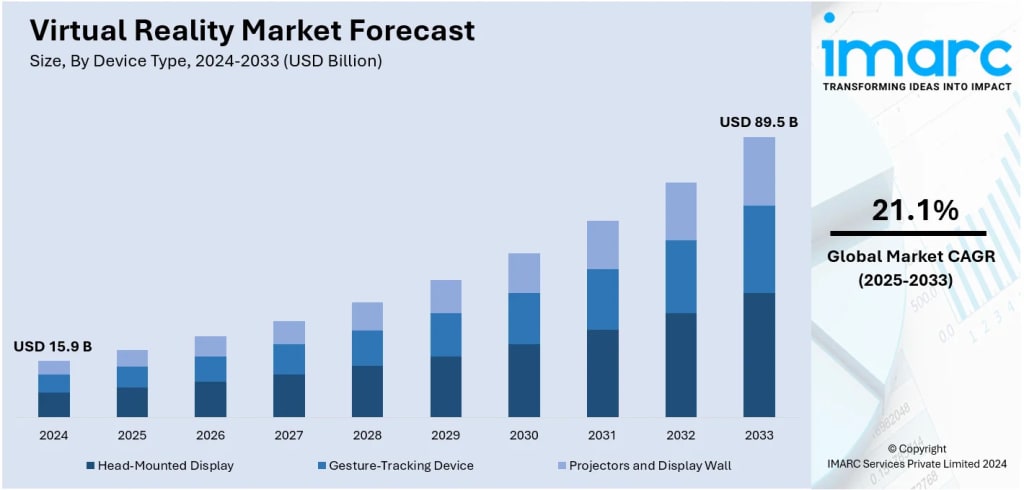
Growing demand for immersive gaming and entertainment experiences, expanding healthcare applications in surgical training and pain management, and increasing enterprise adoption for training and simulation are fueling the virtual reality market's expansion. According to IMARC Group's latest data, the global virtual reality market size was valued at USD 15.9 Billion in 2024. Looking forward, IMARC Group estimates the market to reach USD 89.5 Billion by 2033, exhibiting a CAGR of 21.1% from 2025-2033.
Virtual reality has evolved into a transformative technology reshaping how people interact with digital environments across gaming, healthcare, education, and enterprise sectors. Using headsets equipped with advanced sensors, motion tracking, and high-resolution displays, VR creates fully immersive experiences that transport users into realistic digital worlds. The technology's applications have expanded far beyond entertainment, with healthcare providers using VR for surgical practice and mental health therapy, while businesses deploy it for employee training and product design. Major tech companies continue to invest billions in VR infrastructure, with Meta's Reality Labs alone spending over USD 100 billion since inception to build out the ecosystem.
Virtual Reality Market Growth Drivers:
- Immersive Gaming and Entertainment Experiences
Gamers are demanding increasingly realistic and engaging environments, pushing VR adoption as it delivers unmatched immersion levels. Major gaming studios are integrating VR technology into their platforms, attracting both casual and dedicated players. The entertainment industry is expanding beyond gaming, with live sports, concerts, and movies leveraging VR to simulate real-world experiences. Meta captured 50.8% of global VR headset sales in Q1 2025, demonstrating strong consumer interest. Companies like Rezzil launched Premier League Player, a VR game officially licensed for Meta Quest devices, while iQIYI announced VR location-based entertainment venues in major Chinese cities with plans for Dubai and Bangkok expansion.
- Healthcare and Therapeutic Applications
The healthcare sector is rapidly adopting VR for surgical training, pain management, and mental health treatment applications. Medical professionals use VR to practice complex procedures in risk-free environments without endangering patients. The FDA approved RelieVRx as the first in-home VR treatment for chronic lower back pain, validating VR's therapeutic potential. The U.S. Department of Defense awarded USD 1.5 million to the University of Arizona College of Medicine for portable VR devices assessing traumatic brain injuries in field conditions. VR is also revolutionizing mental health care through exposure therapy, helping patients with anxiety and phobias by recreating challenging scenarios in controlled settings.
Get Your Free "Virtual Reality Market" Sample PDF Report Now!
- Enterprise Applications and Training
Businesses across healthcare, construction, automotive, and aviation sectors are deploying VR for cost-effective and safe training environments. Fortune 500 manufacturers, healthcare systems, and defense contractors transitioned from pilots to full-scale VR rollouts in 2024-2025, integrating VR metrics into performance dashboards. Surgeons practice procedures, architects visualize designs, and engineers simulate machinery performance within virtual spaces, reducing errors and improving efficiency. The U.S. Department of Defense invested USD 5.7 million in Indiana University's Center on Representative Government to create Democracy Quest, an interactive VR learning tool for civics education. Companies are also using VR for remote collaboration and virtual offices, addressing workforce challenges.
Virtual Reality Market Trends:
- Advanced Hardware Development and Accessibility
VR hardware is rapidly evolving with lighter headsets, improved resolution, and more affordable pricing making the technology accessible to broader audiences. Qualcomm's Snapdragon XR2+ Gen 2 platform delivers 4.3K resolution per eye and supports 12 concurrent cameras for spatial computing applications. Apple launched the Vision Pro with the M5 chip in October 2025, featuring hardware-accelerated foveated rendering and real-time environment mapping at USD 3,499. Samsung and Google unveiled Android XR operating system for extended-reality devices, with Samsung hardware scheduled for mid-2026 release. Meta and Microsoft announced native Microsoft 365 integration for Quest headsets to streamline VR productivity workflows.
- Artificial Intelligence and Content Creation
AI integration is transforming VR content creation and user experiences through automated development tools and intelligent interactions. ARuVR introduced its GenAI portfolio in June 2024, enabling real-time auto-generation of 360-degree photos, voice-over audio, and 3D assets, reducing development time from months to minutes. Unity's 2025 engine upgrade embedded generative AI assistants that automate environment creation, expanding native support for Meta Quest and large Android screens. NVIDIA launched an AI-driven software suite designed to optimize VR performance across various platforms, setting new industry standards. These AI-powered tools are democratizing VR content creation, allowing smaller studios and enterprises to produce high-quality experiences without massive budgets.
- Mixed Reality and Extended Reality Convergence
The boundaries between virtual, augmented, and mixed reality are blurring as platforms adopt more versatile approaches to immersive experiences. Mixed reality shipments are projected to grow from 3.3 million units in 2025 to 15.2 million by 2029, reflecting strong market demand. Apple's Vision Pro enables users to share content with other headsets, ideal for collaborative viewing of movies in 3D environments. HTC partnered with Siemens to develop VR solutions for industrial design, simulation, and training applications. Third-party hardware vendors including ASUS and Lenovo adopted Meta's Horizon OS, reducing platform fragmentation and encouraging multi-brand ecosystems. The deployment of mixed reality-capable processing units is reaching mainstream adoption, enabling spatial computing applications across enterprise and consumer segments.
Recent News and Developments in Virtual Reality Market
- December 2024: Perfect Corp. acquired Wannaby Inc., a digital immersive experiences expert, to enhance its digital products and market presence by extending virtual try-on technology into luxury fashion categories including clothing, shoes, and bags, demonstrating VR's expansion into retail applications.
- December 2024: Generative 3D AI firm Backflip closed a USD 30 million funding round co-led by NEA and Andreessen Horowitz to revolutionize the design and manufacturing sector through AI technology that converts text and images into physical objects, combining 3D simulation and physics-based engineering.
- September 2024: HTC unveiled the Vive Focus Vision, the next-generation successor to the Vive Focus 3, featuring a Qualcomm Snapdragon XR2 chip, 2448 x 2448 pixels per eye resolution, 120-degree field of view, dual 16MP cameras with color passthrough, and automatic lens adjustment with 128GB storage expandable to 2TB.
Note: If you require specific details, data, or insights that are not currently included in the scope of this report, we are happy to accommodate your request. As part of our customization service, we will gather and provide the additional information you need, tailored to your specific requirements. Please let us know your exact needs, and we will ensure the report is updated accordingly to meet your expectations.
About the Creator
Andrew Sullivan
Hello, I’m Andrew Sullivan. I have over 9+ years of experience as a market research specialist.
Keep reading
More stories from Andrew Sullivan and writers in Futurism and other communities.
Cookies Market Developments: Functional Cookies, Private Labels & Market Expansion to 2033
The worldwide cookies market is experiencing strong momentum as consumers increasingly gravitate toward convenient, satisfying snacks that fit their busy lifestyles. According to IMARC Groups latest data, the global cookies market was valued at USD 40.62 Billion in 2024. Looking forward, IMARC Group estimates the market will reach USD 58.75 Billion by 2033, exhibiting steady growth from 2025-2033.
By Andrew Sullivan2 days ago in Futurism
AI-Enabled Fitness App Development for Women Guide
Fitness App Development for Women has emerged as a powerful segment within the digital health ecosystem as women increasingly seek personalized, flexible, and holistic wellness solutions. Unlike generic fitness platforms, women-centric fitness apps are designed to address unique physiological, emotional, and lifestyle needs such as hormonal cycles, pregnancy, postpartum recovery, menopause, and mental well-being. This growing demand is fueled by rising health awareness, increased smartphone adoption, and the expanding role of technology in preventive healthcare, making Fitness App Development a strategic investment for businesses targeting long-term engagement and impact.
By Steve Waugh4 days ago in Futurism
Super Bowl LX Recap: A Team Called Hawks
Sixty. The Super Bowl turned 60! Still amazes me that this was the sixtieth Super Bowl played in NFL history. It seems like yesterday that I watched Super Bowl XXVII, the first SB I ever watched. The QB who won Super Bowl XXVII has since called a few SBs, and will call next year's game, but that's another story. Super Bowl LX took place at Levi's Stadium in Santa Clara, California, the home stadium of the San Francisco 49ers. However, it was one of their division foes who represented the NFC, as the Seattle Seahawks faced off against the New England Patriots.
By Clyde E. Dawkinsa day ago in Unbalanced




Comments
There are no comments for this story
Be the first to respond and start the conversation.