
Virtual Reality Headset Market Outlook: Immersive Technology Adoption and Growth Opportunities
The virtual reality headset market is witnessing strong growth, driven by rising demand for immersive digital experiences across gaming, entertainment, education, healthcare, and industrial training applications.


According to IMARC Group's latest research publication, The global virtual reality headset market size was valued at USD 14.05 Billion in 2024. The market is projected to reach USD 69.87 Billion by 2033, exhibiting a CAGR of 19.33% during 2025-2033.
How AI is Reshaping the Future of Virtual Reality Headset Market
- AI-Enhanced Personalization and Adaptive Experiences: Machine learning analyzes user behavior, preferences, and movement patterns to create tailored VR environments. AI-driven systems optimize gesture recognition, voice commands, and object tracking for intuitive interactions, making virtual spaces more responsive and engaging across gaming, training, and healthcare applications.
- Intelligent Virtual Characters and Simulation Training: AI powers realistic non-player characters in gaming and training simulations that respond dynamically to user actions. Medical institutions like SimX deploy AI-driven VR for surgical training with smart virtual patients, while corporate sectors leverage intelligent simulations for employee skill development and scenario-based learning.
- Real-Time Graphics Optimization and Latency Reduction: Advanced algorithms employ foveated rendering to focus processing power where users look, improving visual quality while minimizing computational load. AI optimizes frame rates, reduces motion sickness through predictive tracking, and enhances display resolution, creating smoother and more immersive experiences across standalone and tethered headsets.

Virtual Reality Headset Industry Overview:
The VR headset industry is experiencing rapid transformation driven by technological breakthroughs in display quality, wireless connectivity, and processing power. Meta's Quest 3S launched at $299 making premium VR accessible to mainstream consumers, while Samsung's Android XR platform through Project Moohan creates new ecosystem competition against established players. Apple's Vision Pro with its M2 chip continues pushing spatial computing boundaries despite high pricing. The standalone segment now dominates with 46.8% market share, eliminating the need for external PCs and expanding VR adoption across gaming, healthcare training, and enterprise collaboration.
Virtual Reality Headset Market Trends & Drivers
Gaming and entertainment sectors continue driving VR adoption with India alone reaching 591 million active gamers in FY24, with 23 million new users added. Major game releases like Marvel's Deadpool VR and immersive titles such as Alien: Rogue Incursion showcase VR's potential for deeply engaging experiences. The integration of advanced graphics, motion tracking, and haptic feedback has made virtual environments increasingly realistic. Standalone headsets like Meta Quest 3 have democratized access by eliminating expensive PC requirements, while improved display resolution and reduced motion sickness are attracting casual users. Content libraries are expanding rapidly with exclusive titles and cross-platform compatibility, reinforcing VR's position as a mainstream entertainment medium.
Healthcare and medical training applications are expanding significantly, with Dubai Healthcare City Authority reporting 4,482 private medical facilities adopting advanced technologies. VR enables risk-free surgical simulations where medical students practice complex procedures before real-world application, improving precision and confidence. MediSim VR launched India's first VR-based medical training center of excellence at SRIHER in Chennai in July 2024. Beyond training, VR supports therapeutic applications including pain management, PTSD treatment, physical rehabilitation, and mental health interventions. The technology allows patients to visualize medical conditions and treatment options immersively, improving understanding and engagement. Early clinical results demonstrate VR's effectiveness in reducing patient anxiety and medication needs during procedures.
Enterprise adoption for remote collaboration and workplace training has accelerated dramatically, with 14% of the US workforce now telecommuting. VR platforms enable immersive virtual meetings where distributed teams collaborate in shared 3D spaces, overcoming geographical limitations more effectively than traditional video conferencing. Companies leverage VR for employee onboarding, safety training, product demonstrations, and design reviews, cutting training time by up to 50% according to Fortune 500 adoption data. The automotive sector has invested over $75 billion in US facilities since 2021, with manufacturers integrating VR for vehicle prototyping, design simulations, and showroom experiences. As remote work models solidify, organizations are investing in VR infrastructure to maintain productivity and team cohesion across dispersed workforces.
Leading Companies Operating in the Global Virtual Reality Headset Industry:
- Fove Inc.
- Google LLC (Alphabet Inc.)
- HTC Corporation
- LG Electronics Inc.
- Merge Labs Inc.
- Meta Platforms Inc.
- Samsung Electronics Co. Ltd.
- Sony Interactive Entertainment LLC (Sony Group Corporation)
Virtual Reality Headset Market Report Segmentation:
By Product:
- PC Based
- Console Based
- Smartphone Based
- Standalone
Standalone dominates with 46.8% market share, as these self-contained devices eliminate the need for external hardware, offering convenience and portability with built-in processors, displays, and sensors that make VR accessible to broader audiences.
By Material:
- Plastic
- Paper
- Others
Plastic leads the market due to its versatility, durability, cost-effectiveness, and ability to support ergonomic designs while maintaining lightweight characteristics essential for extended user comfort during immersive experiences.
By End-User:
- Consumer Electronics
- Healthcare
- Games and Entertainment
- Automobile
- Education
- Real Estate
- Military
Games and entertainment accounts for 37.5% market share, driven by immersive gaming experiences, expanding content libraries, and growing consumer demand for interactive entertainment across both casual and hardcore gaming segments.
Regional Insights:
- North America (United States, Canada)
- Asia Pacific (China, Japan, India, South Korea, Australia, Indonesia, Others)
- Europe (Germany, France, United Kingdom, Italy, Spain, Russia, Others)
- Latin America (Brazil, Mexico, Others)
- Middle East and Africa
Asia Pacific dominates with 32.8% market share, supported by its vast tech-savvy consumer base, rising middle-class disposable income, strong presence of major VR manufacturers, and government policies promoting digital transformation and immersive technology adoption.
Recent News and Developments in Virtual Reality Headset Market
- March 2025: Visual-X launched as a wireless virtual reality headset featuring high resolution and uninterrupted usage through a hot-swappable battery system. The device operates without base stations, relying instead on internal tracking and a lightweight design with gesture control for seamless VR experiences.
- March 2025: Vivo officially entered the mixed reality market by unveiling Vivo Vision, its first-ever headset challenging Apple Vision Pro. Showcased at a tech event in China, the device features multiple embedded sensors, gesture tracking, and a padded headband designed for both augmented and virtual reality experiences.
- December 2024: Samsung unveiled its Moohan XR headset powered by Google's Android XR operating system, set to rival Apple Vision Pro and Meta Quest 3. The device features Google's Gemini AI and apps optimized for virtual displays, with launch expected in 2025.
- September 2024: Meta unveiled Quest 3S, an affordable mixed reality headset with the same capabilities as Quest 3, designed for newcomers and budget-conscious users. The company simultaneously reduced the price of the 512GB Meta Quest 3 for tech enthusiasts and gamers.
- September 2024: HTC announced Vive Focus Vision, a gaming-centric VR headset powered by Snapdragon XR2 featuring dual 16MP cameras with color passthrough and automatic lens adjustments. The headset supports both standalone use and PC tethering via USB-C, building on Vive Focus 3 with enhanced visuals.
Note: If you require specific details, data, or insights that are not currently included in the scope of this report, we are happy to accommodate your request. As part of our customization service, we will gather and provide the additional information you need, tailored to your specific requirements. Please let us know your exact needs, and we will ensure the report is updated accordingly to meet your expectations.
About the Creator
James Whitman
With years of experience in analyzing global industries, I specialize in delivering actionable market insights that help businesses stay ahead in an ever-changing landscape.
Keep reading
More stories from James Whitman and writers in Futurism and other communities.
KVM Switch Market Outlook: Data Center Efficiency and IT Infrastructure Growth Opportunities
According to IMARC Group's latest research publication, The global KVM switch market size was valued at USD 1,188.50 Million in 2024. Looking forward, IMARC Group estimates the market to reach USD 1,452.01 Million by 2033, exhibiting a CAGR of 2.14% from 2025-2033.
By James Whitmanabout 13 hours ago in Futurism
GCC Commercial Telematics Market Analysis: Industry Trends, Key Players & Growth Forecast
According to IMARC Group's latest research publication, the GCC commercial telematics market size reached USD 2.21 Million in 2024. The market is projected to reach USD 9.46 Million by 2033, exhibiting a growth rate (CAGR) of 16.14% during 2025–2033.
By Abhay Rajput5 days ago in Futurism
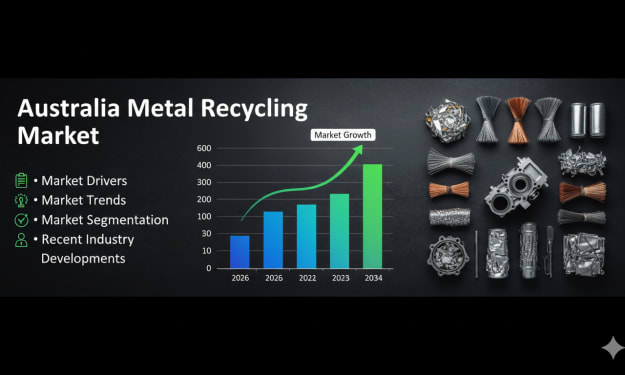
Australia Metal Recycling Market: Scrap Collection, Processing Capacity & Circular Economy Demand
According to IMARC Group, the Australia metal recycling market was valued at USD 5.27 Billion in 2025 and is projected to reach USD 7.35 Billion by 2034, growing at a compound annual growth rate (CAGR) of 3.78% during 2026–2034. This steady expansion reflects the growing strategic importance of recycling within Australia’s industrial and environmental framework. As resource efficiency, emissions reduction and sustainable manufacturing become central economic priorities, metal recycling is increasingly recognized as a core enabler of circular economy objectives. From ferrous scrap used in steel production to non-ferrous metals such as aluminum and copper, recycled metals are supporting domestic manufacturing resilience and export competitiveness across Australia.
By Shrestha Roy7 days ago in Futurism


Comments
There are no comments for this story
Be the first to respond and start the conversation.