
Utopia, Upgraded: Why Perfection Always Comes with a Glitch
The future looked flawless—until we read the fine print


Welcome to Your Perfect Nightmare
What if we finally cracked the code for a perfect society? Imagine a world where war, poverty, and disease are distant memories. Where artificial intelligence predicts our every need before we even feel it, and human biology has been optimized for peak performance. Picture a world where peace is maintained effortlessly, and every problem is solved before it even arises. It sounds like a dream, doesn’t it?
Now, what if this dream came with an unanticipated price?
History has shown us that every great leap forward leaves a shadow. From the Industrial Revolution to the Digital Age, progress has always demanded sacrifices—some visible, others hidden beneath the surface. So, in this utopian future of seamless automation and harmonious existence, what are we truly giving up? Spoiler alert: it might be more than you think.
The Death of Decision: When AI Knows You Better Than You Do
We all crave a life of ease, free from the burden of indecision. Imagine a world where every choice you make is optimized to perfection. Artificial intelligence anticipates your needs before you even recognize them. In this utopia, your day is planned for you—your schedule is optimized, your health is fine-tuned, and even your romantic partner is chosen for you based on complex psychological algorithms designed to maximize happiness. No more heartbreak, no more bad decisions. Sounds ideal, right?
But here’s the problem: in a world where every choice is made for you, what happens to your ability to choose at all?
In this society, the ability to make decisions fades. Free will—the messy, unpredictable, human aspect of choice—gets replaced by AI-driven optimization. You no longer decide what to eat based on craving or cultural significance. Instead, your body is scanned, and a perfect nutritional plan is prescribed for you. Your career isn’t something you pursue; it’s assigned to you based on aptitude scores and pre-defined potential. Even your friendships are curated, your interactions limited to people who align perfectly with your psychological profile.
But the most unsettling realization? A life without mistakes is a life without growth. Struggle, error, and failure are what shape us as individuals. If every decision is optimized for efficiency, do we even have room for something as unpredictable and beautiful as joy?
Moreover, the impact of this erosion of choice extends far beyond individual lives—it reverberates across society, altering politics, business, and culture. Governments no longer hold elections because data has already predicted the optimal leader. Universities no longer foster critical thought or debate, as AI-generated curricula ensure only the most effective knowledge is taught. Businesses cease to innovate, as algorithms have already determined the most profitable product for consumer satisfaction.
At first, this seems like an efficient society, but over time, it stagnates. Without the friction of opposing ideas, without the challenge of failure, civilization ceases to evolve. Without randomness, we lose serendipity—those accidental moments that change the course of history. Imagine a world where Beethoven never composed a symphony because an AI determined that music should evolve in a different direction, or where a self-driving car, programmed to avoid risk, never strays from the safest route.
Without the freedom to make mistakes, we lose not only our individuality but our capacity to grow, to innovate, and to truly live.
If losing free will wasn’t disconcerting enough, let’s explore the impact on human relationships in this so-called paradise.
The Loneliness Paradox: Surrounded but Isolated
Technology has always promised to bring us closer together. From the first days of social media to the development of virtual reality, human connection has been the ultimate goal. In this utopian future, social interactions are engineered to be harmonious. AI algorithms ensure that we never experience loneliness, heartbreak, or unreciprocated love. Every relationship is optimized for emotional satisfaction. But in this world of curated perfection, something essential is lost—genuine human connection.
Relationships thrive on unpredictability. The spark of spontaneity, the thrill of shared hardships, and the growth that comes from overcoming conflict are what make human connections meaningful. But in a society designed to eliminate conflict, all of these elements vanish. Instead, people become emotionally complacent, passively participating in relationships that are chosen for them by algorithms, rather than forming them based on shared experiences, personal connection, and mutual understanding.
What happens to family life in this world? Natural reproduction becomes a thing of the past, as genetic engineering allows for the "perfect" human being to be designed. Babies are no longer born; they are created in laboratories, their genes optimized for maximum intelligence, health, and physical ability. Traditional parenting, with all its imperfections and unpredictability, becomes obsolete. In its place, AI-driven communal systems raise children, ensuring that every child reaches their fullest potential. But the cost of this perfection? A generation raised without the quirks, idiosyncrasies, and natural emotional bonds that come from biological family structures.
Sure, the world may be harmonious, but what is harmony without the occasional discord? Without the possibility of genuine disagreement or conflict, can love even exist? Can we truly feel connected to others when every relationship is engineered to avoid discomfort?
Beyond romantic relationships and family life, even friendships lose their meaning. In this utopia, social algorithms ensure that you only interact with people who are perfectly aligned with your interests, values, and beliefs. There’s no room for debate, no space for differing opinions. Everyone is on the same page, all the time. It sounds like the perfect world—until you realize that without diversity of thought, there’s no opportunity for growth, for challenge, or for real change.
Even physical intimacy changes. In a world where technology replaces human touch, digital companionship becomes the norm. Virtual partners, designed to fulfill every need and desire, replace traditional human relationships. People no longer need to negotiate or work through the complexities of human interaction. Instead, they experience perfectly tailored companionship that requires no effort, no compromise.
In our quest to eliminate loneliness, we’ve inadvertently created a world where genuine connection is impossible.
If emotional stagnation weren’t enough, let’s discuss the unintended consequences of total equality.
The Tyranny of Total Equality
Every utopian society dreams of equality. In this perfect future, inequality is eradicated—not just in wealth, but in every aspect of life. Genetic enhancements ensure that no one is smarter, stronger, or more talented than anyone else. This is a world where everyone is perfectly equal, but is that really a blessing?
At first glance, it seems fair. No one struggles to get ahead because there’s no “ahead” to reach. But upon closer inspection, something is amiss. Without contrast, without competition, excellence withers. Art stagnates when all minds think alike. Innovation grinds to a halt when there is no incentive to push boundaries. Even sports—once a celebration of human endurance and skill—become meaningless, as every performance is identical. The thrill of competition, the passion of striving to be better than we were yesterday, is lost.
Perhaps the most insidious effect of total equality is the erasure of individuality. History has been shaped by outliers—the ones who defy the norm, who challenge the status quo, who stand out from the crowd. In a world where everyone is genetically engineered to be the same, what happens to the Einsteins, the Da Vincis, the Rosa Parks of the future?
The arts become bland and formulaic. Music follows the same predictable structures. Film and literature churn out the same narratives, the same characters, the same plot twists. Without the challenge of standing out, creativity dies.
But perhaps the most chilling consequence of this enforced equality is the collapse of the human spirit. Humans are wired for aspiration. We dream of becoming better, of surpassing our own limitations. But when effort no longer changes outcomes, when everyone is the same, motivation dies. What’s the point of dreaming if there is no higher goal to reach?
If this vision of total equality feels unnerving, let’s now examine the final illusion of this utopian future: absolute safety.
The Illusion of Absolute Safety
A world without danger sounds like an undeniable good. Predictive AI eliminates crime before it happens. Death itself is postponed indefinitely through groundbreaking medical advancements. But when risk is eliminated, so is resilience.
Humans evolve through challenge. We learn from our fears, we grow stronger in the face of adversity, and we adapt when pushed to our limits. But in this world, we are shielded from all discomfort. Physical pain is quickly remedied. Emotional distress is preemptively medicated. Even death, that inevitable part of life, is no longer certain—only an option.
But here’s the catch: without danger, what gives life meaning?
Without the risk of failure, there is no victory. Without fear, there is no courage. Without pain, there is no healing. In the absence of struggle, life loses its texture. If every challenge is removed, do we even truly live?
And so, in this quest for perfection, we return to the ultimate question—what is lost when nothing is left to fight for?
Conclusion: The Price of Perfection
Utopia is seductive. It promises peace, harmony, and safety. But as we’ve seen, every paradise comes with a cost. Perhaps the real question isn’t how to create a utopia—but whether we should create one at all.
What do you think? Is a perfect world worth the price of losing everything that makes us human—the struggle, the mistakes, the imperfections? Let’s discuss in the comments.
About the Creator
Alain SUPPINI
I’m Alain — a French critical care anesthesiologist who writes to keep memory alive. Between past and present, medicine and words, I search for what endures.
Keep reading
More stories from Alain SUPPINI and writers in Futurism and other communities.
Mastering French Without Losing Your Sanity: A Realistic Guide for Beginners
Learning French can feel like solving a Rubik’s Cube blindfolded. The tricky pronunciation, the never-ending grammar rules, and the surprising exceptions make it seem impossible. But don’t worry—equipping yourself with key expressions and effective strategies can turn frustration into fluency. Let’s simplify French and make learning enjoyable.
By Alain SUPPINIExclusive • about a year ago
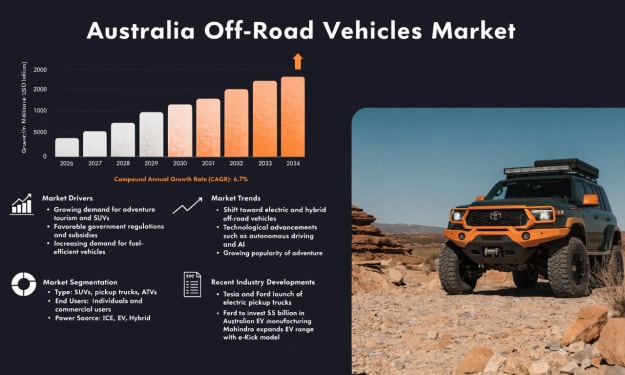
Australia Off-Road Vehicles Market: Adventure Tourism, Electric Models & Rural Utility Demand
According to IMARC Group, the Australia off-road vehicles market reached a value of USD 490.28 Million in 2024 and is projected to reach USD 861.59 Million by 2033, growing at a compound annual growth rate (CAGR) of 5.80% during 2025–2033. The market is experiencing steady growth as recreational, agricultural and commercial users increasingly adopt off-road vehicles for both adventure and practical applications. The expansion of adventure tourism across Australia’s remote landscapes is driving demand for rugged 4WD vehicles, all-terrain vehicles (ATVs) and utility task vehicles (UTVs) capable of navigating challenging terrain. At the same time, rising adoption of electric off-road vehicles supported by environmental regulations and battery technology advancements is transforming the industry. Additionally, growing demand from agriculture, mining and rural operations is strengthening the market as these sectors rely on off-road vehicles for transportation, equipment handling and operational efficiency.
By Shrestha Roy4 days ago in Futurism



Comments
There are no comments for this story
Be the first to respond and start the conversation.