

Young Bradley was always fascinated with the self-service checkout at Winn-Dixie. He’d watch, wide-eyed, as Mom brushed a cereal box over the glass, making the beeping sound. BEEP. He didn’t realize then how a checker or two may have lost their jobs because of the machines. As an adult, he concluded that technology sometimes takes people out of the equation, and he developed a feeling of dread regarding where it all was headed. BEEP. BEEP.
He heard an urgent beeping sound: BEEP-BEEP-BEEP- BEEEP-BEEP-BEEP. Then, a robotic voice: “Warning! Warning! Terrain! Terrain!”
“Terrain?” Bradley mumbled.
BEEP-BEEP-BEEP-BEEP-BEEP-BEEP
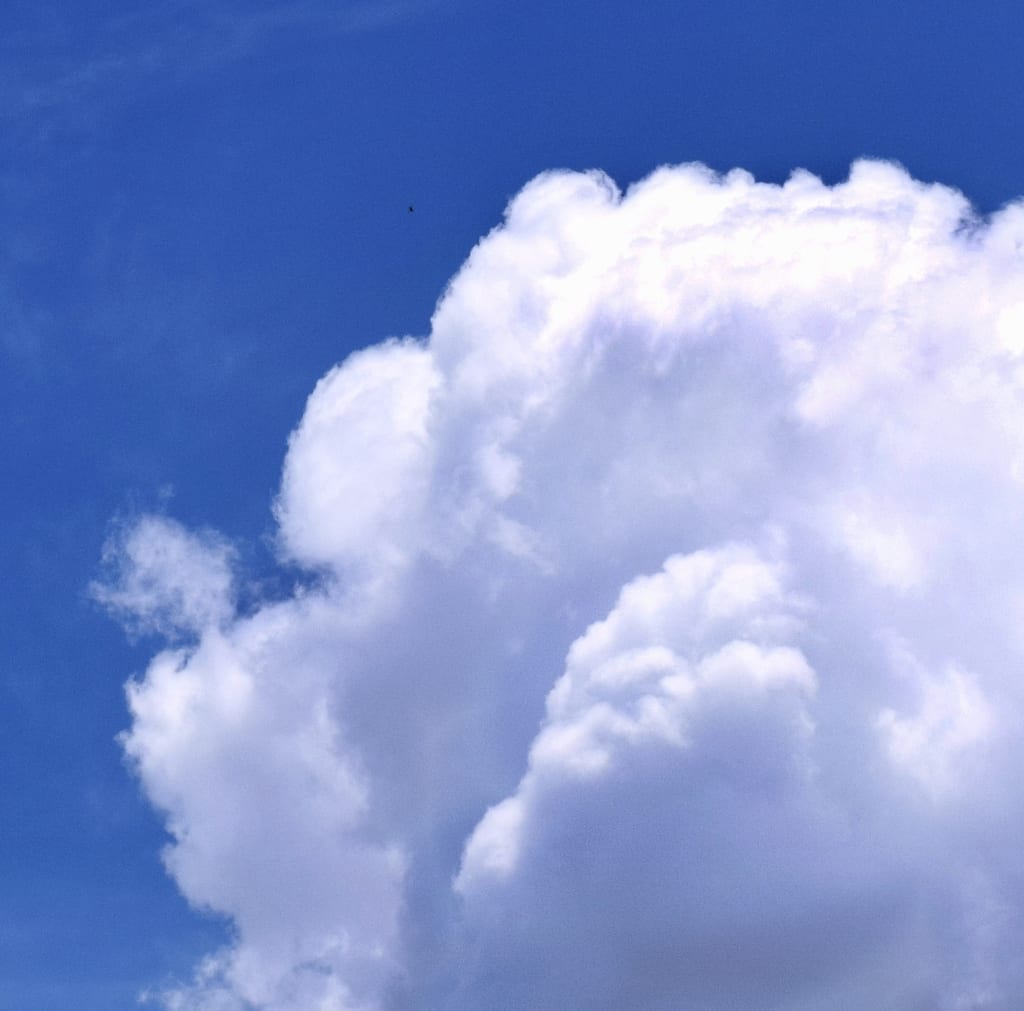
Bradley awoke from his dream and looked outside the cockpit. No turbulence, solid cloud cover underneath, except for a mountain peak piercing the clouds, far from any danger level. The noise continued and he breathed in deeply before glancing at the altitude readout confirming that low altitude wasn’t an issue.
Damn this autopilot, Bradley thought to himself, cursing the way-too conservative programming limits. He switched off the warning before checking the other gauges. Bradley had only drifted off a time or two before during a mission, not long enough for a real dream like this. He never slept on any mission before, even when they allowed it as autopilot systems improved. Today was the first time. The newer 2035 fighter jets were the first to incorporate phase three autopilot systems. Complete fighter drone status was set for February of 2045, but for now, human pilots were required for takeoffs and landings. The sleep allowance made the boredom of watching an aircraft pilot itself more bearable. But Bradley “Pops” Baker was on his final mission. At forty-six years of age, he was ready to leave the Air Force. Missions were too routine, especially with the big push for pilotless aircraft.
Bradley tugged the fastener of a sleeve pocket and reached inside. He pulled out a two-inch gold heart-shaped locket and popped it open. A photo of himself smiled back at him, alongside Kathy, his wife. “Upon your retirement” was written below the photo. “I love you, sweetie,” he said as he snapped the locket closed and returned it to the pocket.
He glanced at the pre-programmed controls. “Babysitters—that’s all we are,” Bradley mused, recalling the time he spent grousing with fellow pilots at the Sound Barrier Bar outside the base gates south of Tacoma. “We’re freakin’ babysitters.”
His retirement plans were to find a job near his home in Seattle. His two young grandkids needed some grandpa time, and Kathy had always wanted to see Paris.
“You having fun, Pops?” Bradley heard on his headset. It was Collins, also known as “Grease.”
“You bet, Grease,” Bradley replied. “A cold war mission is always boring, but I like killing Rooskies, even a dummy desert target. It’s my last mission, so all the better.”
“I sure hope the machines know what they’re doing,” Grease replied. “Hey—you nervous about carrying a hot pocket?”
“They try to make it as real as possible,” Bradley answered, though he knew that carrying a hot payload would never be necessary for training.
“They told us they were audibles—the ones that make heads explode but don’t do nothing to buildings,” Grease added. Bradley knew about the new “audible” bombs, the same concept as the neutron technology from seventy years ago—a bomb that would destroy humans but leave a city’s infrastructure intact. Cleaner than the neutron, an invading force using this weapon technology would have access to a city without any need to rebuild.
An audible bomb was a pod containing numerous small bombs that would spread out over a wide range before detonating. The individual bomblets could cruise up to thirty miles to designated targets. The bombs emitted a high-pitched squeal that would implode the skull of any human or animal in the area. Bradley remembered the post-test tour at a fake city in Nevada they had filled with thousands of animals. The carcasses of lifeless, glassy-eyed sheep, cattle, dogs, and monkeys littered the area.
“You’re so well-informed, Grease. Tell me something I don’t know.”
“OK, my coordinates have changed.”
“Say again?” Bradley requested.
“It shows Detroit. What’s your target, boss?”
“I’m headed to outside of Vegas.”
“Copy that, high roller. Guess I won’t be joining you.
“Roger that,” Bradley answered before scanning his screens once more. But he noticed that his coordinates had changed, too. They now lined up with Seattle, Washington.
“What the…” Bradley exclaimed. “That can’t be right! “I’m going to auto-off, Grease,” Bradley said. “—below the clouds to get a look.”
“Good luck, Pops. I tried that; it was a no-go for me.”
Bradley pulled the tab over the autopilot board and pushed the rocker switch. No response. He tapped the help screen and followed the auto override procedure to get back into manual. Still no response. “Oh, no!” Bradley said to himself, and then called Grease and the three other mission pilots. “Manual override is bent. All-call!” he yelled. “What are your targets? Zeke, you first.”
“San Francisco, Sir,” Zeke replied.
“Sand Man?”
“New York City.”
“Bug?”
“Los Angeles. Tell me what’s going on, Pops! I live there!”
“We’re not in the driver’s seat today,” Bradley answered.
Grease called in: “Check mission info.”
Bradley looked at his screen. The message sender identified himself as “Papa Medved.” Bradley had heard of this Russian hacker. Papa Medved, or Papa Bear, was the handle used by hackers from years before, meddlers in US elections. They were proven successful in controlling the US presidency in 2028 and had compromised two large water treatment facilities that year as well.
The scrolling message on Bradley’s screen informed him that Papa Bear was now in control of his aircraft. Bradley shuddered as he watched the message loop repeatedly. He called the pilots again. “Check your hot status,” he told them just before punching in his screen for payload information.
“HOT” was displayed on Bradley’s screen, and each pilot echoed their report of the same. He punched another button and payload information showed “AUDIBLE.”
“Either someone has an outstanding sense of humor or we’re in the middle of a real war,” Bradley said. His demeanor was still calm, but there was a hint of concern in his voice.
Bradley paused and recalled war game scenarios. Russians would poise fighters and transport planes in the Russian Far East, Cuba, Venezuela, and Greenland. They’d be able to disable our radar defenses and missile guidance systems, thanks to the Chinese, who had placed bugs into millions of chips the US had purchased. Russian planes would begin flying, undetected, and the enemy would begin the second phase of the plan, dropping paratroopers over strategic areas and flying aircraft and equipment into defenseless American bases. The unknown factor was how they would deliver the appropriate weapons since they lacked clean bomb technology. Bradley realized now: he and his fellow pilots were delivering the weapons.
The cockpit clock read 0625. His mission ETA listed 0643. “All call,” he barked into the communication system. “I need your ETAs. Zeke, you first.”
“0651,” Zeke answered.
“0645,” Sandman replied.
“0702,” Bug said.
“Grease,” he called out. “Grease, your ETA.” A few seconds passed and then Grease replied:
“0638.”
“Say again, Grease.”
“0638, Sir. I’ll be dropping in just a few.”
“Copy,” Bradley answered. Stay cool—our drops are clustered close to each other.”
The cloud cover had broken and Bradley recognized the rolling hills of the Palouse region of Washington State below. Corporate farmers would be sending the robo-harvesters out for wheat production, collecting wheat, and blowing it into robo-trucks. The irony of our efficient production wasn’t lost on Bradley; most of this Washington State wheat was being shipped to our cyber enemies in Russia and China.
The jet flew itself over Spokane where two of Bradley’s brothers lived and would soon fly over Fairchild Air and Space Command Base outside the city.
He would then fly near Lewis-McChord Air and Space Center, his home base, before dropping the payload on his main target. His flight details showed that he would land at that same facility right after mission completion.
BEEP-BEEP.
The current alert announced a voice message from Papa Bear. It was an American-accented human voice, calm and reassuring in tone:
“Congratulations, Captain Bradley. Your final mission is to oversee the beginning of a new era. You will soon witness how simple it is to take over a city.”
Bradley knew that this was not a drill. He recalled his first flight on a trainer jet and how he had felt sick to his stomach that day. After that, he never felt motion sickness or nausea. Now, minutes before the completion of Grease’s mission, he felt that same sickness coming over him.
“You’ll see how easy it is,” Papa Bear continued. “How easy to take your country, and ultimately the world.”
“Almost there, Sir. It’s taking me in.” Grease’s voice came across filled with fear now.
“Keep reporting as you go, Grease,” Bradley replied calmly.
All communication silenced, except for Grease:
“Approaching target.” A BEEP-BEEP went off in the background. “Release warning on. Bombs away,” Grease reported.
“Give me your status, Grease,” Bradley ordered.
“Pulling up—fast! Like a bat out of hell!” Grease’s voice was panicky and choppy from pulling Gs. Bradley realized this was the mission procedure—pulling away to avoid any residual audible emission that could harm the pilot.
Seconds later, Grease returned; his voice smoother, but filled with fear.
“Leveling off, Sir. What’s next?”
“Stay cool. You’ll circle for a while. Autopilot will eventually take you to the Detroit Space Center on the lake. You’ll be fine.”
Bradley spoke calmly, but his war game training allowed him to imagine what would happen. American base personnel would be decimated from the audible bomb since the base was close to the center of his target. Grease would see this and freak out as he taxied in. Russian flight crews would have already flown in by then and would be on the ground to remove him from his plane and take him to a detention facility for debriefing. What would happen after that, Bradley didn’t have a clue. His nausea increased and a sharp pain gnawed at his abdomen.
Autopilot had already initiated the descent on Bradley’s jet. He pulled out the heart-shaped locket again and popped it open. He kissed the photo, and then, snagging a small tab at the top, pulled it back to reveal two black capsules. He popped them into his mouth and swallowed.
Bradley’s plane banked left and Mount Rainier came into view, with early morning sunlight that bathed it in gold. His plane leveled off and descended further. Bradley’s head was feeling lighter now, his blood pressure had dropped, and his heart rate slowed. The nausea was gone now and he feeling sleepy, just as he caught a glimpse of the Space Needle and the waters of the Puget Sound. Bradley knew from the flight plan that the bomb would release just south of the city center, taking out the people there and at the King County Space Training facility to the south. The remaining bomblets would fly even farther south and kill base personnel where he would eventually land. The bomb pattern would include Tacoma city center and the port, and it would cover the Fircrest area where his grandchildren lived.
He tried not to think about it. Not that he didn’t care, but he had to fight the intense sadness, fear, and rage welling up inside of him. The huge dose that he swallowed would take some pleasure away from Papa Bear when they would come to pull him out of his plane. They would grab the handles on his shoulders and struggle trying to pull his dead weight out of the tight cockpit. For a brief moment, Bradley felt a small measure of satisfaction as his plane descended further. He heard a soft, faraway beep-beep-beep and he drifted off to sleep.
About the Creator
Keep reading
More stories from Robert G Shaffer and writers in Futurism and other communities.
Lives in Perspective
These items didn’t sell. They sit on dusty shelves and tables, marked with low-priced stickers. I feel odd as I pull clothes from the closet and fold them: shirts, pants, dresses. Some clothing is worn out, some items are fresh with store tags still attached, revealing unfulfilled plans. As I take the dolls out of their glass display cases and stuff them into plastic bags, I feel as if I’m invading a space once occupied by love, strife, laughter, and tears. We have permission to be here, though, and while we're here we learn, little by little, about the owner of these things and how they lived their lives.
By Robert G Shaffer5 years ago in Families
Battery Charger Market: Smart Charging Systems, IoT Integration & Industry Growth Ahead
According to IMARC Group's latest research publication, The global battery charger market size reached USD 28.1 Billion in 2025. Looking forward, IMARC Group expects the market to reach USD 40.0 Billion by 2034, exhibiting a growth rate (CAGR) of 3.90% during 2026-2034.
By sujeet. imarcgroup4 days ago in Futurism
GCC Handicrafts Market Analysis: Key Drivers, Market Dynamics & Future Prospects
According to IMARC Group's latest research publication, "GCC Handicrafts Market: Industry Trends, Share, Size, Growth, Opportunity and Forecast 2026-2034", The GCC handicrafts market size reached USD 19.2 Billion in 2025. Looking forward, IMARC Group expects the market to reach USD 50.3 Billion by 2034, exhibiting a growth rate (CAGR) of 11.31% during 2026-2034.
By Abhay Rajput3 days ago in Futurism




Comments
There are no comments for this story
Be the first to respond and start the conversation.