
"Unleashing Imagination: Generative AI and the Future of Creativity🎨"
"Bridging the Gap Between 🤖 Machines &🧠Human Ingenuity"
The Potential of Generative AI
In today's evolving world of artificial intelligence, generative AI stands out as a spark that innovates and raises interesting questions about creativity. To truly appreciate the significance of generative AI, let's begin by a comparison between machine learning and the neural networks in the human brain.
Machine Learning vs Neurons in our brain:
Machine learning, the learning model of AI, involves training algorithms to recognize patterns, make predictions, and perform tasks based on data that is taught. While it's a powerful tool, it differs fundamentally from the way our biological brains function.
Within our brains, there exist approximately 86 billion neurons, interconnected through trillions of synapses. These neurons process information, form interlinked connections, and adapt continuously, allowing us to learn, remember, and create. In contrast, machine learning relies on mathematical models and computations, which, while impressive, are inherently limited by the data they are trained on and the algorithms they employ.
Let's say that we fetch images of apple and orange to an AI machine learning model. After consuming so much of images the AI model would be abled to recognise which is an apple and which is an orange. But what generative AI does is, it creates an image of a newly fruit which would seem fascinating by combining the apple and orange pictures together.
Creativity in the Our Brain:
The remarkable capacity for creativity in the human brain is one of its most fascinating aspects. Creativity goes beyond artistic endeavors; it encompasses problem-solving, innovative thinking, and adaptability.
Several factors contribute to the creative capabilities of our brains:
1. Diverse Knowledge: Our brains has a vast range of knowledge and experiences accumulated over time. This diverse of inputs enables us to make novel connections and think outside the box.
2. Emotions and Intuition: Emotions play a major role in creativity. They can provide the creative insights and drive our motivations. Intuition, often referred to as a "gut feeling" can guide our decision-making in unexpected and innovative ways.
3. Imagination: The human brain has the incredible ability to generate limitless possibilities and scenarios. Imagination allows us to envision things that don't exist and experiment with alternative solutions.
Generative AI: Nurturing Creativity in Machines:
Generative AI aims to bridge the gap between the structured algorithms of AI , it's creative and the adaptive nature of the human mind. It powers up machines to create, imagine, and innovate in ways which were considered exclusive to humans. Here's how generative AI replicates into the creativity of the human brain:
1. Generative Models: Generative AI has models like GANs (Generative Adversarial Networks) and LSTM (Long Short-Term Memory) networks. These models can generate realistic images, texts, music, and blah,blah,blah.... by learning from vast datasets.
2. Transfer Learning: Generative AI can transfer knowledge from one domain to another, creating something new. A domain here is called a node. A node can learn by itself by utilizing the machine learning algorithm and make the optimal transmission decision on its own. For instance, a generative model trained on art can generate unique pieces of art or even design fashion.
3. Creative Assistance: Generative AI tools assist human creators by suggesting ideas, generating content, or automating repetitive tasks. This allows humans to focus on higher-order creative thinking.
4. Innovation in Problem-Solving: Generative AI can explore countless possibilities rapidly, making it valuable in fields like drug discovery, where identifying novel compounds is a creative challenge.
Challenges and Ethical Considerations:
While generative AI holds huge promise, it also presents challenges and ethical considerations. These include concerns about bias in generated content, intellectual property rights, and the potential for misuse.
Conclusion:
Generative AI represents a significant step forward in artificial intelligence, allowing machines to mimic and enhance the creative processes of the human brain. While it may not replicate the depth and complexity of human creativity entirely, it opens doors to new possibilities in art, science, and innovation. As we continue to develop and refine generative AI, it is essential to do so thoughtfully, considering both the opportunities and responsibilities it entails. Ultimately, the synergy between human creativity and generative AI could serve as a catalyst for groundbreaking discoveries and artistic expressions yet to come.
About the Creator
tech hub
Your guide in exploring wonders of artificial intelligence, futuristic innovations and the latest tech trends. Join me in unraveling tomorrow's mysteries of AI.
Instagram : @techiehub01
Medium_digest : @Techiehub
Quora : Tech Hub
Will AI Really Replace Knowledge Workers?
Why “Will AI Really Replace Knowledge Workers?” Isn’t the Question We Think It Is AI might not take your job — but someone using AI probably will. The latest evidence is messier, scarier, and more hopeful than the headlines want it to be.
By abualyaanarta day ago in Futurism
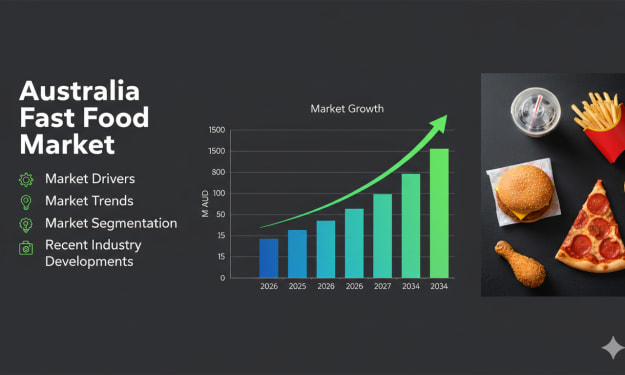
Australia Fast Food Market: Digital Ordering Ecosystems, Health-Focused Menu Innovation & Quick Service Expansion
According to IMARC Group, the Australia fast food market reached a value of USD 18.8 Billion in 2025 and is projected to reach USD 26.5 Billion by 2034, growing at a compound annual growth rate (CAGR) of 3.80% during 2026–2034. The market continues to expand as consumers increasingly prioritize convenience, quick service and accessible dining options that fit busy lifestyles. Fast food restaurants offer affordable and time-efficient meal solutions for urban populations, students and working professionals. Rising disposable incomes and changing food preferences are also encouraging consumers to explore a wider variety of cuisines offered by fast food brands. At the same time, digital transformation within the foodservice industry is enabling restaurants to adopt mobile ordering systems, delivery applications and automated kitchen operations. As competition intensifies among international fast food chains and domestic brands, companies are introducing menu innovations, healthier food options and enhanced digital ordering experiences to attract customers.
By Shrestha Royabout 11 hours ago in Futurism
Becca
"Everything is so... flat." Denille said stupidly as she looked around her new neighborhood. She looked around at the muted desert where even the smallest sign of life seemed to have given up. The plant life was shrubs that were half cooked by the heat and where there should have been a lawn, a mess of white rocks laid glistening in the sun. Even the sky looked stretched thin, like the sun had ironed it smooth. She’d moved from Riverside, where at least there were hills, but here in Barstow, everything felt baked and brittle.
By Sara Wilson8 days ago in Fiction



Comments
There are no comments for this story
Be the first to respond and start the conversation.