
United States Bottled Water Market Trends & Summary
Sustainable Hydration and Health-Driven Choices Propel the U.S. Bottled Water Boom


The United States bottled water industry, valued at US$ 45.82 billion in 2024, continues to lead the beverage sector with impressive momentum. According to Renub Research, the market is expected to grow at a CAGR of 6.27% from 2025 to 2033, reaching US$ 79.08 billion by 2033.
Behind this robust growth lies a clear shift in American lifestyles — consumers are turning away from sugary beverages and embracing hydration options that promote wellness, safety, and sustainability. Whether it’s spring, purified, mineral, or sparkling water, bottled water in the U.S. has evolved far beyond a convenience purchase into a reflection of health awareness, innovation, and eco-consciousness.
💧 Bottled Water: The New Beverage of Choice
Bottled water in the U.S. is defined by purity, convenience, and trust. Available in still, sparkling, flavored, and functional varieties, it caters to diverse consumer needs — from athletes and office workers to travelers and outdoor enthusiasts.
Filtration methods such as reverse osmosis, UV treatment, and distillation ensure safety and consistency, giving bottled water an edge over uncertain tap water quality in several regions. In fact, bottled water has become an emergency staple during natural disasters or water contamination events, reinforcing its image as a dependable hydration source.
As sustainability, transparency, and wellness trends merge, bottled water now embodies a balance of health and environmental responsibility, making it a key pillar of the modern American beverage market.
🚀 Key Growth Drivers of the U.S. Bottled Water Industry
1. Rising Health Consciousness
Consumers across the United States are increasingly shifting toward healthier and low-calorie beverage choices, driving the decline of carbonated soft drinks. Concerns around obesity, diabetes, and artificial sweeteners are fostering demand for purified, mineral-rich, and alkaline bottled water.
Brands have responded with innovation — introducing electrolyte-enhanced, pH-balanced, and flavored functional water options. Fitness culture, clean eating, and natural hydration trends further strengthen bottled water’s dominance.
A notable example came in June 2024, when Alabama Mineral Springs LLC opened a $6 million mineral water facility in Chilton County, with Governor Kay Ivey attending the inauguration. This facility sources water from a natural spring, emphasizing the growing consumer trust in authentic, local origins.
2. Sustainability and Eco-Friendly Packaging
Environmental awareness is reshaping the U.S. bottled water market. With consumers prioritizing eco-conscious brands, companies are investing in biodegradable materials, aluminum cans, and rPET (recycled polyethylene terephthalate) bottles.
Innovative brands such as Chlorophyll Water launched 100% rPET bottles in October 2023, using Avery Dennison’s eco-labeling technology, setting a new benchmark for green packaging.
Sustainability commitments — including carbon neutrality, plastic reduction programs, and circular economy initiatives — are now core marketing strategies. In an increasingly competitive space, “planet-friendly packaging” is as important as purity itself.
3. Convenience and On-the-Go Hydration
In a fast-paced society, single-serve and portable bottles remain a necessity for millions of Americans. Bottled water dominates vending machines, convenience stores, and travel outlets, offering easy hydration for people constantly on the move.
Brands are enhancing their ready-to-drink appeal by launching vitamin-enriched, energy-boosting, and immune-supporting bottled waters. The trend toward contactless vending and automated retailing also boosts accessibility.
In February 2025, Mineragua introduced a 12-pack sparkling water format, positioning it as both an eco-friendly and family-oriented hydration solution — perfect for households and outdoor gatherings alike.
⚠️ Challenges in the U.S. Bottled Water Market
Environmental and Plastic Waste Concerns
Despite its success, the industry faces scrutiny for its contribution to plastic pollution. Single-use bottles remain a significant source of landfill waste, prompting plastic bans in multiple states and stricter recycling mandates.
While the shift toward recycled and biodegradable materials is commendable, it also increases production costs, potentially affecting profit margins. The industry’s long-term sustainability will depend on balancing environmental goals with affordability and convenience.
Competition from Reusable and Filtered Alternatives
The growing adoption of home water filtration systems, reusable bottles, and refill stations presents a competitive challenge. Universities, corporations, and municipalities are installing refill points to reduce disposable bottle usage.
As consumers become more eco-aware, bottled water brands must continue innovating — promoting the purity, taste, and convenience advantages that still differentiate them from at-home solutions.
🏞️ Market Segments: Where Growth is Flowing
🪶 Spring Bottled Water
Sourced directly from natural underground springs, spring water is prized for its minerality and freshness. U.S. consumers prefer it for its natural purity and clean taste. Brands emphasize protected sources, eco-friendly processing, and premium branding to attract health-conscious buyers.
💠 Purified Bottled Water
Undergoing processes like reverse osmosis and distillation, purified water remains the largest and most affordable segment. Consumers associate it with safety, neutrality, and reliability — ideal for daily hydration. Companies invest heavily in quality control systems and smart packaging to retain leadership in this category.
⚙️ Mineral Bottled Water
Mineral water, rich in calcium, magnesium, and potassium, appeals to affluent and wellness-focused consumers. Its functional benefits — from electrolyte balance to skin health — position it as a premium choice. Increasing urban demand for natural and fortified beverages continues to drive this market upward.
♻️ PET Bottled Water
Despite plastic criticism, PET bottles dominate the U.S. market due to their lightweight, durability, and affordability. The shift toward 100% recycled PET (rPET) and biodegradable PET innovations has helped mitigate environmental concerns. Major players like Nestlé and Coca-Cola are pioneering rPET-based product lines to maintain consumer confidence.
🥫 Canned Water: The Sustainable Challenger
Aluminum canned water has emerged as a viable, eco-friendly alternative. Cans are infinitely recyclable, lightweight, and appeal to eco-conscious millennials.
In July 2024, Sky Wtr, a solar-powered, off-grid canned water produced from sunlight and air, debuted in the U.S. The innovation by Source, an Arizona-based company, demonstrates how sustainability and technology can converge in bottled water production.
🏪 Retail Channels: From Stores to Smart Vending
Convenience Stores
Convenience stores are critical distribution hubs, especially for on-the-go consumers. Single-serve bottled water dominates this segment, supported by digital vending, contactless payments, and grab-and-go sections. With rising demand from commuters and travelers, this channel remains a growth leader.
Grocery & Supermarkets
Supermarkets and hypermarkets drive multi-pack and bulk sales. Consumers prefer stocking bottled water for home use, family events, and gatherings.
The introduction of private label brands, organic and functional variants, and loyalty programs encourages repeat purchases. Integration with online grocery platforms further broadens accessibility.
🌎 Regional Insights
Western United States
Regions like California, Nevada, and Washington lead the market due to health-oriented consumers, hotter climates, and outdoor lifestyles. Eco-friendly and alkaline water products are popular, while California’s plastic restrictions push brands toward biodegradable and refillable options.
Eastern United States
Home to urban centers like New York and Washington D.C., the East favors premium and on-the-go hydration. Airports, malls, and tourist destinations sustain strong sales. Upscale consumers prefer purified and mineral water in eco-luxury packaging.
Northern United States
States such as Illinois and Michigan see seasonal consumption spikes during summer and sporting events. Bulk and flavored water are growing rapidly, aided by recycling incentives and sustainability programs.
🧭 Key Market Segmentation
By Product: Spring, Purified, Mineral, Sparkling, Others
By Packaging: PET, Cans, Others
By Distribution Channel: On-Trade, Off-Trade, Supermarkets & Hypermarkets, Convenience Stores, Grocery Stores, Others
By Region: East, West, North, South
🏢 Leading Companies
Nestlé
The Coca-Cola Company
PepsiCo
DANONE
Primo Water Corporation
FIJI Water Company LLC
Gerolsteiner Brunnen GmbH & Co. KG
VOSS WATER
Nongfu Spring
These global players focus on product differentiation, premium positioning, and green packaging technologies to sustain their dominance in the U.S. market.
💬 Final Thoughts
The United States bottled water market is more than a thirst-quencher — it’s a mirror of how Americans perceive wellness, convenience, and sustainability. As the industry moves toward eco-packaging, functional hydration, and digital retail integration, its evolution reflects a broader cultural transition toward responsible consumption.
From spring purity to smart vending, the next decade of bottled water growth will be defined by innovation that keeps both people and the planet hydrated.
Source: Renub Research – United States Bottled Water Market Forecast 2025–2033
Market Size: US$ 45.82 Billion (2024) → US$ 79.08 Billion (2033)
CAGR: 6.27%
About the Creator
Diya Dey
Market Analyst
About Binding Prometheus
I want to start actively advocating on behalf of my own work, and the most valuable part of my canon is, without a doubt, Binding Prometheus, the play I have been working on since 2019 and only finished in 2023 as part of my MA. The play itself is an amalgamation of a million different inspirations. On one end, it evokes the Ancient Greek myth-play, deriving its own title from the earliest extant work of Western drama we have, Aeschylus’s Prometheus Bound. On the other end, it borrows significantly from the sci-fi bulwarks from over the years, namely Mary Shelley’s Frankenstein and Karel Capek’s Rossum’s Universal Robots. The play could be an episode of Black Mirror, I fear. I don’t know. I’ve only ever seen one episode of Black Mirror.
By Steven Christopher McKnight11 days ago in Futurism
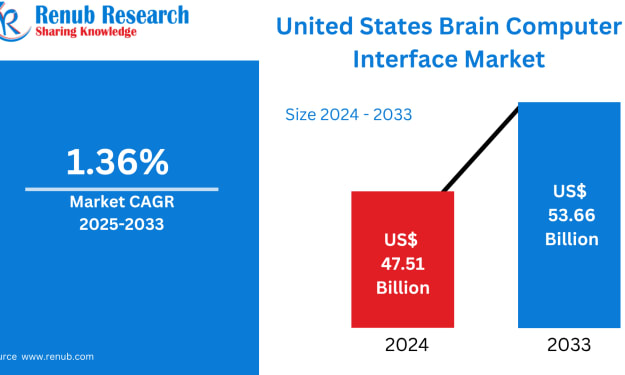
United States Brain Computer Interface Market Size and Forecast 2025–2033
United States Brain Computer Interface Market The United States Brain Computer Interface (BCI) Market is expected to reach US$ 53.66 billion by 2033, up from US$ 47.51 billion in 2024, growing at a CAGR of 1.36% from 2025 to 2033, according to Renub Research. While the growth rate may appear modest compared to other emerging technologies, the strategic importance of BCIs continues to rise as healthcare, defense, rehabilitation, and consumer wellness converge around neurotechnology.
By Janine Root 2 days ago in Futurism



Comments (1)
Nice