
Understanding Retrieval-Augmented Generation (RAG) in Generative AI
LLM


In recent years, the field of Generative AI has seen tremendous growth, with models like OpenAI’s GPT-3, GPT-4, and Google’s LaMDA transforming the way machines understand and generate human language. These large language models (LLMs) have demonstrated remarkable capabilities, from writing essays to answering questions and even creating art. However, despite their impressive abilities, there is one limitation that even the most powerful LLMs struggle with: accessing real-time or domain-specific information.
This is where Retrieval-Augmented Generation (RAG) comes into play. By combining the power of retrieval-based systems with generative models, RAG offers a solution that enhances the model’s ability to generate accurate, contextually relevant, and up-to-date responses.
In this blog, we’ll break down how RAG works, its components, use cases, and why it is becoming a game-changer for generative AI applications.
What is Retrieval-Augmented Generation (RAG)?
At its core, Retrieval-Augmented Generation is an architecture that combines two crucial components:
1. Retrieval: This refers to fetching relevant documents, pieces of information, or knowledge from a database, corpus, or external knowledge base.
2. Generation: After retrieving relevant information, a generative model (like GPT-3 or GPT-4) processes the information to generate a meaningful response or output based on the retrieved content.
The idea is simple: instead of relying solely on the fixed knowledge encoded in the language model’s parameters (which is often limited and outdated), RAG enables the model to fetch external information in real-time, making it far more powerful and capable of producing responses that are both accurate and contextually appropriate.
How Does Retrieval-Augmented Generation Work?
The RAG process generally follows a two-step approach:
1. Retrieving Relevant Information
The first step in the RAG pipeline is the retrieval of relevant information. In this stage, the system searches a large corpus of documents, knowledge bases, or databases to find content that could help answer the input question or assist with the generation task.
• Retrieval System: The retrieval component usually relies on either traditional information retrieval (IR) techniques (such as TF-IDF or BM25) or modern dense retrieval methods. Dense retrieval uses embeddings (vector representations of text) and similarity search to find the most relevant documents. Examples of dense retrieval systems include Faiss (Facebook AI Similarity Search) and ElasticSearch.
• Query Expansion: In some advanced RAG systems, the query is expanded or reformulated to improve the chances of retrieving relevant documents.
2. Generating the Response
Once the relevant documents or data points are retrieved, these are fed into a generative model. The model can then use the external information along with the user’s query to generate a more accurate and context-aware output.
• Contextualized Generation: The generative model does not generate text in isolation; it augments its output based on the additional information provided by the retrieval component. This helps ensure that the generated response is both coherent and relevant to the specific query.
• Fine-Tuning: In some RAG systems, the generative model may be fine-tuned to work specifically with the retrieved information, making it better at understanding how to use the external content to inform the generated response.
Example: Question Answering with RAG
Imagine you want to ask an AI model a question like, “What are the latest advancements in quantum computing?”
• Retrieval: First, the system searches a database of academic papers, news articles, or a curated set of resources on quantum computing.
• Generation: After retrieving the top articles, the generative model processes this information and generates a comprehensive, accurate response that synthesizes the retrieved content into a coherent answer, like:
“Recent advancements in quantum computing include the development of superconducting qubits by IBM, as well as breakthroughs in quantum error correction algorithms presented at MIT…”
This approach allows the system to provide information that is not necessarily encoded in the model’s training data but instead is dynamically retrieved from a live database, ensuring that the response is accurate and up-to-date.
Why is Retrieval-Augmented Generation Important?
1. Enhancing Accuracy and Relevance
Traditional generative models can only rely on the information they were trained on, which means their knowledge is fixed and outdated once the training process is complete. This is a major limitation in tasks that require real-time or highly specialized knowledge. By incorporating a retrieval system, RAG ensures that the model can always access the most current and relevant data, making the generated responses much more accurate.
2. Handling Long-Form Content
Language models like GPT-3 can sometimes struggle with very long documents or specific technical details. RAG systems can break long queries or documents into smaller chunks, retrieve relevant pieces of information, and then combine them to form coherent and well-informed responses.
3. Reducing Model Size
One of the advantages of RAG is that it reduces the burden on the language model. Without the need to memorize vast amounts of data, the generative model can instead focus on processing and generating outputs based on real-time data. This can lead to more efficient AI systems with less resource-intensive models.
4. Specialized Domains
In specialized domains like healthcare, law, or finance, a traditional LLM may struggle to answer domain-specific questions accurately. By retrieving information from specialized sources, RAG can ensure that the generated responses are grounded in domain-specific knowledge, leading to more useful outputs for these high-stakes applications.
Applications of Retrieval-Augmented Generation
The combination of retrieval and generation opens up several exciting use cases across industries. Here are some notable applications:
1. Customer Support
Chatbots and AI-driven customer support systems can benefit immensely from RAG. By integrating a retrieval system, customer service agents powered by generative models can provide responses based on a company’s knowledge base or FAQs, ensuring accuracy and reducing the chances of incorrect or incomplete answers.
2. Search Engines
Traditional search engines provide a list of links to web pages based on a query. However, RAG can enable search engines to generate direct, well-informed answers to user queries by retrieving and synthesizing relevant information from indexed pages, saving users time.
3. Legal and Healthcare Document Analysis
In sectors where information is both dense and critical, such as law or medicine, RAG can assist by retrieving relevant legal precedents or medical literature and using this data to generate answers or summaries for professionals.
4. Personalized Content Generation
For content creation applications (such as personalized recommendations or reports), RAG can dynamically retrieve content based on user preferences and generate a custom-tailored output, which improves user experience by offering highly relevant and context-aware responses.
Challenges of Retrieval-Augmented Generation
While RAG provides significant advantages, it also introduces new challenges.
• Retrieval Quality: The success of RAG heavily depends on the retrieval system’s ability to fetch high-quality, relevant information. If the retrieval system fails, the generative model might produce inaccurate or irrelevant outputs.
• Latency: The need to retrieve documents in real-time could add latency to the response time, making it slower than traditional language models that only generate text without external dependencies.
• Complexity: Implementing a RAG system requires integrating both retrieval and generation components, which can increase the complexity of the pipeline. Efficient coordination between these components is crucial to maintain the overall system’s performance.
Conclusion
Retrieval-Augmented Generation (RAG) represents a powerful paradigm for enhancing the capabilities of generative AI systems. By incorporating real-time retrieval of relevant data, RAG enables language models to produce more accurate, up-to-date, and contextually relevant responses. This makes it ideal for a wide range of applications, from chatbots to document analysis to content generation.
As generative AI continues to evolve, RAG will likely play an increasingly important role in ensuring that AI systems are not only creative but also grounded in real-world knowledge. By combining the strengths of both retrieval and generation, RAG is helping to create more robust, intelligent, and contextually aware AI applications.
With further advancements in retrieval systems and generative models, the potential for RAG is vast, and its impact on industries from healthcare to finance to entertainment will continue to grow.
About the Creator
Raj’s Vocal
Welcome to my channel :)
Keep reading
More stories from Raj’s Vocal and writers in Futurism and other communities.
Harnessing the Power of LangChain
In recent years, the rise of large language models (LLMs) has sparked significant innovations in natural language processing (NLP). Among the most exciting tools developed to leverage these models is LangChain, an open-source framework designed to simplify the integration and orchestration of language models in complex applications. Whether you are building chatbots, document summarizers, or other NLP-driven tools, LangChain offers powerful abstractions that can help accelerate development.
By Raj’s Vocalabout a year ago in Futurism
Australia Energy Storage Market: Renewable Integration, Battery Deployment & Grid Stability
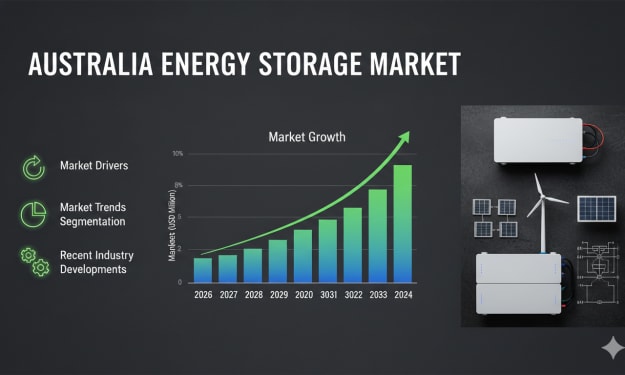
According to IMARC Group, the Australia energy storage market reached 4.72 GW in 2025 and is projected to expand significantly to 19.81 GW by 2034, exhibiting a compound annual growth rate (CAGR) of 17.28% during 2026–2034. The rapid growth of the sector reflects the country’s accelerating transition toward renewable energy and the increasing need for reliable electricity systems across Australia. As solar and wind power generation expands, energy storage technologies such as battery energy storage systems (BESS) are becoming essential for maintaining grid reliability and balancing electricity supply and demand. Government policies supporting clean energy adoption, declining battery costs, and investments in grid modernization are significantly strengthening Australia energy storage market share while enabling the integration of renewable power into the national electricity network.
By Shrestha Roy6 days ago in Futurism
The Last Fortress
The Final Frontier of Privacy For centuries, the human mind has been the only place where true freedom existed. No matter how oppressive a regime was, or how invasive a technology became, your thoughts were yours alone. They were the "Last Fortress"—a sanctuary of private dreams, silent rebellions, and unspoken loves.
By Alex Sterling 2 days ago in Futurism



Comments