
Transparent Solar Panels may soon become a reality
Transparent solar panels, also known as "transparent photovoltaics"

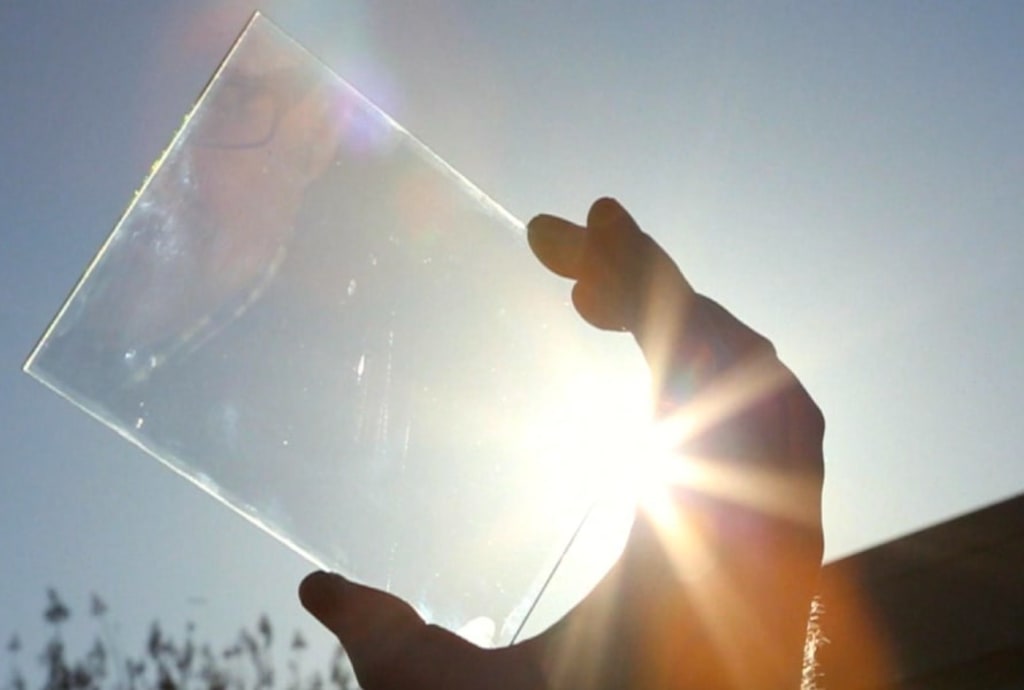
Transparent solar panels, also known as "transparent photovoltaics" or "transparent PV," are a relatively new technology that allows for the generation of solar power while maintaining the transparency of a surface. These panels are made up of small, transparent solar cells that are embedded into a clear or translucent material, such as glass or plastic. This allows for the solar cells to be virtually invisible while still capturing sunlight and converting it into electricity.
One of the main benefits of transparent solar panels is their ability to be integrated into a wide variety of applications. For example, they can be used in architectural design to create building facades that generate power while maintaining transparency. They can also be used in automotive design to create car windows that generate power while still allowing for visibility. Additionally, transparent solar panels can be used in consumer electronics, such as smartphones and laptops, to extend battery life.
Transparent solar panels are typically made using a combination of organic and inorganic materials. The solar cells themselves are typically made from a thin film of organic materials, such as polymer or small-molecule organic semiconductors. These materials are chosen for their transparency, as well as their ability to absorb a wide range of wavelengths of light. The solar cells are then embedded into a clear or translucent substrate, such as glass or plastic, to create the final product.
One of the challenges in creating transparent solar panels is maintaining a high level of transparency while still capturing enough sunlight to generate a significant amount of power. To achieve this, researchers have developed a number of different strategies. One approach is to use small, transparent solar cells that are spaced far apart from one another. This allows for a large amount of light to pass through the panel while still capturing enough to generate power. Another approach is to use multiple layers of transparent solar cells, each tuned to capture different wavelengths of light. This allows for the panel to capture more light overall and generate more power.
The efficiency of transparent solar panels is currently lower than that of traditional, opaque solar panels. The efficiency of current transparent solar panels is around 5% which is significantly lower than the efficiency of traditional silicon solar cells, which can be as high as 20%. However, research is ongoing in this field and it is expected that the efficiency of transparent solar panels will improve over time.
Transparent solar panels have a wide range of potential applications, including architectural design, automotive design, and consumer electronics. They can be used to create building facades that generate power while maintaining transparency, car windows that generate power while still allowing for visibility, and consumer electronics, such as smartphones and laptops, to extend battery life.
In architectural design, transparent solar panels can be integrated into building facades to create a "smart" building that generates its own power. This can be done by using transparent solar panels in place of traditional building materials, such as glass or plastic. The building can then generate power while still maintaining a high level of transparency and natural light.
In automotive design, transparent solar panels can be integrated into car windows to generate power while still allowing for visibility. This can be done by using transparent solar panels in place of traditional car window materials, such as glass or plastic. The car can then generate power while still maintaining a high level of visibility and natural light.
In consumer electronics, transparent solar panels can be integrated into smartphones and laptops to extend battery life. This can be done by using transparent solar panels in place of traditional display materials, such as glass or plastic. The device can then generate power while still maintaining a high level of visibility and natural light.
About the Creator
Gajendira Kumar
I am Not a Legend I am the Lengends Maker by GAJAJI
Content Creator
Future Technology
Keep reading
More stories from Gajendira Kumar and writers in Futurism and other communities.
Now Possiable 45 days to mars
Nuclear thermal propulsion (NTP) and nuclear electric propulsion (NEP) are two advanced propulsion technologies that use nuclear energy to power spacecraft. Both NTP and NEP have the potential to greatly improve the performance of spacecraft and enable new missions that are currently impossible with traditional chemical propulsion systems.
By Gajendira Kumar3 years ago in Futurism
GCC Generic Drug Market Outlook: Growth Drivers, Competitive Landscape & Emerging Trends
According to IMARC Group's latest research publication, "GCC Generic Drug Market: Industry Trends, Share, Size, Growth, Opportunity and Forecast 2025-2033", The GCC generic drug market size reached USD 6.4 Billion in 2024. Looking forward, IMARC Group expects the market to reach USD 15.9 Billion by 2033, exhibiting a growth rate (CAGR) of 10.04% during 2025-2033.
By Abhay Rajput4 days ago in Futurism
General Purpose vs. Medical AI for HealthTeach Companies
Nowadays, Artificial Intelligence is booming, but not every solution is interchangeable, especially in a clinical setting. General-purpose models are trained on broad data and excel at versatile tasks, but healthcare has unique demands. Founders should note that while general-purpose AI can automate many workflows, they lack the built-in safeguards and domain focus that medical applications require.
By Sergey Laptick3 days ago in Futurism




Comments
There are no comments for this story
Be the first to respond and start the conversation.