
Top 10 Reasons Why You Should Consider Xamarin to .NET MAUI Migration
See why Xamarin to .NET MAUI migration is the right move for your business. Ensure long-term app stability, faster updates, and lower maintenance costs.

Introduction
The mobile development space keeps evolving all the time. For many years, Xamarin served as a trusted framework for building cross-platform applications. It gave businesses the ability to share code across Android, iOS, and Windows while maintaining native performance. But, with time, technology evolves, and so does Microsoft’s vision for modern app development.
With Microsoft formally ending support for Xamarin on May 1, 2024, organizations now face a critical decision. Staying on a discontinued framework means more risk, higher maintenance costs, and reduced innovation potential. Many teams had already started adopting .NET MAUI even before Xamarin reached its end of life.
Introduced in May 2022, .NET MAUI quickly became Microsoft’s go-to framework for building cross-platform and cloud-connected applications. It allows developers to share a single codebase across Android, iOS, macOS, and Windows while integrating easily with cloud-native backends, modern DevOps pipelines, and the broader .NET ecosystem.
Having said that, let us explore why you should also migrate your application from Xamarin to .NET MAUI.
Top 10 Reasons for Xamarin to .NET MAUI Migration
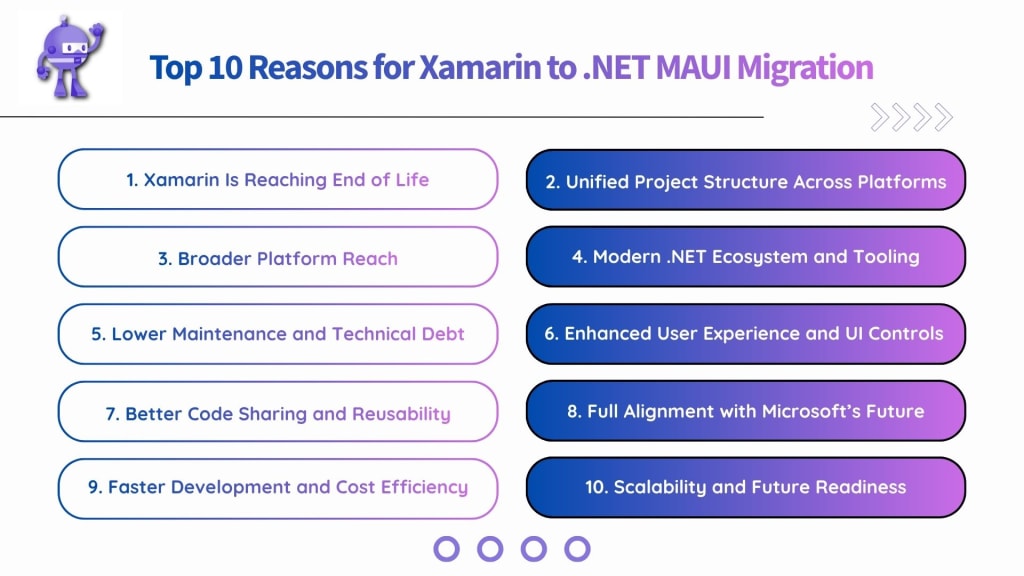
Here are the ten major reasons why every CTO and technical decision maker should consider Xamarin to .NET MAUI Migration for their applications.
1. Xamarin Is Reaching End of Life
Microsoft officially ended support for Xamarin.Forms in 2024. That means no new updates, patches, or compatibility improvements for Android, iOS, or Windows. Continuing with Xamarin increases security risks, limits scalability, and introduces more bugs over time.
Migrating to .NET MAUI ensures your application continues to receive Microsoft’s full support, keeping it safe, reliable, and future-ready.
2. Unified Project Structure Across Platforms
With Xamarin, businesses had to manage separate projects for each platform. Whereas .NET MAUI lets you consolidate everything into a single project. Resources, dependencies, and configurations are managed in one place, reducing complexity and build errors.
This unified structure improves developer productivity and simplifies deployment. Many teams that hire .NET developers with MAUI expertise get to experience shorter development cycles and smoother release management.
3. Broader Platform Reach
.NET MAUI extends beyond mobile platforms, now supporting Windows and MacOS. Businesses that once had to maintain separate desktop versions can now serve all major platforms with one shared codebase.
This broad coverage makes it easier to expand product reach without doubling development efforts, helping companies achieve consistency in performance and design across every device.
4. Modern .NET Ecosystem and Tooling
.NET MAUI is built on the updated versions of .NET, offering better runtime performance, access to advanced libraries, and tighter integration with Visual Studio. Features like Hot Reload and enhanced debugging provide a smoother developer experience.
For organizations, this means faster time to market, simpler updates, and reduced dependency issues. Migrating now ensures alignment with Microsoft’s active ecosystem, not its past.
5. Lower Maintenance and Technical Debt
Xamarin applications are gradually becoming harder to maintain due to outdated dependencies and limited community support. Each year that passes adds more technical debt and higher maintenance costs.
By opting for Xamarin to .NET MAUI Migration, businesses can modernize their architecture, reduce code clutter, and eliminate many compatibility challenges. The result is a cleaner, more maintainable foundation for future development.
6. Enhanced User Experience and Modern UI Controls
.NET MAUI brings a refined UI layer with advanced layouts, animations, and graphics capabilities. Applications built with MAUI feel more responsive, faster, and visually modern compared to older Xamarin-based apps.
For enterprises, this translates into better user engagement, improved retention, and a stronger competitive presence. A consistent, high-quality user interface is no longer optional, it is expected.
7. Better Code Sharing and Reusability
With MAUI, code sharing across platforms has reached new levels of efficiency. Up to 95 percent of business logic and UI code can be reused across Android, iOS, macOS, and Windows.
This approach reduces duplication, speeds up feature rollout, and simplifies testing. For growing engineering teams, this level of reusability also means faster onboarding and fewer integration issues.
8. Full Alignment with Microsoft’s Future
.NET MAUI is Microsoft’s officially supported framework for cross-platform app development moving forward. It will continue to evolve with new versions of .NET, while Xamarin will not.
Aligning with MAUI ensures continued compatibility with Microsoft’s ecosystem, including Azure services, DevOps pipelines, and cloud-native integrations. Staying on Xamarin, in contrast, isolates applications from future advancements.
9. Faster Development and Cost Efficiency
One of the most practical reasons to move from Xamarin to .NET MAUI is the gain in development speed and cost efficiency. MAUI’s single-project structure, unified libraries, and improved tooling remove many of the repetitive tasks that used to slow down Xamarin projects.
From a financial perspective, this means lower maintenance costs, fewer developer hours, and improved ROI. After the Xamarin to .NET MAUI migration, teams can spend their time on innovation and strategy rather than wasting it on legacy issues.
10. Scalability and Future Readiness
.NET MAUI provides a flexible foundation for long-term scalability. It supports integration with cloud services, AI-driven experiences, and upcoming device categories. Whether your organization plans to extend apps to desktop, integrate analytics, or build for new form factors, MAUI offers the adaptability needed to scale.
This ensures that the investments you make in your application development endeavors will continue to yield value in the long run.
Final Thoughts
Xamarin helped thousands of businesses embrace cross-platform development, but its lifecycle is ending. The shift to .NET MAUI is no longer just an upgrade; it is a necessary step businesses need to take for maintaining performance, security, and future readiness.
Organizations that delay migration risk higher costs, security vulnerabilities, and limited platform compatibility in the coming years. The right approach is to assess current applications, identify dependencies, and begin planning the Xamarin to .NET MAUI migration before support and talent availability decline further.
For teams aiming to manage this transition without disrupting ongoing operations, partnering with an experienced .NET migration services provider can be of great help. Their team of experts can modernize your existing Xamarin applications while ensuring they remain scalable, secure, and ready for the future.
About the Creator
Harman Diaz
I'm a seasoned technology consultant with six years of hands-on experience collaborating with major industry players. Let's explore the future of technology together!
Keep reading
More stories from Harman Diaz and writers in Futurism and other communities.
Top DevOps Consulting Service Providers You Need to Know in 2025
DevOps was always there, just not in the spotlight. Lately, it has become essential for organizations that want faster releases, stable production environments, and seamless collaboration between development and operations teams. Choosing the right DevOps consulting service provider can help set up automation, secure pipelines, and optimize cloud infrastructure in ways that align with both technical needs and business goals.
By Harman Diaz7 months ago in 01
Alzheimer’s Drugs Market Outlook: Neurodegenerative Therapy Innovation and Growth Opportunities
According to IMARC Group's latest research publication, The global Alzheimer’s drugs market size reached USD 8.1 Billion in 2024. Looking forward, IMARC Group expects the market to reach USD 12.9 Billion by 2033, exhibiting a growth rate (CAGR) of 5.07% during 2025-2033.
By James Whitman6 days ago in Futurism
The Summer of Independence: Why the Galaxy Watch Ultra 2 is Finally Killing the Smartphone Tether
1. Introduction: The Tether is Breaking Let’s be honest: for the better part of a decade, your "smart" watch has actually been quite dumb the moment you step out of Bluetooth range. We’ve been sold the dream of mobile independence, yet we still find ourselves compulsively patting our pockets for a smartphone before heading out the door. In the Summer of 2026, Samsung is betting that the Galaxy Watch Ultra 2 will finally shatter that digital leash. This isn’t merely an incremental update; it is a hardware-driven declaration that the wearable is graduating from a secondary screen to a primary communicator.
By Tech Horizonsabout 2 hours ago in Futurism


Comments
There are no comments for this story
Be the first to respond and start the conversation.