


To understand Descartes’ Meditations, one must be aware of the time period that he wrote these philosophy analyses. He sought to undermine Aristotelian thought (the majority of knowledge comes from the senses). While he, on the other hand, unfolds his own assertion that knowledge comes from the mind. In the first and second meditations he thoroughly discards all belief that could be doubted and thus comes to the conclusion that thought is the essential action that allows and determines the world around us. In other words, we must know more about our mind than the world around us, rather than analyzing the world. He also proves why one must analyze the mind and how one could do this.
The first Meditation is called “What can be called into Doubt”, and this is essentially what he does. He reflects on the amount of false beliefs he has lived with, all the while never questioning their provability. So for him to find fact, he must begin by discarding all previous assumptions and prejudices so that he can slowly analyze himself and perceptions to find at least one certain foundation to grow from. He determines that if he can find even one doubtable aspect in any present opinion he must discard them as fictional. He also asserts that by simply finding doubt in an opinions foundation he can discard them as a whole, rather than individually proving them wrong.
The first point that sticks out to a reader is his statement that all his opinions that he believed to be most true were based upon his senses and his perception of these senses. The fact is that the senses are very able to deceive, whether the object being observed is too far or too small for one to fully understand. This is the first example he uses that some would say is the foundation of skepticism. Another revolutionary idea is his ‘dream state argument’. He mentions that when one is dreaming the dreamer is convinced that it is real, not a deception. One can sense real objects and feel certain that one is awake. This stipulates the fact that it cannot be undoubtedly proven he is not always in a dream state. It can also make one question if everyone is within a universal dream state and further showing that one’s entire life could be a falsified.
Descartes also states that dreams are formed from reality. He mentions imaginary creatures and that fact is the creature is a combination of real things, enabling one to imagine it in the first place. Even a completely authentic, new design is still, at the base of reality, founded upon real things such as the color used to paint the creature creation. This allows him to determine that he does not have to discard the simple and universal components of the world such as shapes, colors, amounts, and time. This assertion causes him to throw out more complicated things such as medicine, astronomy and physics while allowing him to keep things as simple as arithmetic and geometry. This leads to his omnipotent God theory.
Many can argue that God is completely good, thus would not lead his creations into deception. This could not be true, he argues, as many are deceived daily. Nor would a perfect God create a people with senses that are so easily mislead. After these thoughts, he must determine that it is not a perfect God that is deceiving, but rather an Evil Demon. This evil demon misleads our senses and causes many to be deceived. This also gives him a more urgent need to doubt everything so that he is not further deceived by this possible evil demon. Descartes is not declaring that these radical doubts are probable but simply the fact that they cannot be completely pronounced impossible. Descartes is challenging rationality and bringing to light the fact that one cannot know anything certain about the world that one is observing. He fully maintains his rationality while disproving these opinions and by doing this proves it is not insanity that motivates his doubt.
In Descartes second meditation he evaluates his quest for certainty and what he has discovered so far. If he can discover even one thing of certainty, he is positive he could discover great things. He is trying to justify his last discovery that the mind is known better than the body. He rejects that his memory is certain, and what he sees is real. He has no body, senses or movement. He begins to wonder if the only thing that holds certainty is that nothing can be certain. Do all these revelations deter him from existence in the first place? He decides this is not the case because if he was none existent then he could not be creating the meditation. For the evil demon to deceive him he must be, to be deceived. To doubt things he must be a something. “all things being maturely and carefully considered, that this proposition, I am, I exist, is necessarily true whenever it is put forward by me or conceived in my mind.” But how can he know what he is?
His original opinions have been thrown into doubt. He cannot know with certainty that he has a soul that nourishes him and allows movement, and fuels that which allows him to sense the world and thus doubt it. After this he realizes that he has not cast his ability to doubt into false nor the fact that he thinks into uncertainty. This awareness allows Descartes to determine even without all other previous opinions and attributes he once determined are not needed to justify his own existence. Thought alone proves without a doubt that he is and that he is a thinking thing, and as far has he has proven he is only a thing that thinks. Descartes is not simply saying the only thing he has ever done or could ever do is think, he is purely stating that this is his unchangeable foundation in his quest to assert existence and reality.
Though Descartes has asserted himself as a thinking thing, he still needs to define exactly what that is. “But what is a thinking thing? It is a thing that doubts, understands, conceives, affirms, denies, wills, refuses; that imagines also, and perceives.” Even if Descartes is being deceived by an evil demon or whether he is merely dreaming these attributes, they are still his. He also determines that even though his senses and imagination may not be certain, they are still apart of his mind and the way he thinks. He has concluded that he cannot trust his imagination and he cannot rely on his senses because they conjure false realities and it cannot be any kind of guide for understanding what a thinking thing is. He is puzzled and is faced with the question of why he seems to know the physical self, better than his own mind.
He begins to answer this by trying to understand how one could know any item. This is his wax argument. He begins by listing every aspect of the wax he knows, its color, shape, hardness, size and smell. However, when he puts it near the fire everything that he had originally decided about the wax completely changes. Its color darkens, the texture becomes liquefied, the original smell evaporates and it is no longer pertained to a solid shape. How can he know that it is still the wax he evaluated to begin with? His knowledge of what the wax is could not be from the senses nor imagination because if it were he would understand the melted wax as a completely different substance. He knows that it is always wax through intellect alone. This widens his understanding of what it actually means to see an object. When he says, he sees the wax, he is not actually seeing the wax he is seeing color but our intellect allows an understanding and an explanation of what are sensations perceiving.
Descartes felt the need to elaborate on this by making another relevant example. When one looks out the window down on the city, people are walking around on the street. He sees the people, but is that true? In truth his eyes only see hats, coats, and bags as well as the colors one could associate with a person. Yet our mind finds a way to automatically determine that it is groups of people walking. These observations prove that the mind is known much more than the body. Frankly, anything perceived about the world outside ourselves is open to deception and is doubtable. All perceptions could be illusions and there aren’t many ways to prove otherwise. Though possibly deceptive, it proves our existence. The ability to perceive, doubt, understand and even be misled are key components proving that he assuredly exists. The world is known by intellect alone which aligns with his existence as a thinking thing.
Without intellect, one could never make sense of the jumbled, nonsensical sensory information that flood into our mind. Intellect is the key that explains and makes sense of the perceived world around all of us. With this realization that our mind alone determines what we see and understand, proves that it is not the physical body that we understand the most, but instead our own intellectual minds. Descartes was not only the first to say it but he also says it best.
“I have reverted to the point I desired; for, since it is now manifest to me that bodies themselves are not properly perceived by the senses nor by the faculty of imagination, but by the intellect alone; and since they are not perceived because they are seen and touched, but only because they are understood or rightly comprehended by thought], I readily discover that there is nothing more easily or clearly apprehended than my own mind.”
Whatever one may think of Descartes, no one can assert that his Meditations did not shift a great change in the world of philosophy. Though through reading, one can feel left a little uncertain as to what one can do with these new ideas, no one can deny its revolutionary influence. There are, as in all writing, aspects which could be made more certain but every idea has the capability to be scrutinized. These ideas which inspired such philosophers as Kant and Hume, have truly been an inspiration in my thoughts, before I even knew it was Descartes who began this outlook on the world and one’s self.
About the Creator
Keep reading
More stories from Katelind Sky and writers in Futurism and other communities.
OSU Students, Their Technology and Their Personalities
Technology is used in a wide variety of ways. Whether for entertainment, cultivating information, sharing social information or completing online homework, technology has become a necessity in modern education and in many ways, social communication. The Ohio State University is no exception. I was curious to see not only what kinds of devices that students at OSU use most frequently but also why and how. My initial assumption was that, for the most part, students use technology to communicate, assist in organizing and planning and at times, to substitute for the ‘here and now’. After taking time to observe students around campus and interviewing a student in regards to these questions, I was not surprised to find that all of these assumptions seem to be true, at least generally. When cultivating this information I was able to make only one sold conclusion that would not constrain our understanding of technology use. How a student uses his or her technology, as well as the types of technology used, vary as widely as their individual personalities. This reflects their trait based behavior patterns which is largely affected by the situation, the task at hand and their state of mind. In order to support this conclusion, I will delve into some personality perspectives as well as continuously refer back to them in order to explain the wide range of technological functions. I will also reference my interviews and observations. The striking inconsistencies in technology use as well as the whys and how’s require that these suppositions allow for all aspects of this issue to be accounted for. By asserting that these differences range as widely as personality we are able to encompass all technological variety.
By Katelind Sky6 years ago in Longevity
Crowdfunding Market Trends: Digital Capital Expansion & Growth Forecast to 2034
Rising digital adoption, the democratization of finance, and a growing appetite for alternative investment models are reshaping how startups, creators, and nonprofits raise capital. According to IMARC Group's latest research, the global crowdfunding market size reached USD 20.4 Billion in 2025. Looking forward, IMARC Group expects the market to reach USD 52.3 Billion by 2034, exhibiting a growth rate (CAGR) of 10.47% during 2026-2034. Europe currently dominates the market, holding the largest regional share, driven by its high consumer purchasing power, strong digital infrastructure, and harmonized regulatory environment.
By Suhaira Yusufabout 23 hours ago in Futurism
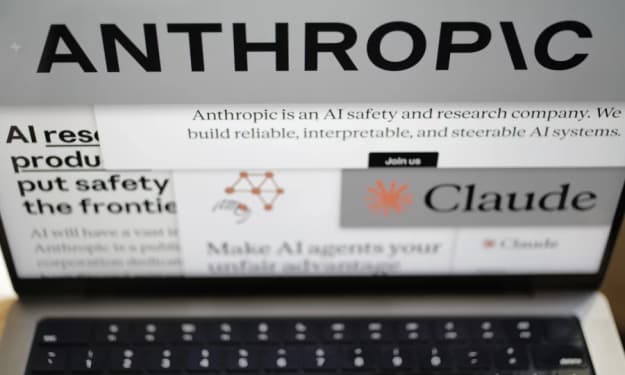
Deadline Looms as Anthropic Rejects Pentagon Demand to Remove AI Safeguards
A showdown is unfolding between Anthropic and the U.S. Department of Defense after CEO Dario Amodei formally rejected a Pentagon ultimatum to loosen safeguards on the company’s AI model, Claude.
By Behind the Tech5 days ago in Futurism



Comments
There are no comments for this story
Be the first to respond and start the conversation.