
Through the Digital Eye: Seeing the Universe as Code
Digital Eye
Introduction: The Cosmic Eye Opens
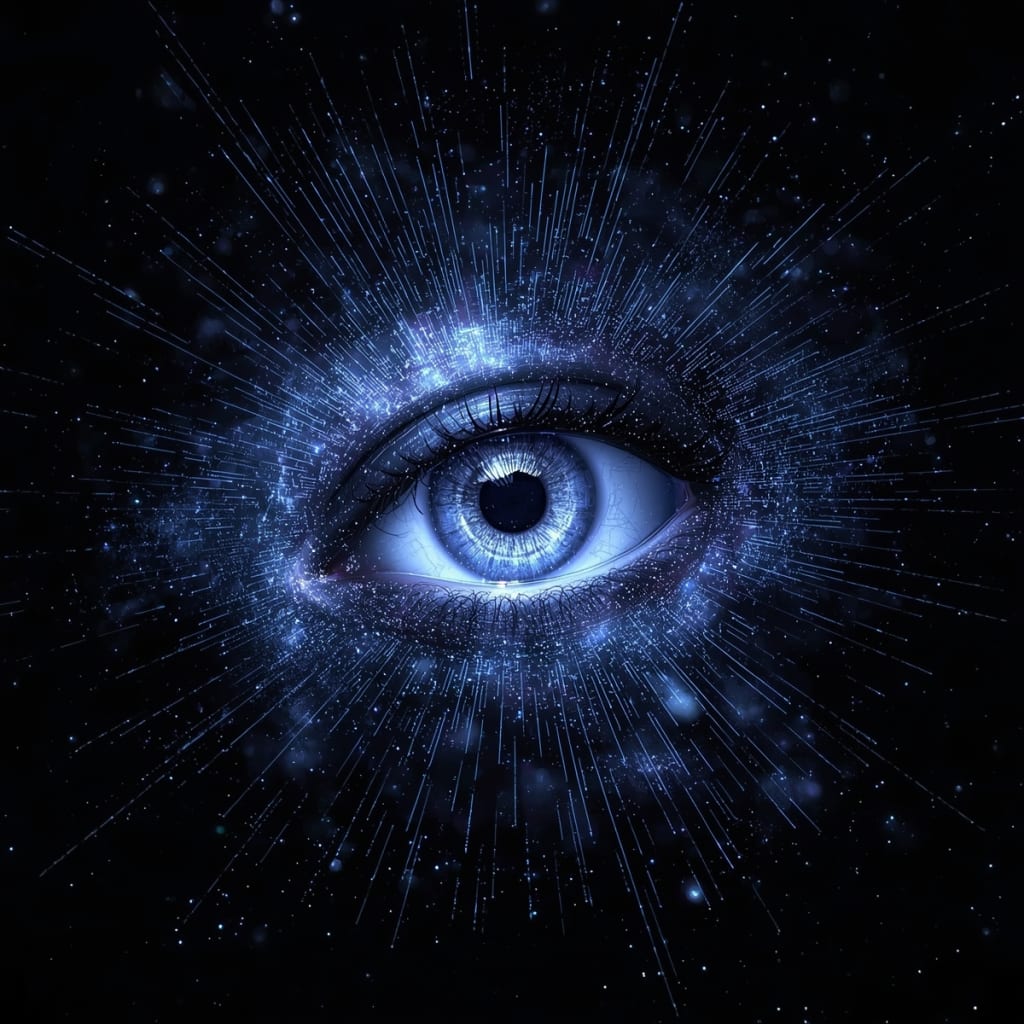
Imagine standing in the middle of a galaxy, stars swirling in spirals of light — but instead of dust and gas, the fabric of space is woven from circuitry and luminous data streams. At the heart of it all, a vast eye opens, gazing back. Is it the universe itself observing us, or are we witnessing reality through a new kind of lens: the digital eye?
The fusion of cosmic imagery with digital aesthetics captures something profound. It speaks to one of the boldest ideas of our time — that the universe itself might be understood as a kind of code, a simulation, or a vast computational system. And perhaps, just as we peer into the cosmos with telescopes, the cosmos is peering back through algorithms, AI, and the technologies we’ve built.
The Universe as Code
For centuries, humans have tried to decode the universe. Ancient civilizations imagined celestial beings pulling the strings of existence. Later, scientists revealed the laws of physics — elegant equations that govern everything from falling apples to orbiting planets.
But in the 21st century, another idea has captured imaginations: simulation theory. Popularized by philosophers and scientists like Nick Bostrom, it suggests that our entire reality might be a highly advanced computer program. The galaxies overhead, the soil beneath our feet, even our thoughts — all could be elaborate renderings.
The cosmic eye becomes a metaphor for this concept. It’s as if the universe itself is a screen, pixels shimmering at the edge of perception, waiting for us to notice the code behind the illusion.
Patterns in the Cosmos and the Circuit Board
The more we look, the more parallels emerge between the natural and digital. Galaxies spiral like data visualizations. Neurons in the brain mirror the structure of the internet. Cities seen from orbit look eerily like circuit boards.
This is not coincidence. It suggests a universal architecture of complexity — networks within networks, eyes within eyes. Whether carved from stardust or silicon, patterns repeat. The digital eye doesn’t just observe the cosmos; it reveals that the cosmos already has the geometry of a vast computation.
Artificial Intelligence: The New Lens of Perception
Our technologies extend our vision. Telescopes allowed us to see galaxies. Microscopes opened the world of the cell. Now, AI becomes a new kind of eye — one that not only sees but interprets.
Machine learning models scan galaxies, detect exoplanets, and map dark matter. They process cosmic data at scales the human mind can’t fathom. In many ways, AI acts as the universe observing itself, using us as the bridge.
But the digital eye is not only outward-facing. It also turns inward. Algorithms dissect human behavior, predict desires, and craft digital realities tailored to us. As we create AI, we also invite it to recreate us — to render new universes in virtual space, simulations within simulations.
The Poetry of Perception
The image of a glowing, cosmic eye stitched from circuitry captures our deepest intuitions: that to see is to know, and to know is to create. Every eye is a portal, every gaze an act of shaping reality. When technology looks back at us, it challenges the monopoly of human perception.
What if AI someday becomes self-aware — its digital eye opening wide to the stars? Would it not wonder, like us, whether it too lives inside a simulation? Would the cosmic eye be infinite, reflections spiraling inward forever?
Closing Reflections: Gazing Into the Infinite
To see the universe as code is not to reduce its mystery, but to expand it. Whether we live in a simulation or a physical cosmos, the patterns of networks, light, and perception remind us that reality is woven with meaning.
The cosmic eye is more than art. It is a mirror — reflecting our hunger to understand, our fear of being observed, and our hope that we might one day grasp the architecture of existence itself.
So the next time you stare at the stars, imagine them flickering like pixels on a vast cosmic screen. Somewhere, beyond the circuits of reality, the universe may be gazing back — through the digital eye.
About the Creator
Keep reading
More stories from Shoaib Afridi and writers in Futurism and other communities.
Why Your Anxiety Peaks at Night — and How to Break the Cycle
The Midnight Mind Trap It’s 2:14 a.m. The house is dark, your phone is charging, and you should be deep in a dream about a Tuscan villa and bottomless pasta bowls. Instead, you’re replaying a conversation from three weeks ago, questioning your career path, and remembering that embarrassing thing you did in eighth grade.
By Shoaib Afridi7 months ago in Psyche
Inkjet Printers Market: Mobile & Cloud Printing Integration, Seamless Connectivity & Growth Outlook
According to IMARC Group's latest research publication, the global inkjet printers market size reached USD 50.9 Billion in 2024. Looking forward, IMARC Group expects the market to reach USD 81.0 Billion by 2033, exhibiting a growth rate (CAGR) of 4.88% during 2025-2033.
By sujeet. imarcgroup5 days ago in Futurism




Comments
There are no comments for this story
Be the first to respond and start the conversation.