
Three Events, One Narrative: How Energy, War, and Media Collided in 48 Hours
From the Caribbean to the Middle East and Australia, a chain of seemingly unrelated events reveals how geopolitics, energy security, and media narratives intersect — and how one human act disrupted a carefully built storyline.

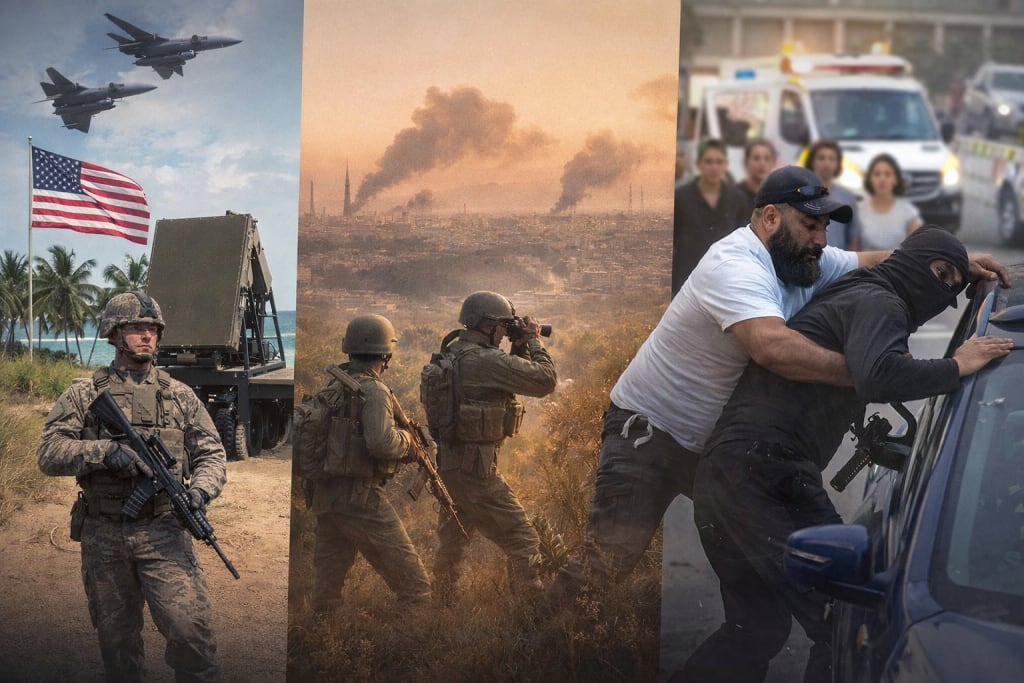
Over the past 48 hours, three major events unfolded across different parts of the world. At first glance, they appear disconnected. But when examined together, they form a coherent picture that sheds light on what may be quietly taking shape in the Middle East and beyond.
Let’s start from the western edge of the map — Venezuela.
According to reports published by Reuters and The Guardian, Trinidad and Tobago has allowed the United States to use its airports for military and logistical purposes. Days earlier, a sophisticated U.S. radar system was installed on the island of Tobago, and U.S. Marines were deployed on the ground. Officially, these moves were framed as part of “anti-crime” operations.
Geography, however, tells a different story.
Trinidad and Tobago lies just kilometers off the coast of Venezuela. A radar installation, military presence, and logistical air access in that location effectively create a forward monitoring and staging platform adjacent to a potential strategic target.
Venezuela is not just another state. It holds the largest proven oil reserves in the world — approximately 303 billion barrels — surpassing Saudi Arabia, Canada, and Iran. Roughly 17% of global proven reserves lie beneath its soil.
From Washington’s perspective, the issue is not the existence of this oil, but control. Nearly 85% of Venezuelan oil exports go to China, while Russia remains a close strategic ally of Caracas. This represents Chinese and Russian influence in what the U.S. has historically viewed as its strategic backyard.
In a scenario where the Middle East enters a new phase of large-scale conflict, global energy markets would immediately come under extreme pressure. Securing a massive, nearby oil source in the Western Hemisphere would then become a strategic necessity, not a luxury. This context helps explain the recent U.S. escalation against President Nicolás Maduro, including the seizure of a Venezuelan oil tanker under the pretext of anti-narcotics enforcement.
This brings us to the Middle East.
In recent days, Israeli media outlets have openly discussed what they describe as a limited “window of opportunity” to decisively confront Hezbollah. Reports suggest preparations for expanded military operations not only in Lebanon, but also within Syrian territory.
At the same time, U.S. diplomatic activity in Tel Aviv intensified. Israeli press leaks spoke of new security understandings that would grant Israel greater operational freedom to strike perceived threats in Syria. Taken together, these signals point toward an escalation in preparation — not speculation.
Any significant military expansion in Lebanon or Syria would immediately dominate global media, diplomatic agendas, and financial markets. Oil prices would likely surge. Once again, the energy dimension connects directly back to Washington’s moves in the Caribbean.
The third event appears, on the surface, to be unrelated — yet it may be the most revealing.
During a Jewish religious gathering on Bondi Beach in Sydney, an armed attack resulted in multiple casualties. Within minutes, Israeli political and media discourse framed the incident as evidence of rising antisemitism and Islamist terrorism, accompanied by accusations that the Australian government had failed to protect Jewish communities.
The speed and coordination of this narrative raised questions. The familiar “us versus them” framing emerged almost instantly — a pattern often seen when public opinion needs to be mobilized ahead of broader political or military actions.
Then the narrative broke.
Amid the chaos, an ordinary civilian intervened. Ahmed Al-Ahmad, a Syrian-born Australian fruit shop owner with no military or security background, used parked vehicles as cover, confronted one of the attackers, and despite being shot, managed to disarm him before police arrived.
The moment was recorded and spread rapidly across global media.
Suddenly, the story no longer fit the intended frame.
The defining image was no longer “Muslims attacking Jews,” but a Muslim risking his life to save Jewish civilians — acting purely on human instinct, without regard to religion, ethnicity, or identity.
This reversal placed several political figures in an uncomfortable position. Early attempts to portray the rescuer as Jewish were quietly abandoned once the facts became undeniable, forcing public acknowledgment that the man who saved lives was, in fact, Muslim.
The strategic significance of this moment goes beyond symbolism. It disrupted a narrative that could have been leveraged to morally justify future escalation — a narrative built on portraying Muslims as inherent threats and violence as inevitable.
When the three events are viewed together, a pattern emerges.
The United States appears to be securing energy leverage in anticipation of regional instability. Israel appears to be preparing for expanded military action that would require political and media justification. And the incident in Australia had the potential to become a powerful emotional trigger within that justification framework.
Instead, a single human act altered the storyline.
Not a government decision.
Not a military intervention.
But one person choosing to act as a human being.
Sometimes, global strategies unravel not because of armies or policies, but because reality refuses to follow the script.
About the Creator
Echoes of the Soul
"A space for storytelling where memories and imagination meet, inspiring reflection and self-discovery."
Keep reading
More stories from Echoes of the Soul and writers in Futurism and other communities.
Saudi Arabia Beauty and Personal Care Market: Premiumization, E-commerce Growth & Expansion Outlook
According to IMARC Group's latest research publication, Saudi Arabia Beauty and Personal Care market size reached USD 4.6 Billion in 2024. The market is projected to reach USD 6.4 Billion by 2033, exhibiting a growth rate of 3.7% during 2025-2033.
By Shubham Sharma 2 days ago in Futurism
Saudi Arabia Cold Pressed Juices Market: Rising Health Awareness, Clean-Label Beverages and Premium Juice Offerings
The Saudi Arabia cold pressed juices market size was valued at USD 12.1 Million in 2025. Looking forward, IMARC Group estimates the market to reach USD 24.7 Million by 2034, exhibiting a CAGR of 8.28% from 2026-2034.
By Kishan Kumar2 days ago in Futurism



Comments
There are no comments for this story
Be the first to respond and start the conversation.