
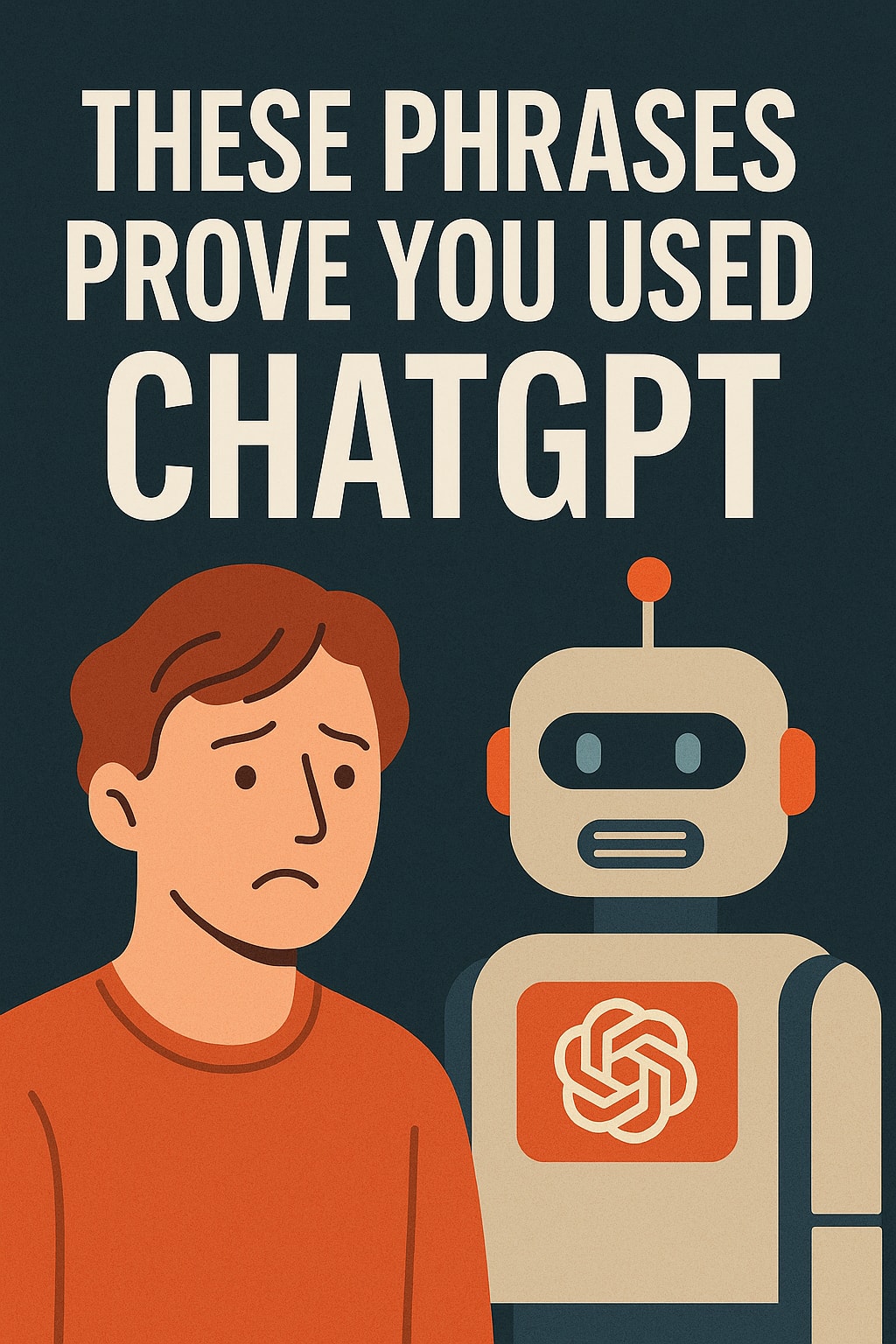
These Phrases Prove You Used Chatgpt
How AI-Written Words Lose Their Soul—And How to Reclaim Your Voice in a World Full of Robotic Content.

📌 Outline
Hook / Introduction:
The moment you realize something sounds... just too perfect.
Why we can tell when something is written by AI.
Introduce the topic and connect emotionally.
Why It Matters:
Human connection vs. machine polish.
How trust is built on tone and authenticity.
Why readers (and clients) notice these cues.
Phrases That Scream “ChatGPT Wrote This”:
List and explain 5–7 commonly used ChatGPT-sounding phrases.
Use relatable examples and metaphors.
Why These Phrases Are a Problem:
The curse of sounding smart but soulless.
Reader disconnection, lack of engagement.
Step-by-Step: How to Humanize AI Content:
Recognize robotic phrasing.
Reword with emotion, personal story, and real-life rhythm.
Add your voice: mistakes, quirks, personality.
Inject storytelling, metaphors, dialogue, and variety.
Real-World Examples:
Before vs. After comparison.
Share personal experiences where authenticity won.
Conclusion:
Call to action: Rewrite with your heart, not just your head.
Final thoughts on the art of “sounding human.”
🎯 Section 1: Hook / Introduction
“As a content writer, I know that eerie moment when a paragraph sounds too clean. Like someone vacuumed all the soul out of it.”
You’ve probably read something online and paused, feeling like a robot whispered it into your brain. The structure? Flawless. The grammar? Impeccable. The tone? Flat. It’s like biting into a cake that looks perfect but tastes like cardboard.
Welcome to the new age of AI-generated writing, where we’re not just readers—we’re detectives sniffing out digital fingerprints. And trust me, some phrases scream louder than others: “Hey! I’m ChatGPT!”
💡 Section 2: Why It Matters
Words are more than ink or pixels—they’re human breath turned into meaning. When we write, we aren’t just transferring information; we’re transferring feeling. AI can organize, summarize, and even imitate. But it struggles to bleed on the page. And people can feel that.
When you publish content that feels mechanical, your readers may not consciously say, “This was written by ChatGPT,” but they’ll sense it. They'll click away. They'll forget you. And in an online world where connection is currency, that’s a cost you can’t afford.
📣 Section 3: Phrases That Scream “ChatGPT Wrote This”
Here’s the red-flag parade—phrases that show up like fingerprints at a digital crime scene:
“In conclusion…”
Sounds like a high school essay. Real people don’t say this unless they’re defending a thesis.
“It is important to note that…”
This phrase is like a robotic crossing guard—it’s functional, but makes you roll your eyes.
“Let’s delve into…”
Who says this at a dinner table? No one. It’s the literary version of wearing a tuxedo to a barbecue.
“Furthermore…”
Oh, furthermore, shall we adjourn to the drawing room? Again, too formal.
“Here’s a comprehensive guide to…”
While helpful, it’s a dead giveaway of GPT content—too polished, too generic.
“The following are some of the key benefits…”
This line needs a heart transplant. It's technically right, emotionally flat.
“Whether you’re a beginner or an expert…”
ChatGPT loves this one. Humans? Not so much.
🎭 Imagine someone giving a toast using these phrases. Awkward, right? Like a robot at your wedding.
💔 Section 4: Why These Phrases Are a Problem
Here’s the thing—these phrases aren’t wrong. But they’re cold. They sound like something written to check a box, not to move a heart.
Think of writing like music. These stock phrases are the background elevator tune—safe, repetitive, forgettable. But what readers want is a melody that surprises them, touches them, maybe even makes them cry.
When you use these stale expressions, you risk sounding like everyone else—and worse, like no one at all.
🛠️ Section 5: Step-by-Step: How to Humanize AI Content
Step 1: Spot the Robot
Start by identifying the AI’s “comfort phrases”—they’re often formal, repetitive, or detached.
Step 2: Add Emotion
Replace robotic lines with language that breathes. Add a sigh, a laugh, a what-the-heck moment.
Step 3: Personalize It
Bring in your own experiences:
“I remember when I tried X…”
“To be honest, this part frustrated me too…”
Let readers see your fingerprints.
Step 4: Use Metaphors and Stories
If a paragraph feels stale, wrap it in a story. Metaphors are magic—they light up the brain. For example:
Don’t say: “This method is effective.”
Say: “This method is like a key slipping into a lock—you’ll feel it click.”
Step 5: Play With Sentence Rhythm
Mix short jabs with longer, winding thoughts. That’s how we talk, how we breathe. Let your writing dance.
🪞 Section 6: Real-World Examples
Before (ChatGPT-flavored):
“Let’s delve into the many benefits of journaling. It is important to note that journaling improves mental clarity and emotional regulation.”
After (Humanized):
“I started journaling during a really rough patch. At first, it felt weird—like talking to paper. But one night, I wrote everything I couldn’t say out loud. And that paper? It listened. It didn’t judge. That’s when I realized—journaling doesn’t just help. It heals.”
See the difference? One sounds like a textbook. The other sounds like you.
I once wrote an article using AI, and my best friend read it and said, “This doesn’t sound like you.” It stung—but she was right. It was like wearing someone else’s skin. Since then, I blend AI’s strength with my voice, my scars, my stories. That’s the real secret.
💬 Section 7: Conclusion
Here’s the truth: AI is a powerful tool. But you are the storyteller. You’re the beating heart behind the keyboard. If you let ChatGPT write your message without your soul in it, you risk becoming a ghost in your own story.
So before you hit publish, ask:
Does this sound like me?
Would I say this out loud to a friend?
Does this make someone feel something?
If the answer’s “no,” don’t delete it—rewrite it. Line by line. With your breath. With your blood.
Because people don’t remember perfect writing—they remember honest writing.
Next time you use ChatGPT, don’t stop there. Infuse your truth. Add your flavor. Be the spark in a sea of static.
Now go—rewrite something. Make it yours. Make it unforgettable.
About the Creator
Aleesha Ilyas
Storyteller & digital creator sharing inspiring content on freelancing, growth, and life skills. Turning thoughts into powerful words. Let’s grow, learn & shine together! ✨💻✍️
Let’s learn, grow, and glow together! 🌟
Keep reading
More stories from Aleesha Ilyas and writers in Futurism and other communities.
How AI is Changing Everyday Life for Students, Workers, and Creators in 2025
AI and Education: Empowering Students to Learn Smarter For students, the classroom is no longer confined to traditional methods of learning. With AI-powered tools, students can access personalized learning experiences tailored to their unique strengths and weaknesses. AI-based tutors can provide real-time feedback, suggest additional resources, and even adjust the difficulty of exercises based on performance. This allows students to learn at their own pace, ensuring a deeper understanding of subjects rather than just rote memorization.
By Aleesha Ilyas9 months ago in Futurism
About Binding Prometheus
I want to start actively advocating on behalf of my own work, and the most valuable part of my canon is, without a doubt, Binding Prometheus, the play I have been working on since 2019 and only finished in 2023 as part of my MA. The play itself is an amalgamation of a million different inspirations. On one end, it evokes the Ancient Greek myth-play, deriving its own title from the earliest extant work of Western drama we have, Aeschylus’s Prometheus Bound. On the other end, it borrows significantly from the sci-fi bulwarks from over the years, namely Mary Shelley’s Frankenstein and Karel Capek’s Rossum’s Universal Robots. The play could be an episode of Black Mirror, I fear. I don’t know. I’ve only ever seen one episode of Black Mirror.
By Steven Christopher McKnight12 days ago in Futurism
Will Earth Remain the Center of Civilization?
For all of recorded history, Earth has been more than just a planet. It has been the unquestioned center of human civilization — the birthplace of culture, science, politics, and technology. Every empire, every revolution, every scientific breakthrough has unfolded on this single world. Yet for the first time, this central role is no longer guaranteed. As humanity takes its first serious steps into space, a profound question emerges: will Earth remain the center of civilization, or is it destined to become just one node in a much larger human network?
By Holianyk Ihor5 days ago in Futurism
Day 4 of Quitting
If this is how sobriety feels, maybe it’s better to go through life a little buzzed… this, along with other hits like, I want to kill myself, I wish I was dead, and I’m going to throw myself off a bridge have been the only thoughts on rotation these past few days. I promise myself that if, in a month, I still feel like this (‘this’ meaning despondent, full of rage, and simultaneously numb) I can go back to smoking. Until mid-February though? Nicotine is off the table.
By sleepy drafts6 days ago in Longevity


Comments
There are no comments for this story
Be the first to respond and start the conversation.