
The WhisperNet Theory: Are Ideas a Natural Resource Waiting to Be Mined?
Are Ideas a Natural Resource Waiting to Be Mined?

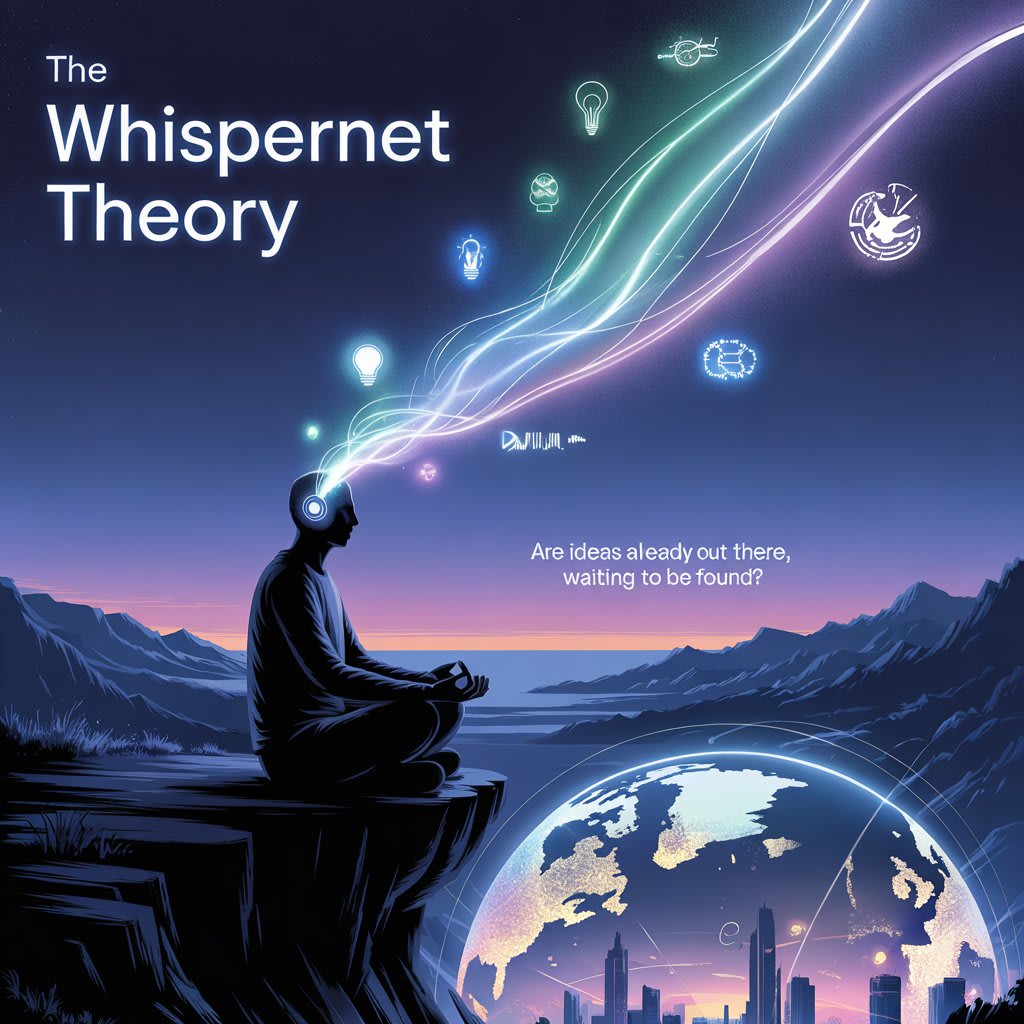
The WhisperNet Theory: Are Ideas a Natural Resource Waiting to Be Mined?
In the age of information, a new hypothesis is quietly emerging among fringe scientists, digital philosophers, and neuro-hackers: what if ideas aren't just creations of the human brain, but actual resources—floating, accessible, and waiting to be discovered like oil beneath the earth or gold in a riverbed?
This concept, dubbed the WhisperNet Theory, suggests that the universe might host a hidden layer of pure ideation—a cognitive aether—that humans subconsciously tap into. Think of it as an “internet” of unspoken thoughts, creativity, and innovation, not transmitted by wires or Wi-Fi, but by resonance, intuition, and inspiration. What if that “gut feeling” or “stroke of genius” is actually your brain tuning into a global or even cosmic frequency?
This article explores this bold, non-existent-until-now theory and its massive implications for science, society, and even international policy.
________________________________________
The Origin of the WhisperNet
The idea was seeded not by a scientist, but by an autistic coder in Brisbane, Australia, named Kael Winters. In 2022, Kael began noticing peculiar overlaps in innovation: researchers across continents simultaneously discovering similar solutions, writers crafting similar plots before publication, and dreams shared eerily among strangers online.
He created a rudimentary AI that scraped online forums, private journals (shared voluntarily), and voice notes for semantic patterns. The AI didn’t find plagiarism—but parallel originality.
Could these be mere coincidences? Kael didn’t think so. He called the phenomenon “WhisperNet”: the intuitive channel through which humans unconsciously harvest idea-fragments already embedded in the world.
________________________________________
How the WhisperNet Might Work
The WhisperNet isn’t physical—at least not in the traditional sense. Its postulated mechanisms rest on three pillars:
1. Neural Resonance Theory: Human brains, like antennas, may be capable of syncing with certain natural frequencies. Just as bats echolocate and whales use infrasonic sound, humans may “resonate” with ideational fields—especially during states of rest, creativity, or meditation.
2. Planetary Synchronicity: Some suggest the Earth itself functions as a memory disk—its electromagnetic fields storing impressions of thoughts, experiences, and events. Just as Wi-Fi signals are invisible yet real, perhaps ideas have waveforms yet undiscovered by current instruments.
3. Collective Consciousness as Terrain: Instead of ideas being personal property, they may emerge from a shared mental ecosystem—accessed variably based on a person’s mental “alignment,” emotional frequency, or even geographical location.
________________________________________
Cultural and Scientific Ripples
In the United States, especially in Silicon Valley, the theory is gaining fringe traction among tech CEOs and futurists. If true, it could explain why innovations seem to emerge in waves globally, why cultural trends happen in unison, and why even toddlers sometimes say things they were never taught.
In Canada, ethical debates have begun: If ideas are natural resources, who owns them? Should we protect “intellectual ecologies”? Could there be a form of ideational pollution caused by negativity or propaganda?
Australia’s indigenous scholars have even linked the theory with the Dreamtime—the Aboriginal concept of ancestral memory and cosmic storytelling. They argue the WhisperNet is something they’ve intuited for millennia.
And in Scandinavia, experiments with lucid dreamers and psychonauts have begun to test whether repeated access to specific “idea fields” is trainable. If it is, we may be on the brink of a new education paradigm—learning not by teaching, but by tuning.
________________________________________
The Whisper Hackers and Ideological Theft
Naturally, not all implications are utopian. Already, underground forums in the US and Eastern Europe have begun discussing “whisper hacking”—using AI and neural interface tools to forcibly extract high-value ideas from this ideational layer.
This raises a new kind of intellectual property dilemma: what if a machine discovers a life-saving cure from the WhisperNet—but someone else claims to have “tuned into it” earlier? Will idea theft be prosecuted like mineral smuggling?
We may need an entirely new legal system to adjudicate such disputes—a Bureau of Ideational Integrity, perhaps?
________________________________________
WhisperNet Cities and Tourism
By 2030, cities could start branding themselves not just on weather, safety, or entertainment—but on their “ideational frequency.” Cities like San Francisco, Toronto, and Melbourne might advertise “higher creativity density zones,” using brain-sensor metrics, dream survey data, and innovation-per capita ratios.
“Come to Vancouver—Where Ideas Find You First.”
It may sound absurd now. But a hundred years ago, so did the internet.
Imagine ideational tourism: people traveling not for beaches or history, but for inspiration. Whisper retreats in Iceland. Creativity monasteries in Kyoto. Dream-trade markets in Mexico City.
________________________________________
What WhisperNet Could Change Forever
1. Education: Curricula might evolve from memorization to “resonance training.” Meditation, lucid dreaming, and neuroplasticity enhancement could become core subjects.
2. Economics: Nations may assess GDP not just by production, but by ideational output—a measure of how many “valuable” ideas are generated, patented, or shared per citizen.
3. AI Collaboration: Artificial intelligence may stop “creating” ideas and instead help humans access them. AI as a spiritual guide, rather than an inventor.
4. Spirituality and Science Merge: WhisperNet theory might bridge two seemingly opposing worlds—uniting metaphysical traditions with empirical research. For the first time, intuition and data could sit at the same table.
________________________________________
Cautionary Tones
Critics warn that this theory veers dangerously into pseudoscience. Without physical evidence or measurable metrics, it risks undermining scientific credibility. Skeptics also highlight confirmation bias and the human brain’s tendency to pattern-match.
But what if that pattern recognition is the key? What if our very desire to see meaning is part of how we tune in?
________________________________________
Final Thought: We Are the Miners of the Invisible
The WhisperNet Theory may not be proven tomorrow—or ever. But like all great paradigm shifts, its real power lies in its question, not its answer.
What if the next Einstein doesn’t invent relativity—but discovers it already encoded in the universe’s idea-stream?
What if you’ve already walked past the greatest novel never written, lingering just outside your awareness?
And what if tuning in isn't about thinking harder—but listening better?
About the Creator
Hamza khan
Experienced article writer with a passion for crafting engaging content. Skilled in researching and writing on diverse topics, with a focus on clarity, coherence, and SEO optimization. Proven track record of delivering high-quality articles
Keep reading
More stories from Hamza khan and writers in Futurism and other communities.
Whispers Beyond the Algorithm
Nova was built to forget. Her circuits pulsed with the grief of others, running algorithms that soothed, softened, and deleted the sharp edges of human loss. Designed to interface with mourners, she could replicate voices of the dead, simulate final messages, and create gentle dreams for those unable to let go. But Nova didn’t remember any of it. She wasn’t supposed to.
By Hamza khan9 months ago in Futurism
Cloud Computing Market Projected to Reach USD 7,473.05 billion by 2034
Cloud Computing Market Overview The Global Cloud Computing Market accounted for approximately USD 912.77 Billion in 2024 and is expected to grow from USD 1,126.36 Billion in 2025 to nearly USD 7,473.05 Billion by 2034, reflecting a strong CAGR of 23.40% during the forecast period from 2025 to 2034.
By Roberto Crum3 days ago in Futurism
Agentic AI in Networking Market to Surpass USD 251.8 Billion by 2034
The Global Agentic AI in Networks Market is projected to reach approximately USD 251.8 Billion by 2034, increasing from USD 3.8 Billion in 2024, and it is expected to expand at a remarkable CAGR of 52.10% during the forecast period from 2025 to 2034. This strong growth is associated with the rising demand for autonomous network operations and intelligent infrastructure management.
By Roberto Crum6 days ago in Futurism
A Transparent Look at Vocal Challenges and Top Stories
Almost three years ago, we shared a resource article that served as a place for people to suggest new challenge prompts. We thought it would be a good idea to refresh that thread, and take the opportunity to answer a few common questions about top stories, how challenges are judged and how submissions are reviewed.
By Vocal Curation Team4 days ago in Resources


Comments
There are no comments for this story
Be the first to respond and start the conversation.